New aboard
- Race a rocket round the hullNo air, no grip, no top speed: every corner costs fuel. Watch the racer trailer, then fly the sprint yourself.
- See who pays for ConcordiaNo trend line builds a two-billion-tonne city by 2045. What changed, who paid and what the station sells.
- Try the hull-breach calculatorHole a rotor wall and set the size. One square metre takes 27 days to lose 1 percent of the air.
- Read why Concordia is safer than the 1970s designsNo windows, a shield that stands still, four sealed cities. What the 1970s cylinders got wrong and what changed.
What is Concordia
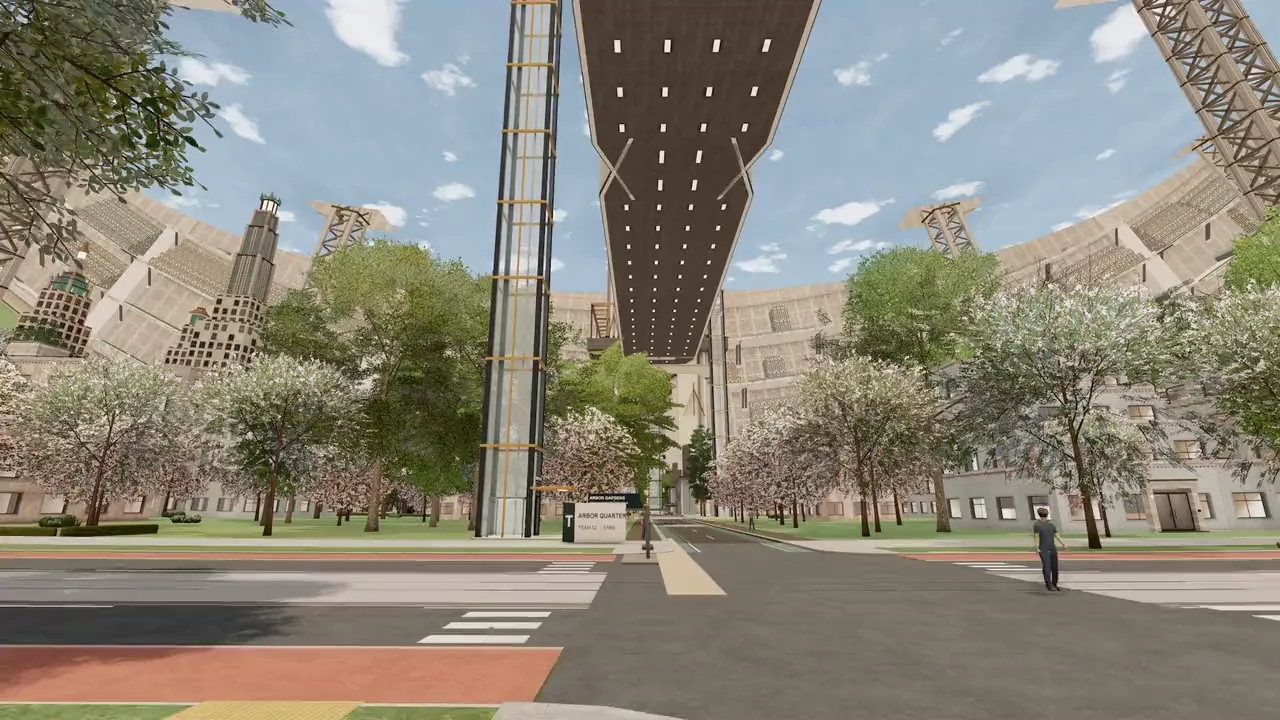
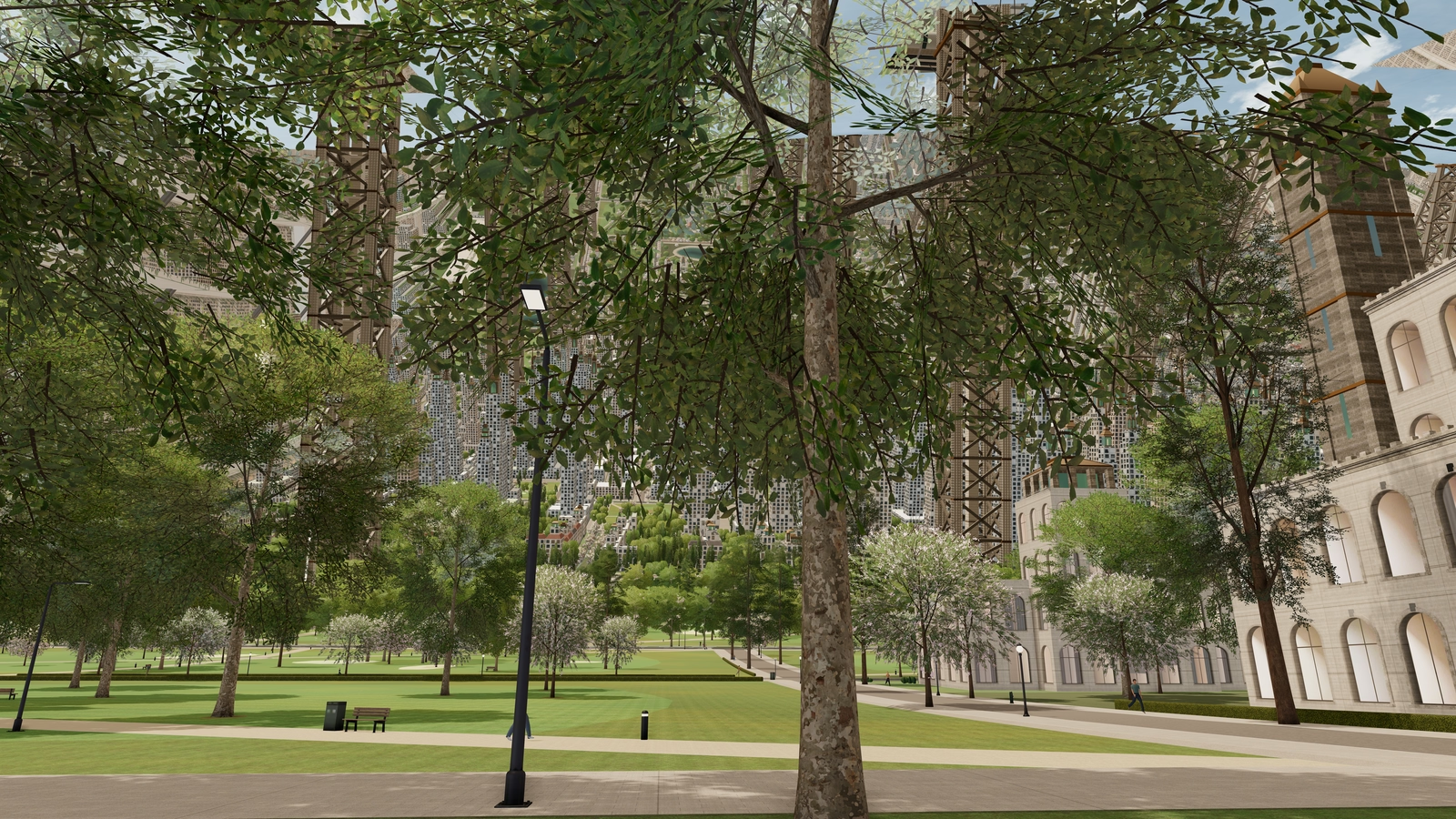
Concordia is a city that spins. Its four habitation rotors each turn once every 100 seconds, which presses the ground under your feet with the same pull as Earth. Streets, parks, lakes and farms run along the inside of each rotor, and the sky is a lit ceiling 450 m up.
About 400,000 people live here today. The station is built for 1.0 to 1.2 million. Factories, a shipyard and a spaceport share the same axis, so what the city makes leaves the station by the same road that brings visitors in.
Concordia sits in the Earth-Moon L5 region, 384,400 km from home. It was not launched from Earth. Its walls are sintered lunar regolith, its air and water come from the Moon and from captured asteroids, and its power is sunlight, collected around the clock.
A space colony built as a city
A space colony is a settlement in orbit that people live in for good, not a station they visit for a tour of duty. Gerard O'Neill proposed the rotating-cylinder version in the 1970s. Concordia carries that idea through: four O'Neill-style cylinder cities with a stationary shield around them, an industrial rotor, Ehricke, beside them and room for a million people. How it differs from the 1970s design is on the station page.
Start here
Every page teaches the real physics and engineering that make a place like this work. Every page also opens the live simulation at the place it describes.
How it works
Gravity from spin, shielding, air, power and the machines that move people around.
Places
Walk the streets, ride the ascenders, tour the shipyard and the spaceport.
A day aboard
Follow one family from breakfast to a shuttle bound for Earth.
Want the overview first? The station at a glance lays out the whole axis, and the numbers are all in one place. Or ask the bigger question: why build in space at all.
Five generations of space habitats
People have lived in orbit since 1971. Concordia is the fifth step in that line, the first built as a city and made from materials found in space.
Generation 1
Government outposts, 1971 on.
Generation 2
Commercial orbital stations.
Generation 3
Lunar surface and propellant.
Generation 4
The first rotating stations.
Generation 5
Concordia, 2041 on.
Questions worth asking
Why does the ground curve up? Does a train change your weight? What happens in a hull breach? Six discoveries take one question each: guess first, then stand in the place and change the number.
Step inside
The simulation runs in your browser. Start in the family's house, ride the ascender through the artificial sky, float through the shipyard, or fly the whole 21 km yourself. In Story mode the guided tour takes about 11 minutes. In Explore mode you go where you like, and in Engineer mode overlays show the gravity, momentum, power and heat behind what you see.
Open in the simulation: Step inside the family's home Open in the simulation: See the whole station