The family is a father, a mother, a teenager, a daughter and a son. They live in a ground-floor apartment seven metres by six, with five chairs around the table. Today a neighbor walks them to the Axis Station, and from there the route is the one every passenger takes: the metro, the ascender, the spine, the spaceport and the launcher.
At a reading pace, the sixteen stops take about 10 minutes. Linger at any of them as long as you like. Every stop has a button that starts the live simulation at that moment, so you can begin anywhere. Open in the simulation: Start at breakfast Open in the simulation: Start at the sky Open in the simulation: Start at the launcher
A world in motion.
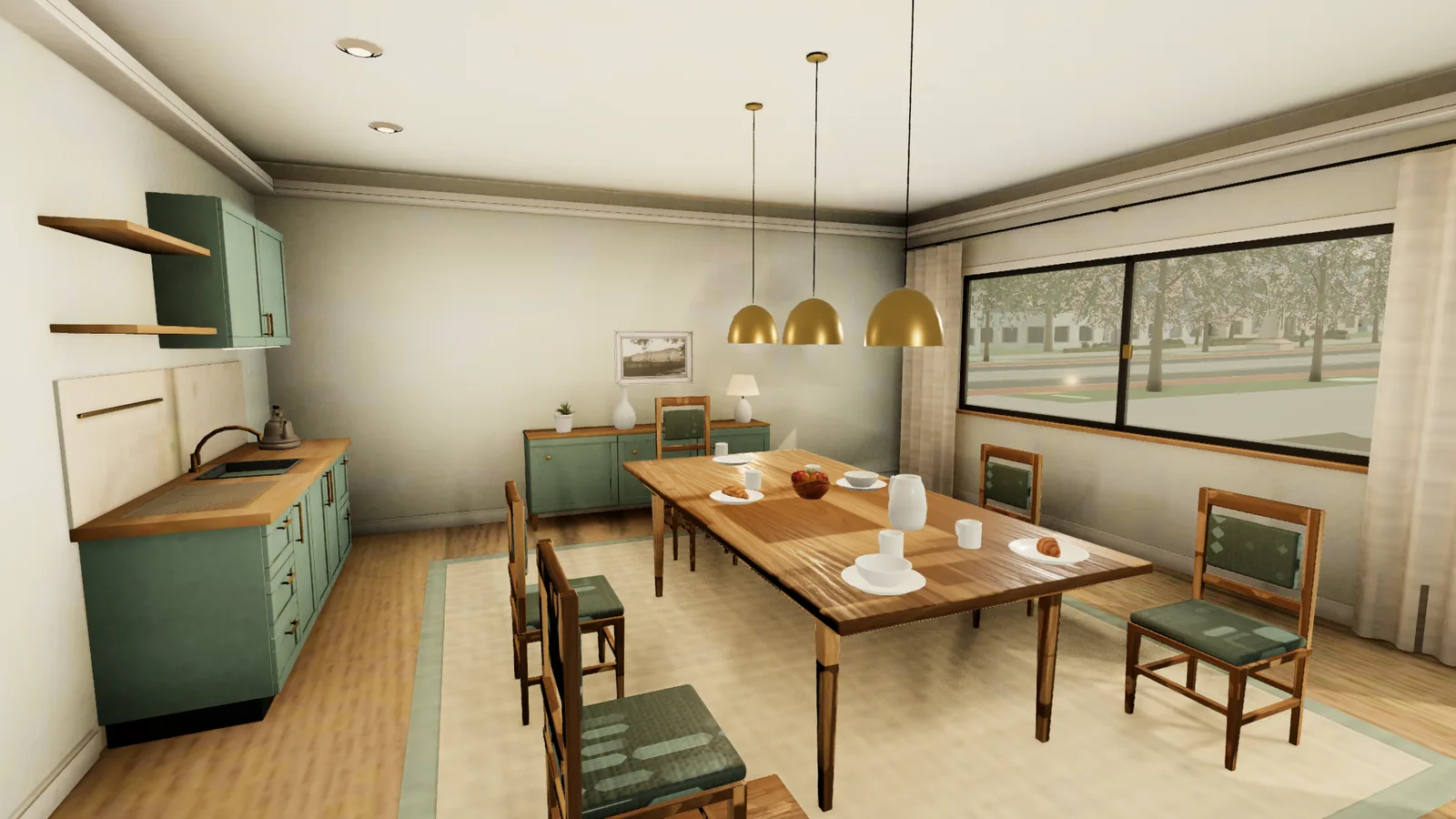
Morning light comes through the window onto an ordinary street. The family sits at breakfast: bowls, a pot of tea, a teenager who would rather sleep. Nothing here feels unusual. The floor is firm, the cups sit flat and a dropped spoon falls straight down. Outside, the street runs away in both directions and the city rises gently as it goes. It is a normal morning in a place that turns once every hundred seconds.
The idea: the floor is the rotor wall, 2,500 m from the axis, and its turning supplies exactly 1 g.
A city without an edge.
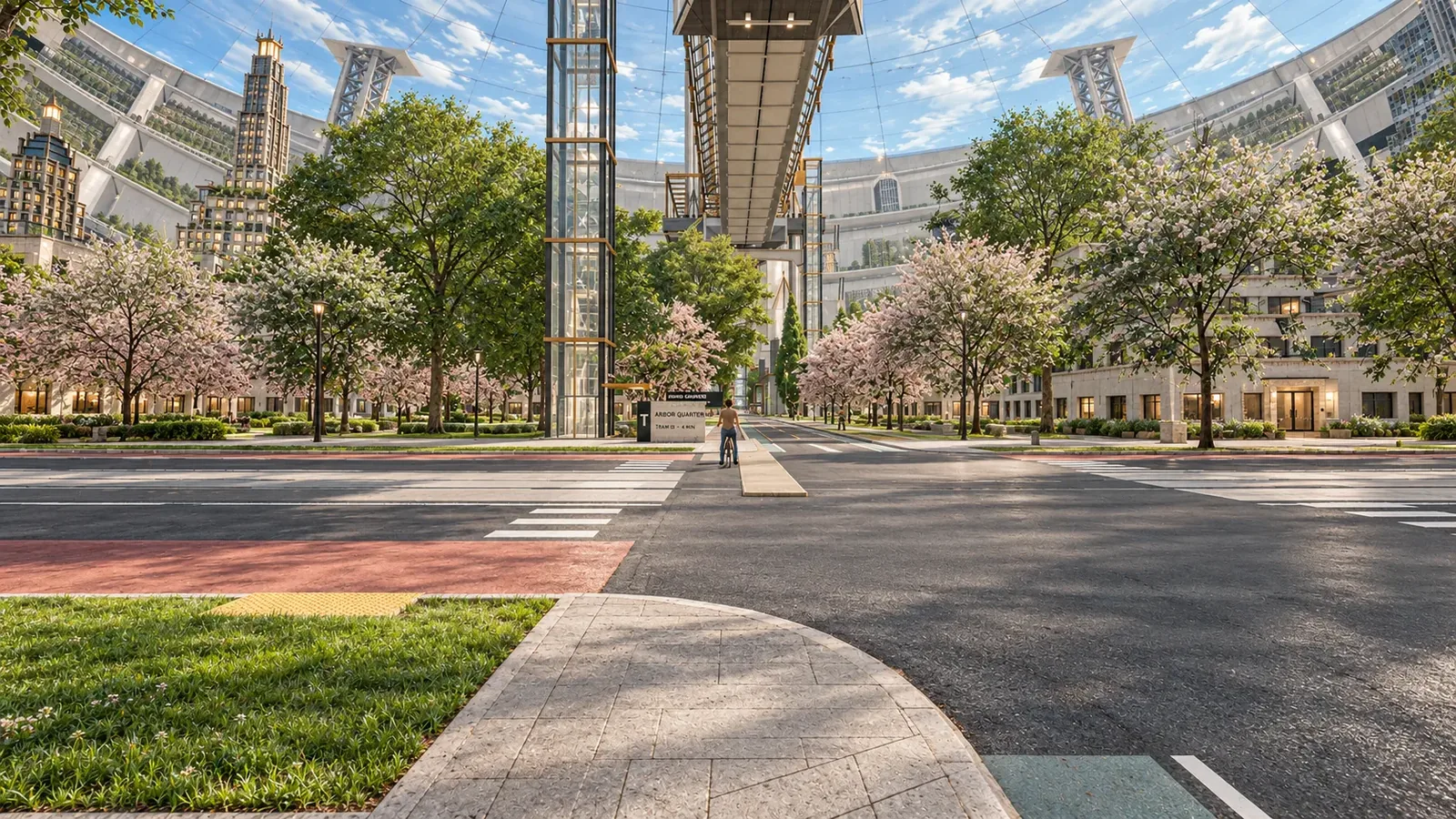
The neighbor leads the family along the street past a tram shelter. Trees line the path and children cross toward a park. Look ahead and the street does not stop at the horizon. It keeps rising: lawns, rooftops and towers climb away along the ring until they meet a bright sky. After a few steps nobody notices. They have seen it all their lives.
The idea: you live on the inside of a cylinder, so the ground curves up in front of you instead of falling away.
A train along the axis.
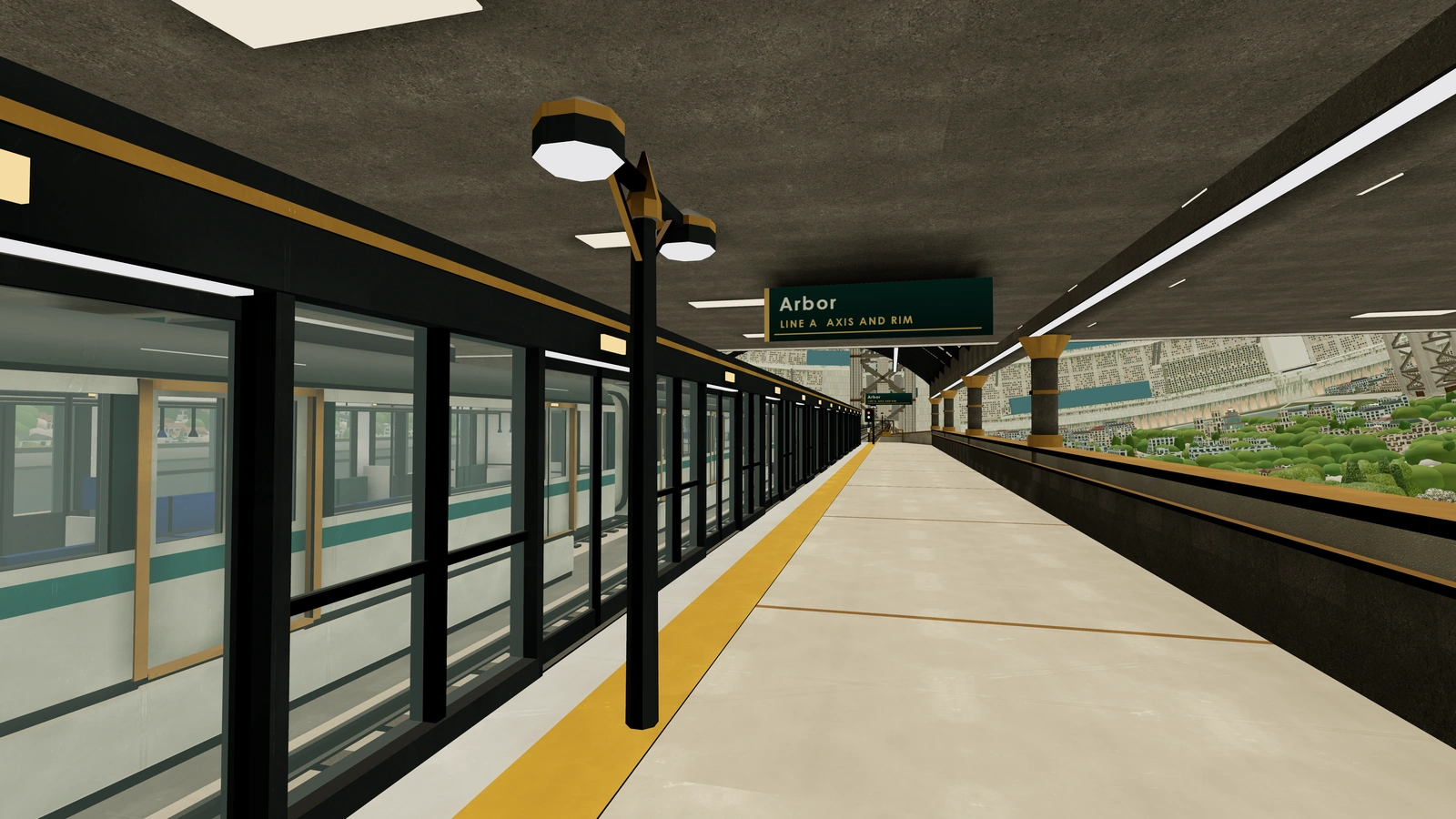
A glass lift carries the family 46 m up to the Arbor platform, where the viaduct runs out toward the axis. The train is quiet and fast. It rides the axial line, which runs along the length of the rotor rather than around it, and the passengers stand without holding on. Along that direction the spin adds no sideways push, so weight stays almost what it was in the kitchen. Twenty seconds later the train slows at Axis West.
The idea: moving along the spin axis adds no Coriolis weight, so the car stays at 0.98 g.
A neighborhood meeting place.
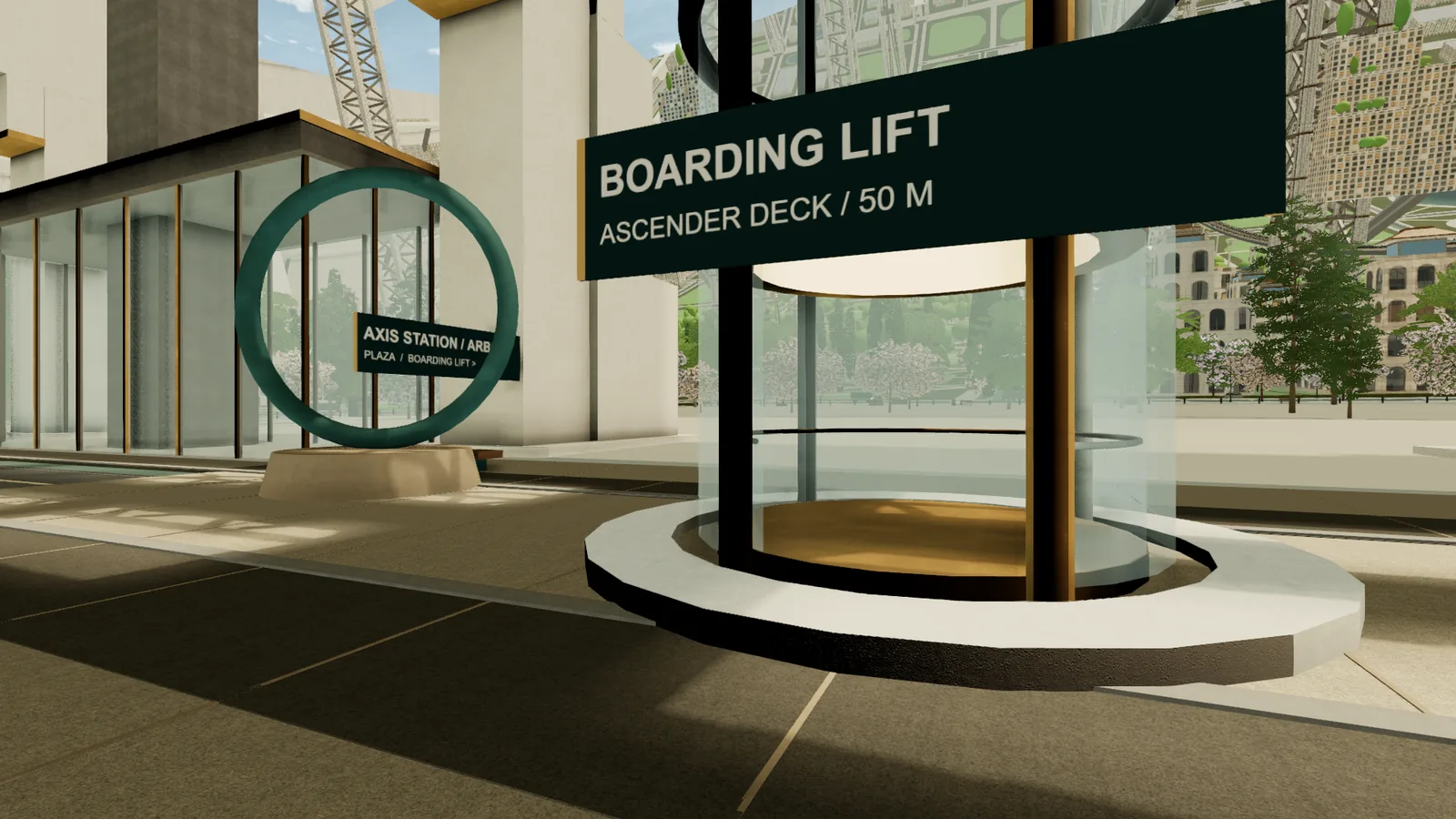
The Axis Station plaza is a wide, quiet square at the foot of the ascender. A ring sculpture stands in the middle of it. Commuters cross with bags and coffee, and a group of schoolchildren waits at the base of a tower that rises out of sight. The family follows the signs to a glass lift that carries them up to the boarding deck. Nobody hurries, because the next cabin is never far away.
The idea: at the foot of the tower you still weigh a full 1 g, and every metre of the climb ahead takes a little of it away.
Where the spokes begin.
On the boarding deck the family stands at the rail. A cabin the size of a small train car waits at the platform, ready for 150 people at a time. Beyond the deck, a bronze lattice tower climbs into the upper air and out of sight. The ride is about ten minutes long in life and sixteen seconds in this story. The family steps aboard and finds a place by the glass.
The idea: the ascender moves people straight toward the axis, along a radial track 2,380 m long.
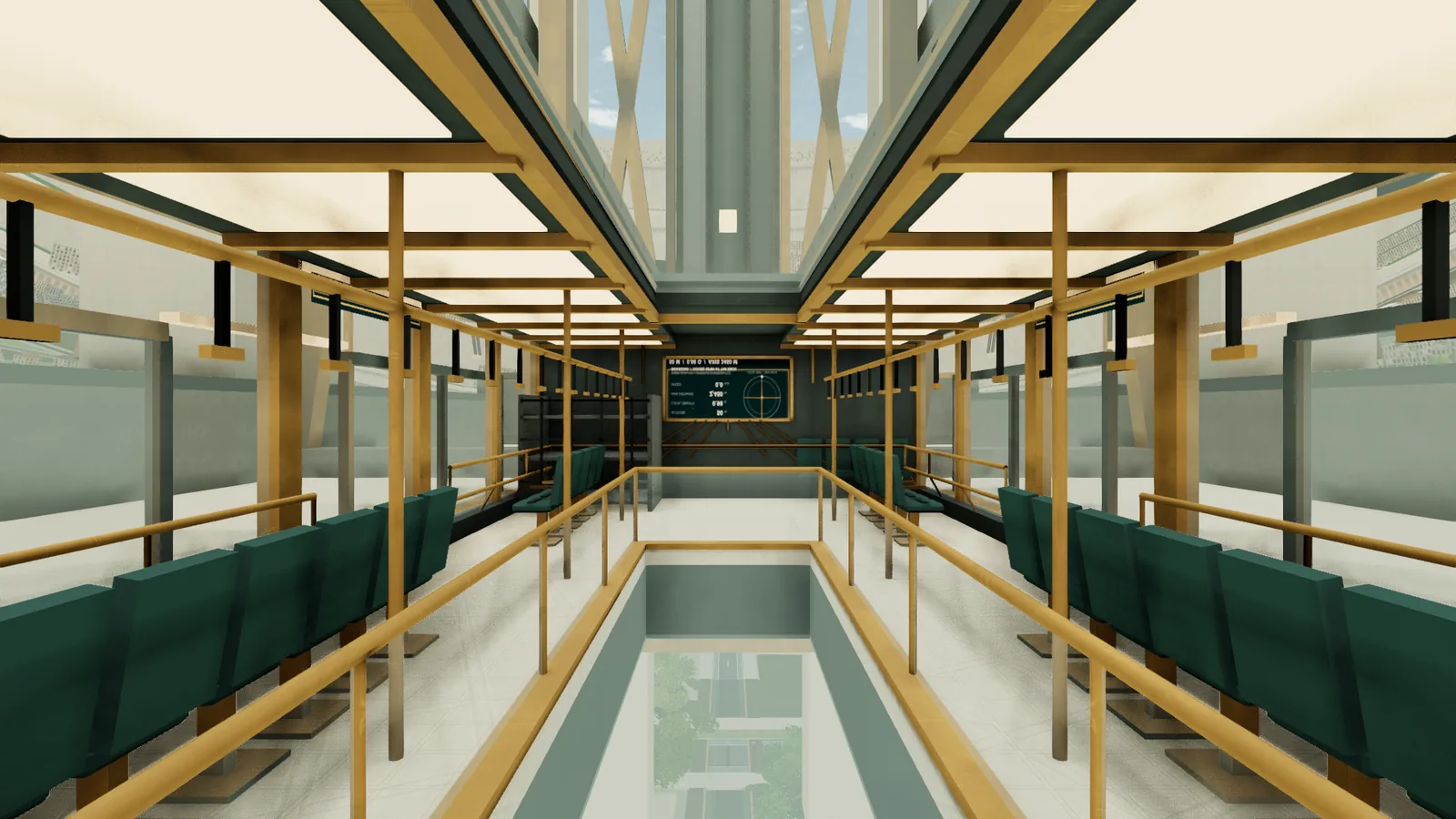
The sky is machinery.
The cabin rises and the neighborhood shrinks below the glass. A hundred metres up, then three hundred, then the blue sky waits just overhead. At 544 m the cabin slides through an opening and the sky turns into machinery: lit panels on frames, maintenance paths between them, and above them the upper half of the cylinder opening out. Across the interior a second city hangs upside down, small and bright.
The idea: gravity falls as you climb (0.78 g at the sky layer, 0.60 g at 1,000 m), and the cabin tilts to follow the changing vertical.
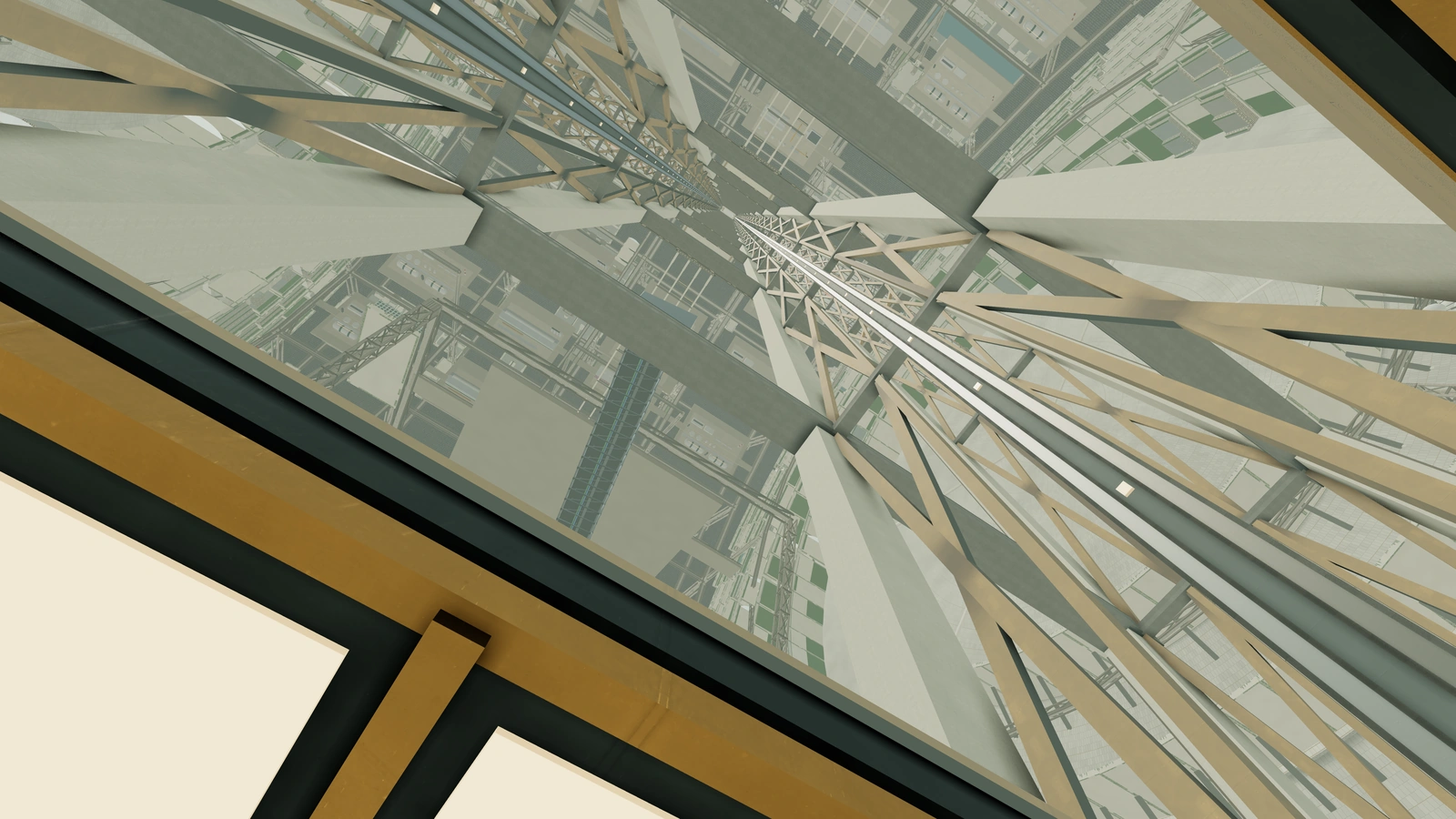
The work that feeds us.
Above the sky, a grow gallery fills the glass wall. Racks of lettuce, basil and kale stand in stacks twelve decks high, lit white and magenta, and a harvest gantry rolls along its rail. The air is the same air as the street, and the floor holds feet that now weigh 0.60 of their ground weight. Dinner for the neighborhood starts here, and it reaches the table the same day.
The idea: farms sit at partial gravity (0.60 g at 1,000 m), in the same pressurized air as the city.
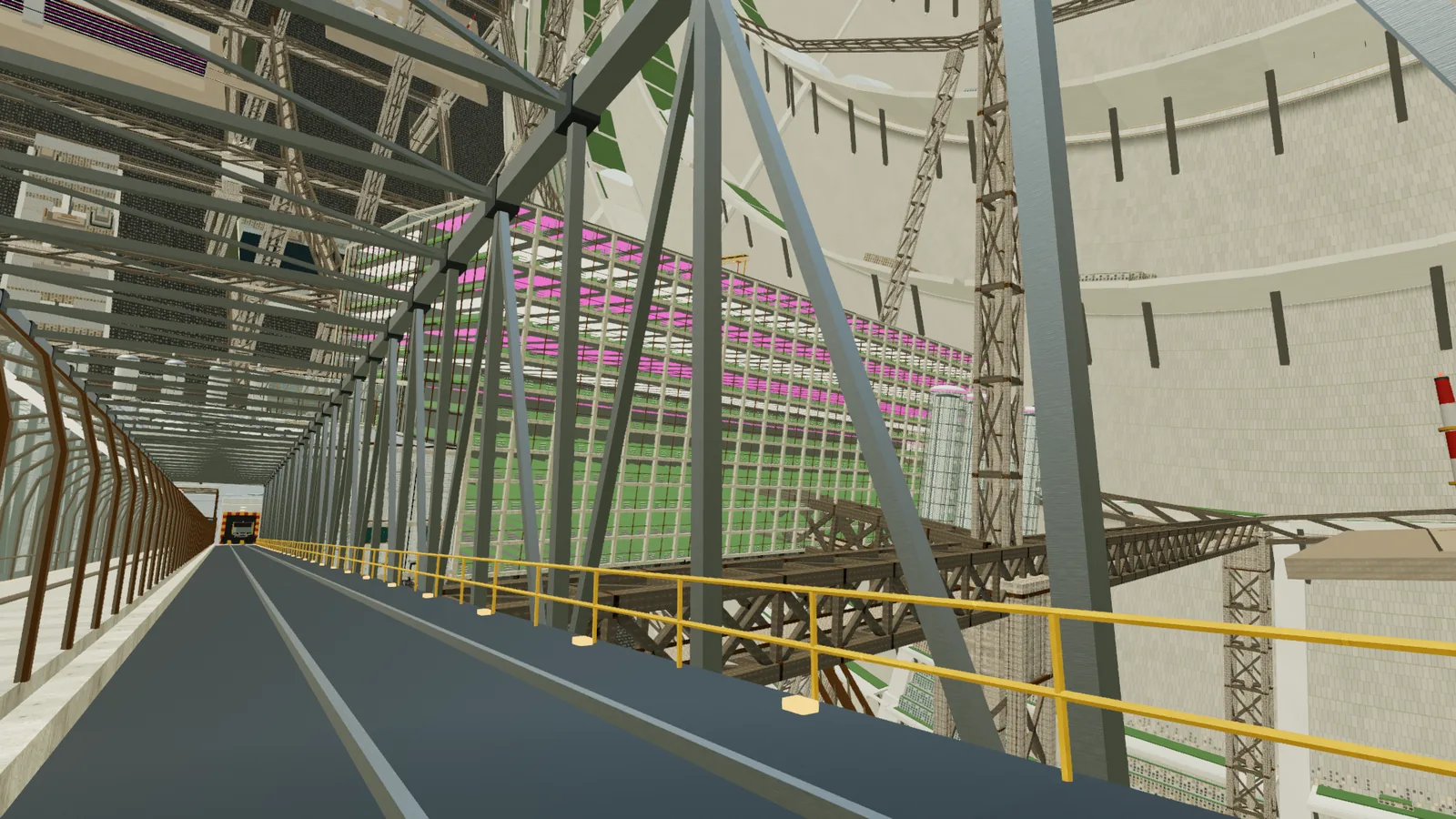
A first moment of weightlessness.
The ascender enters the hub drum and the world goes quiet. Weight is almost gone. The family drifts a little off the floor, hands on the rail, the youngest laughing. Beyond the glass is a stationary tube 120 m wide that does not turn at all. To reach it, a spin-decoupling lock slows the family's carriage over 96 seconds until it matches the spine. Then the doors open on a place without up.
The idea: there is no direct doorway from a turning world to a still one, so a lock brings the car to rest first.
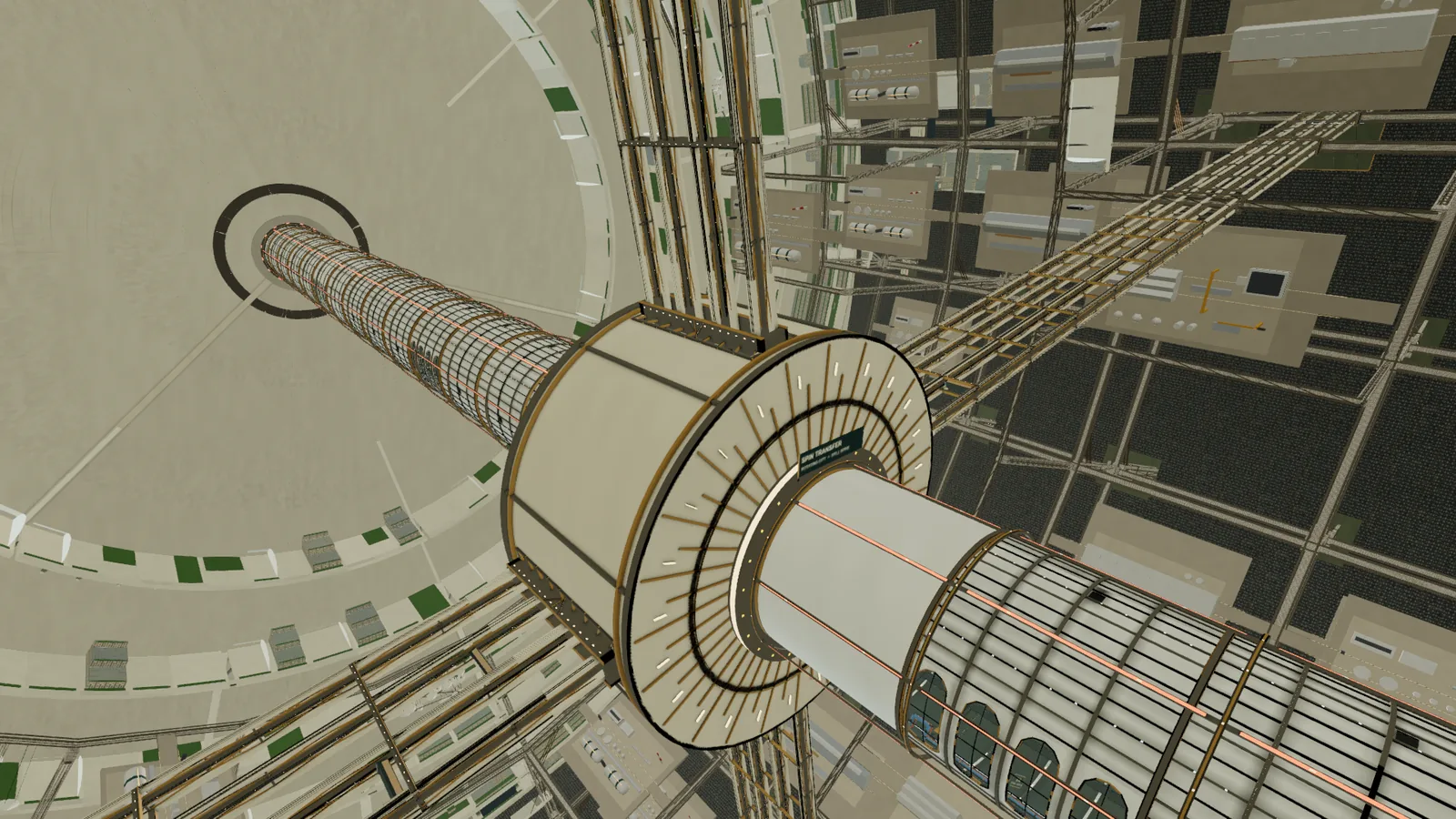
Two spins, one steady station.
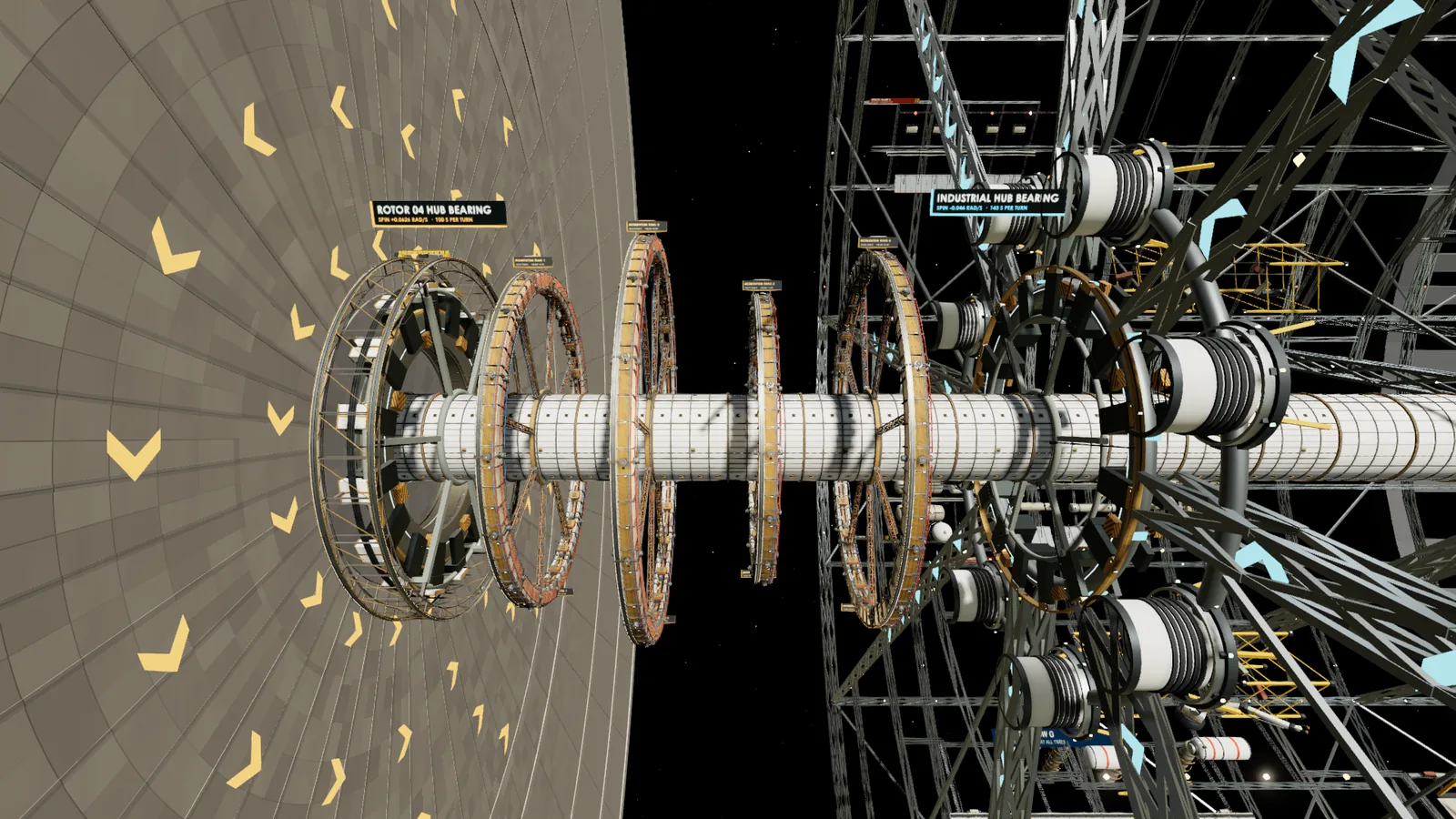
The express passes a bearing gallery where two great hubs face each other across a narrow gap. One turns one way and the other turns the other way. Further along, momentum rings spin in their housings behind glass, and a ledger shows the sums holding near zero. The family watches in silence. A station this size with net spin would fight every attempt to turn it.
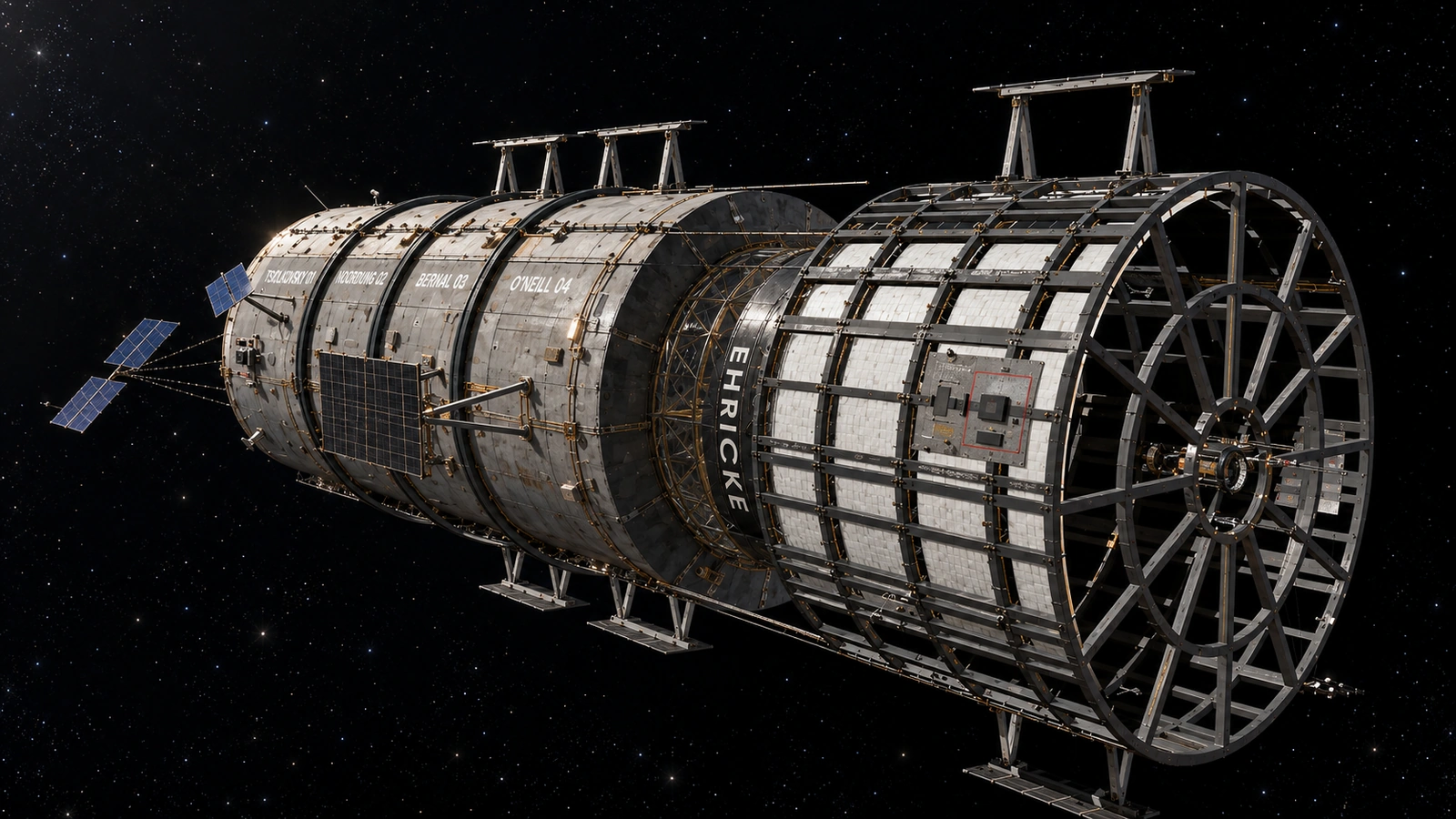
The idea: Tsiolkovsky and Noordung (Rotors 1 and 2) turn one way and Bernal and O'Neill (Rotors 3 and 4) the other, so the net angular momentum is close to zero.
A different kind of world.
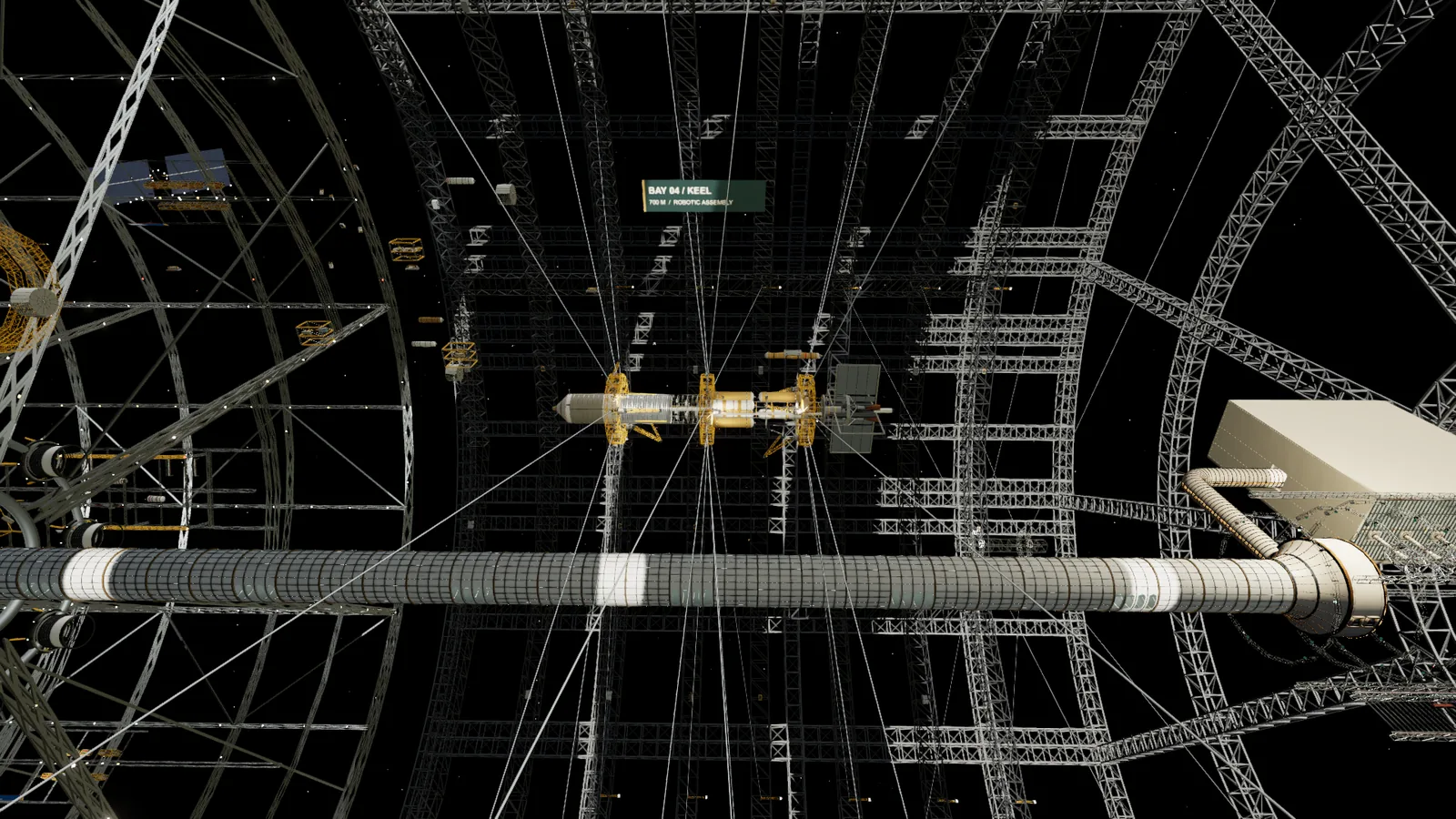
A very large dark space opens beside the spine, and in the middle of it a ship is being built. It is 700 m long, held by tension lines and tugs, with its tanks open and robot arms working along its flank. Nothing supports it from below, because below does not exist here. Lamps pick out cranes, framing and a crew drum. The family watches from a gallery and nobody speaks for a while.
The idea: in zero gravity you can build very large things without a floor, because nothing sags.
The port between orbits.
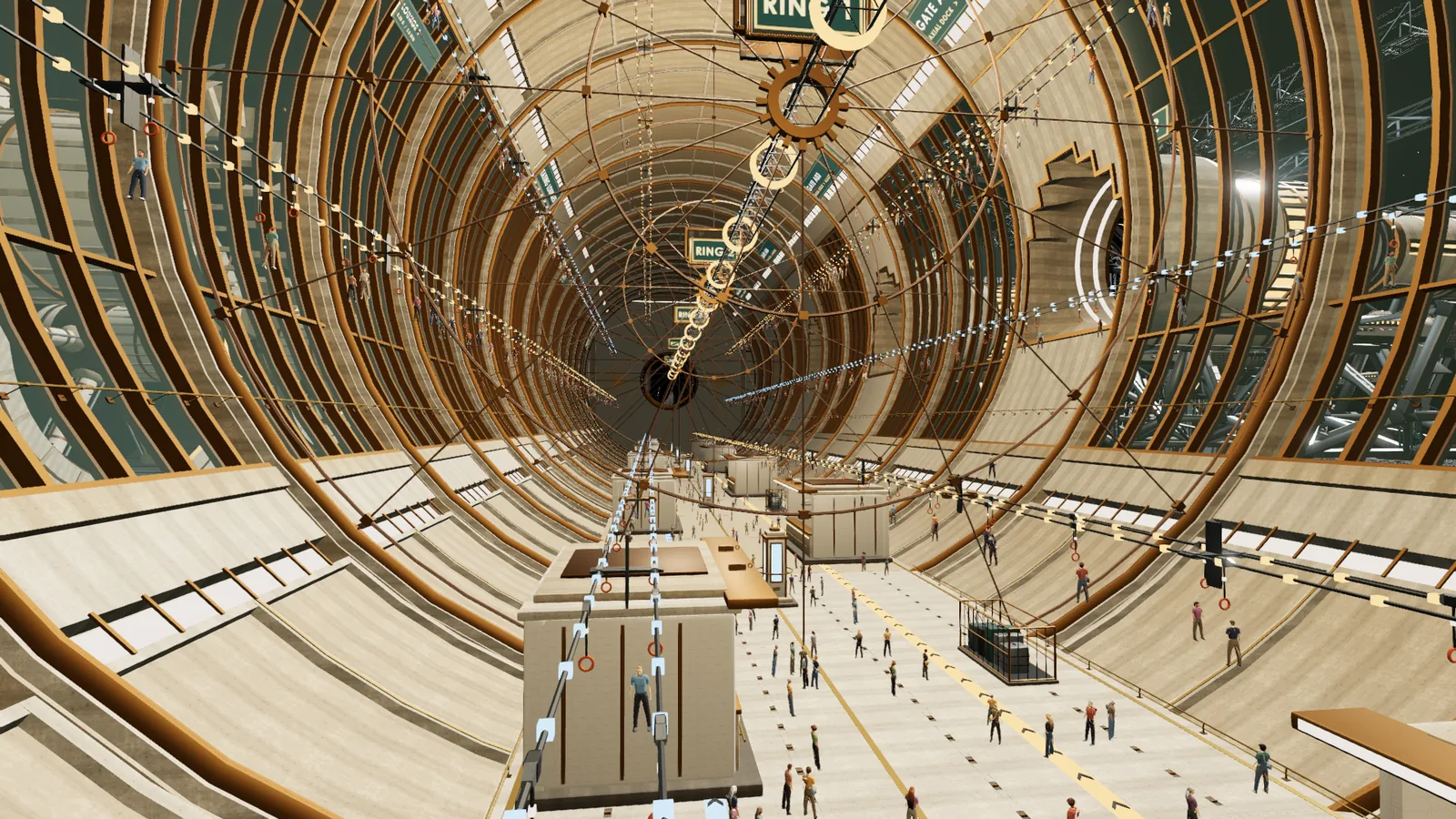
Concourse A is a long glazed hall full of passengers, shop pods and glide rails along the floor. Through the glass wall, gate pods and docked craft hang in the sunlight. The family follows the signs past the arrival face and the screening ranks toward their gate. The people around them are bound for the Moon, for Earth orbit, for the shipyards and farther out. It feels more like an airport than a launch pad.
The idea: the port is stationary and weightless, so traffic between orbits needs no rotating frame to match.
A departure made of momentum.
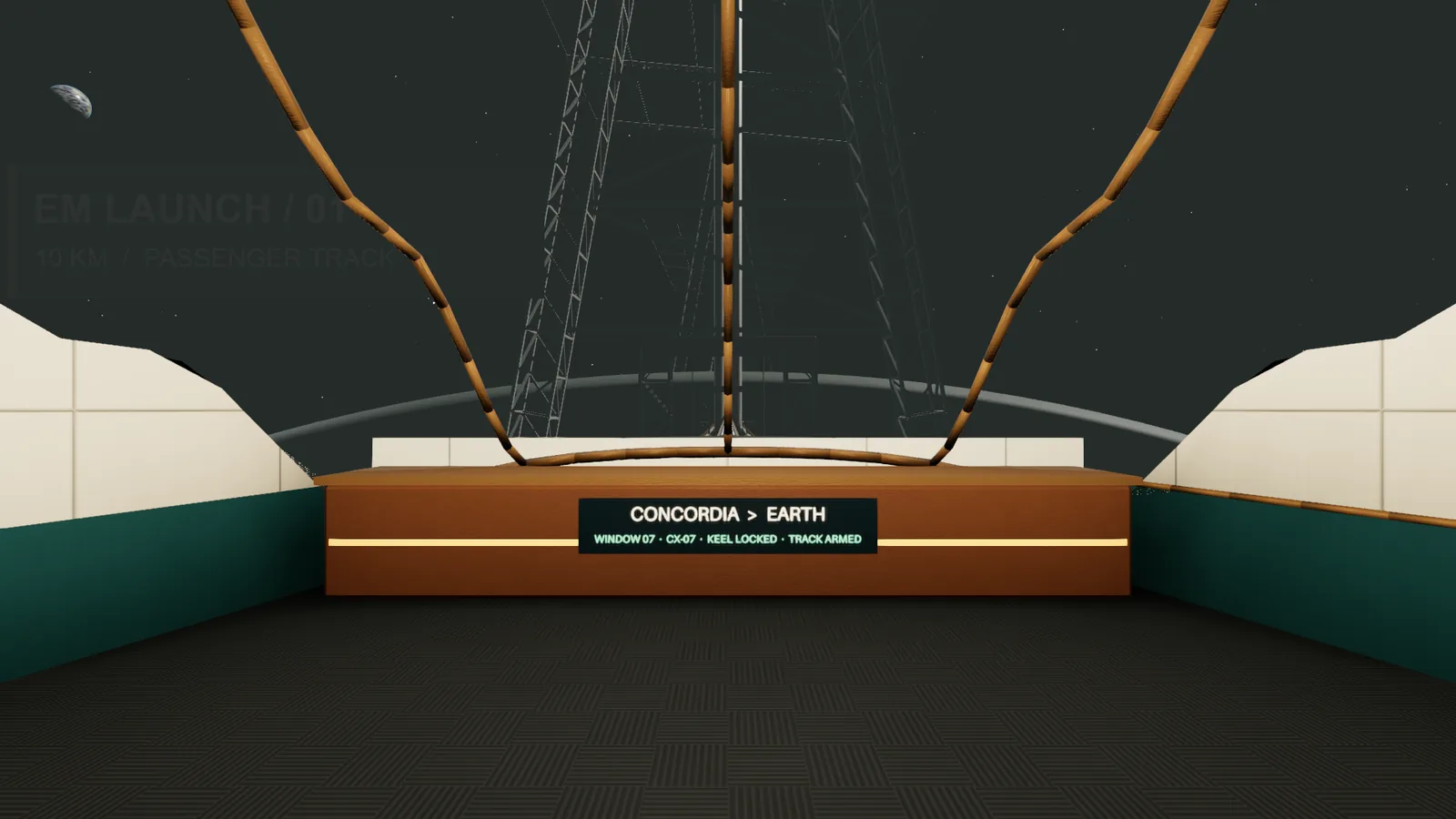
In the cabin the countdown reads T minus 60 seconds. Harnesses click, and a window band shows the long track running out ahead. The last ten seconds are quiet. Then the push begins: 1.5 g, steady for 37 seconds, a long pressure on the chest with the track sliding past the glass. At 540 m/s the cabin lets go, and the family is free of the station.
The idea: a 10 km track gives the shuttle its first 540 m/s with electricity instead of propellant.
A mountain built by people.
From 29 km out the whole station fits in one window. It is a grey mountain 21 km long, with radiator banks standing off its flanks like open books and the launch track running along its side. The family has never seen it from outside. There is no sign of the rotors turning, no sign of the streets, no sign of the sky. A home that large looks like a small piece of the dark.
The idea: scale. Concordia is 6.2 km across, and the launch is only the first leg of the trip.
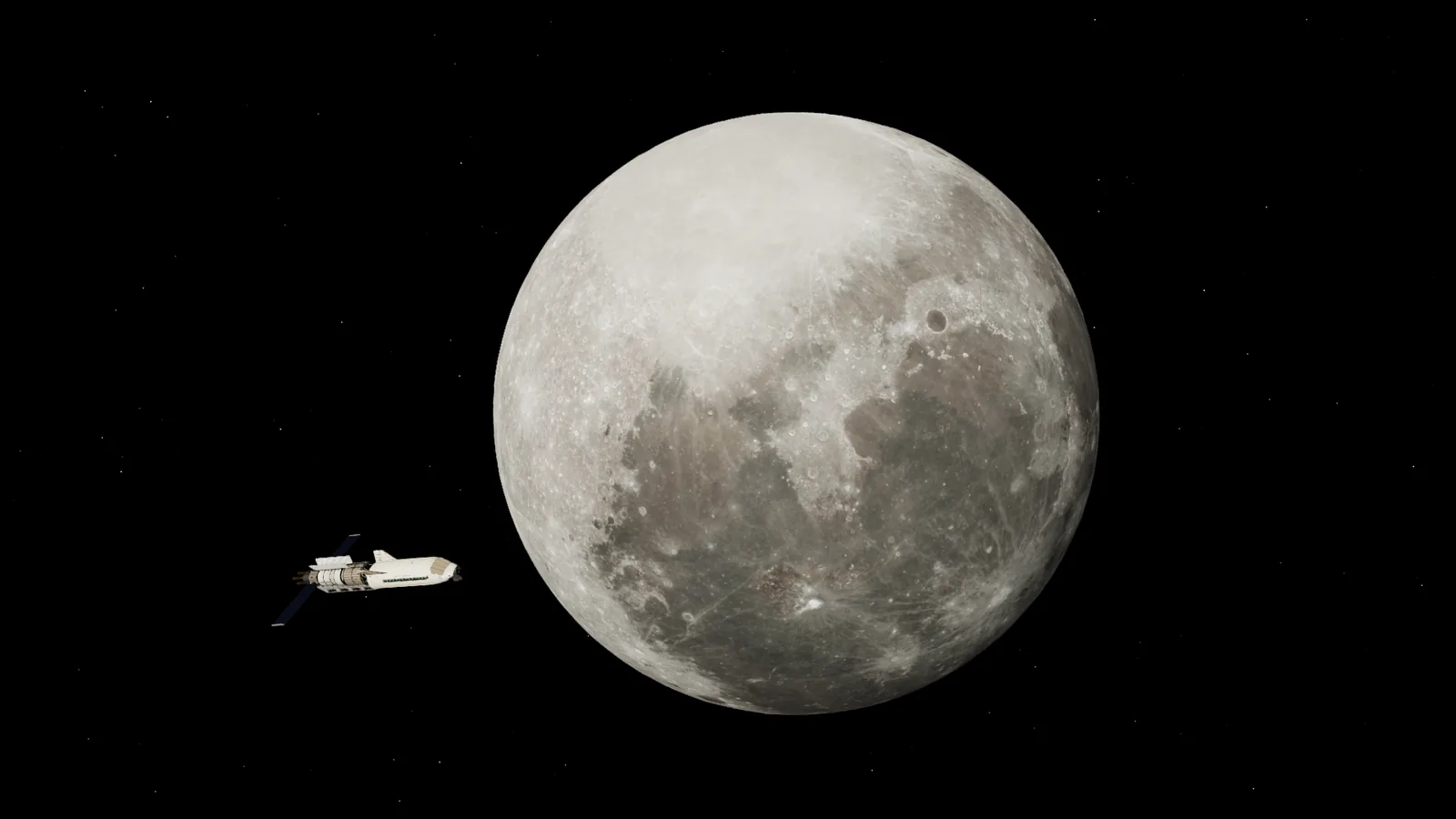
The Moon turns us home.
Six days out, the Moon fills the window, about 50 degrees across, a hundred times wider than it looks from Earth. The engines are off. The carrier passes about 2,400 km above the surface and the craters slide by. The family floats at the glass. The Moon's gravity bends the path toward Earth at no cost in propellant, and the moment of the pass sets the length of the trip.
The idea: a gravity assist turns the path for free, and when you pass the Moon sets the 15 days.
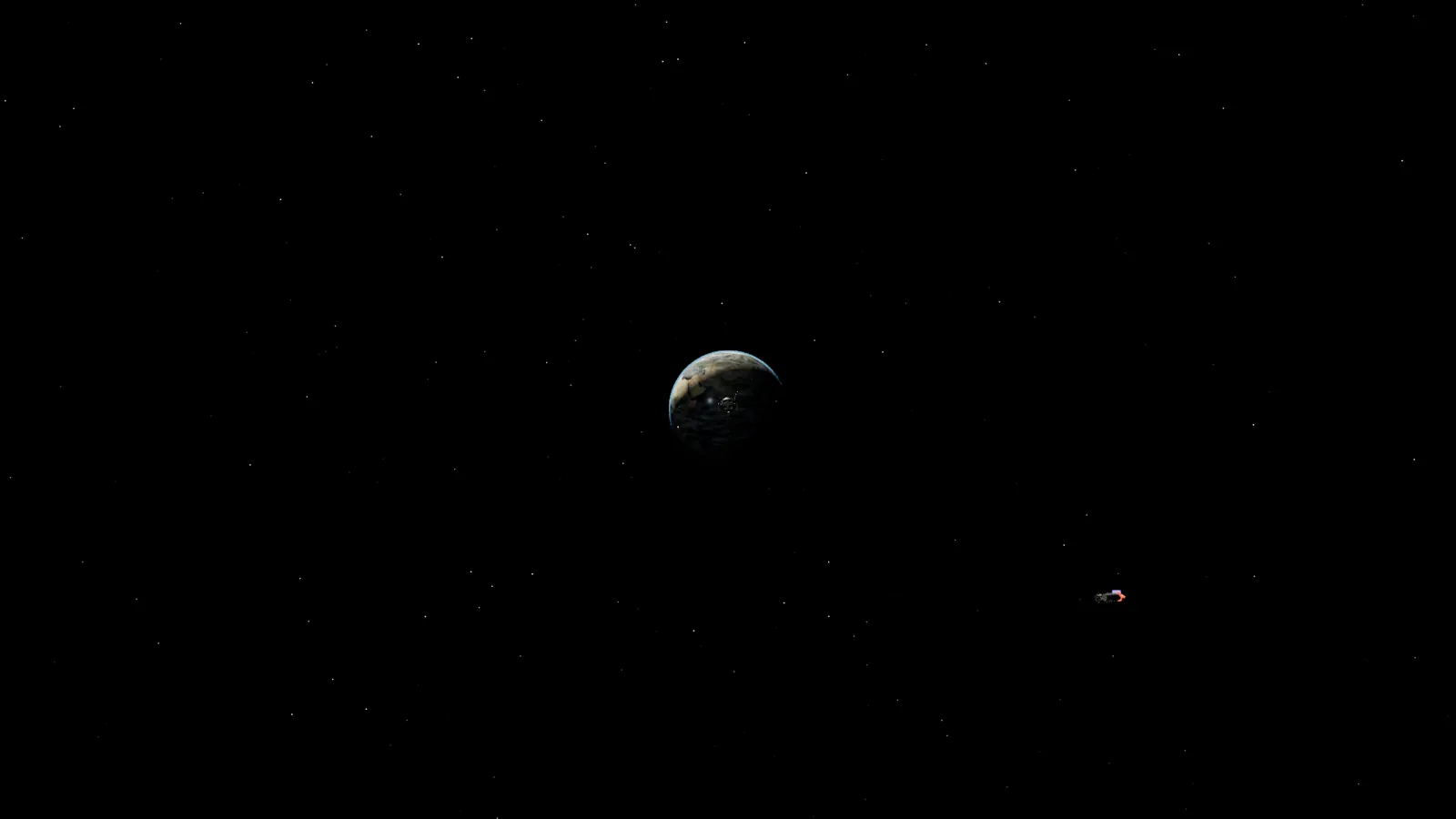
Home, seen from afar.
Earth is a small blue disc, about ten degrees wide, and it grows every hour. The stars around it are fixed and sharp. The days are compressed, so the readout counts them off against the 15 of the trip. A midcourse burn trims the path and the family braces. For the first time, the old world looks like a place they can reach.
The idea: a transfer needs three burns: departure, a small midcourse correction and the capture burn at the far end.
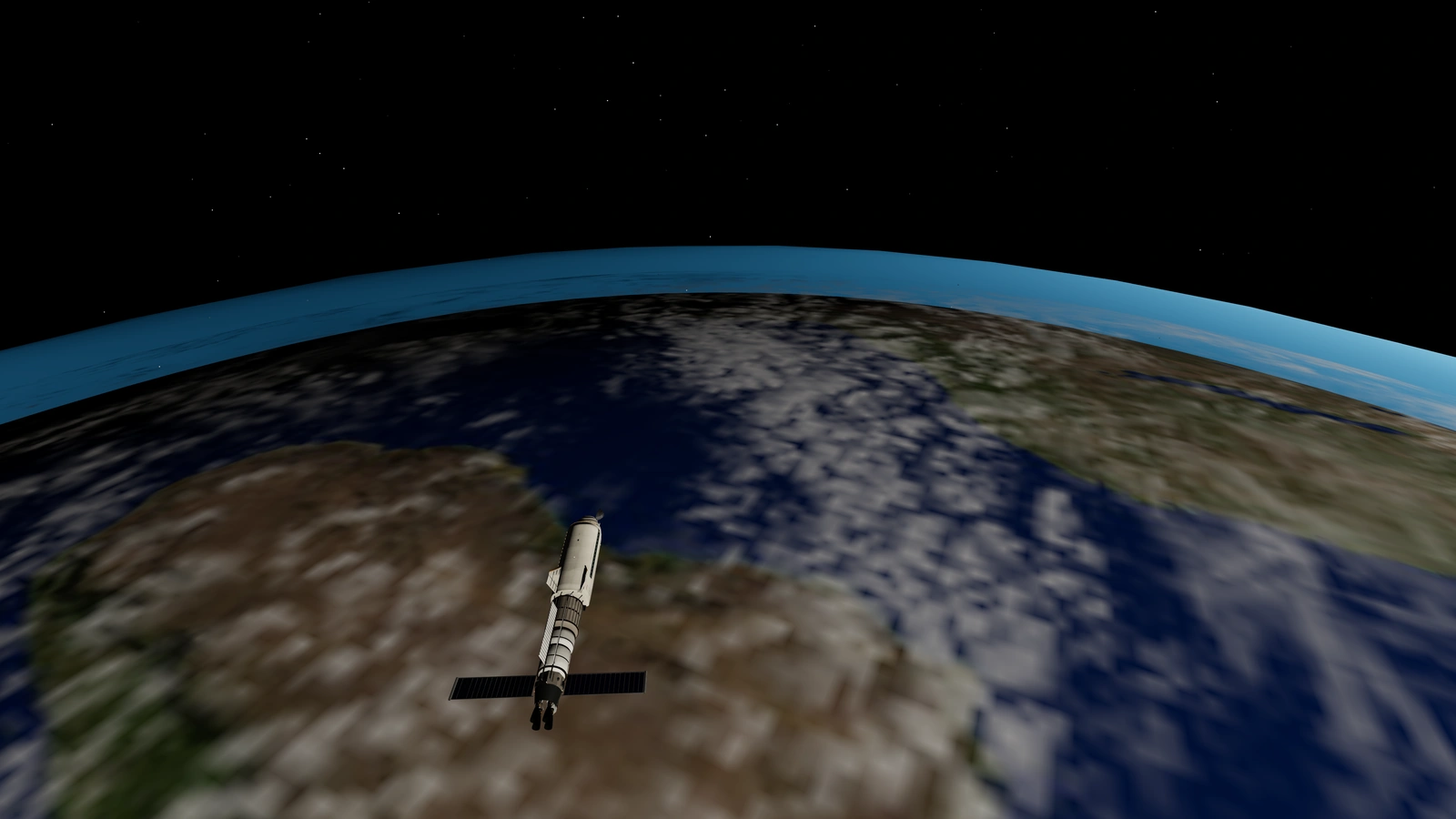
The old world fills the window.
The stack falls from 70,000 km toward a perigee 400 km above the surface. Speed climbs as the planet grows, from 1.1 km/s at the start to 10.4 km/s at the lowest point. Clouds, coasts and a thin blue edge fill the window. The coach readies to separate from the carrier, and the family looks down at the world they are about to land on.
The idea: vis-viva. Speed in an orbit depends on distance, so the stack speeds up from 1.1 to 10.4 km/s as it falls.
Go deeper: How the route is timed
The guided tour takes about 10 minutes at a reading pace, with a short authored ride between stops. The real trip is longer.
| Leg | In the story | In life |
|---|---|---|
| Metro, Arbor to Axis West | about 70 s | 20 s on the axial line, plus waits and lifts |
| Ascender | 16 s | 595 s, average 4.0 m/s, cruise 5.5 m/s |
| Spine express | 9 s | 140 m/s along the tube |
| Launch | 43 s | 37 s at 1.5 g to 540 m/s |
| Earth transfer | under a minute | 15 days, with a lunar swing-by at day 6 |
The launch alone does not reach Earth. It saves propellant, and the departure and capture burns finish the job.