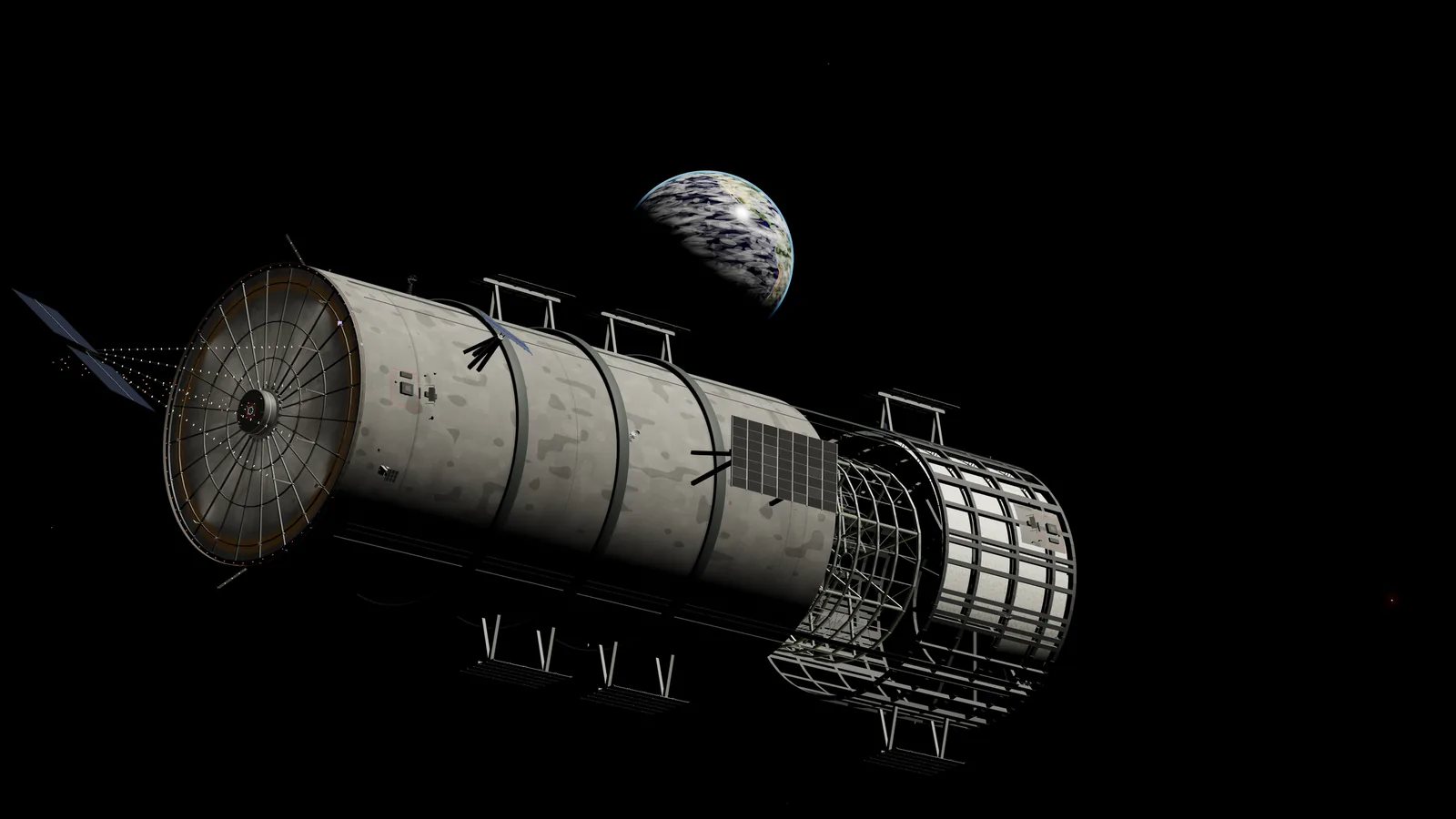
What it is and where it sits
Concordia is a stationary mountain with rotating cities inside it. The mountain carries the shielding, the radiators, the launcher and the docks. The cities turn so the people inside feel weight. About 400,000 people live here, in a station built for 1.0 to 1.2 million.
It rides the Earth-Moon L5 region at lunar distance, 384,400 km from Earth, on a path kept in place by constant small corrections (station-keeping). The Moon is the quarry and Earth is the market. L5 gives low-energy access to lunar material and room to build. A consortium of companies and cities runs the station, which earns its keep by selling energy and computation, structural materials, propellant and ships across cislunar space (who pays for it).
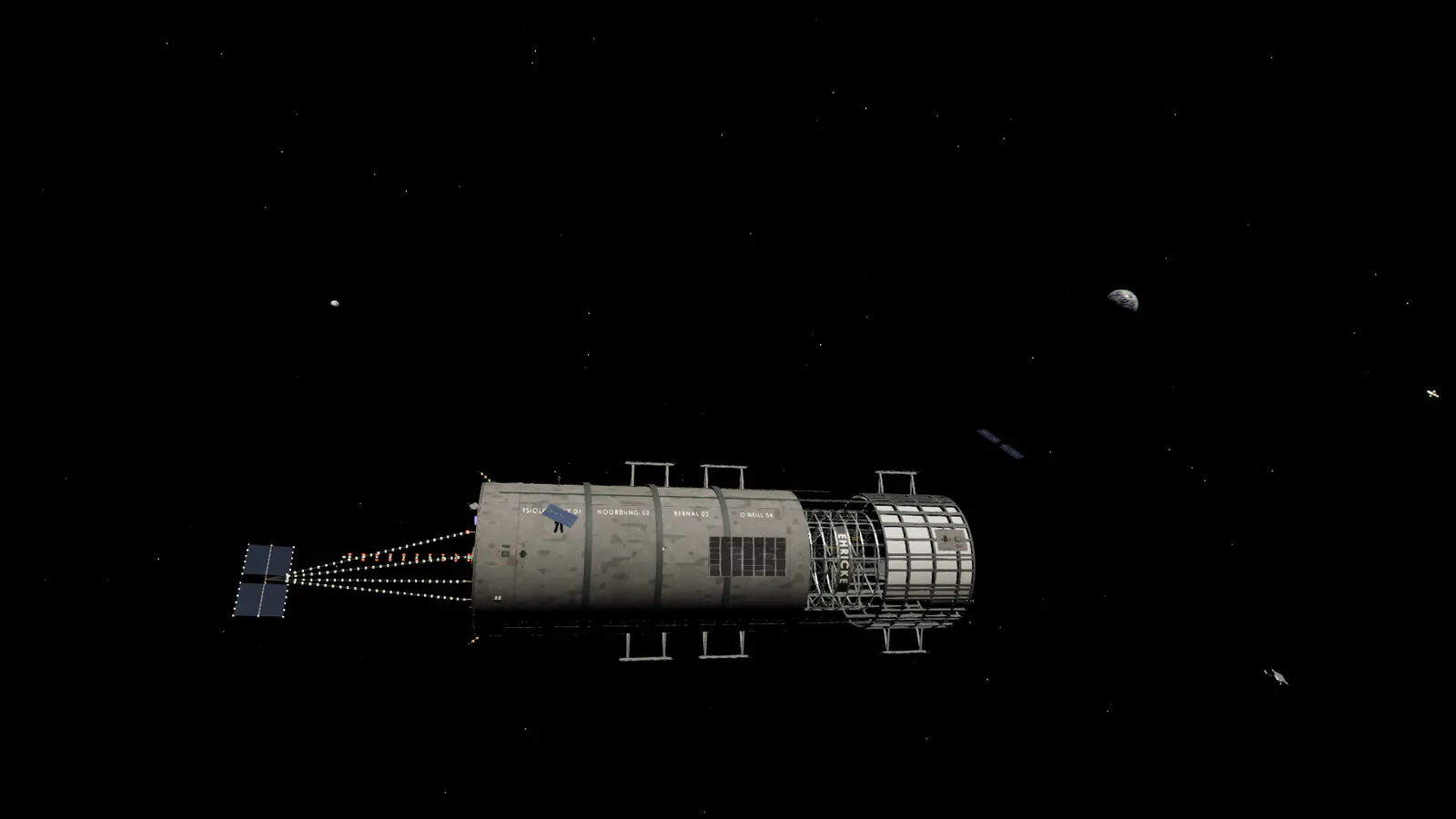
The layout along the axis
Everything lines up on one axis, 21 km long and 6.2 km across at its widest. The aft end holds the power landing and thrusters. Forward of it are four rotors, a momentum bay, the industrial rotor, the zero-g shipyard and the spaceport. The rotors are named Tsiolkovsky, Noordung, Bernal and O'Neill from aft to forward, and the industrial rotor is Ehricke; the station map says who they honour.
Distances run from -10.5 km at the aft face to +10.5 km at the forward port frame. The propellant farm sits beyond the forward end, so a tank failure cannot reach a rotor.
Open in the simulation: Exterior Hero: Complete Habitat Open in the simulation: Systems at 5 km
Five coupled systems
Concordia is one machine with five parts that depend on each other.
- The stationary mountain. A 21 km truss with shielding, radiators, the launcher, communications and docks. It does not spin.
- The rotating cities. Four independent habitation rotors, each 5 km across, each at 1 g on its ground. See artificial gravity.
- The industrial machine. A counter-rotating industrial rotor and partial-gravity farms that make food, water and building stock. See the industrial rotor.
- The zero-g harbor. The shipyard and the spaceport, where ships are built, docked and fitted out. See the shipyard.
- The utility ecosystem. Solar platforms, radiators, depots and robots that supply power and carry away heat. See power and heat.
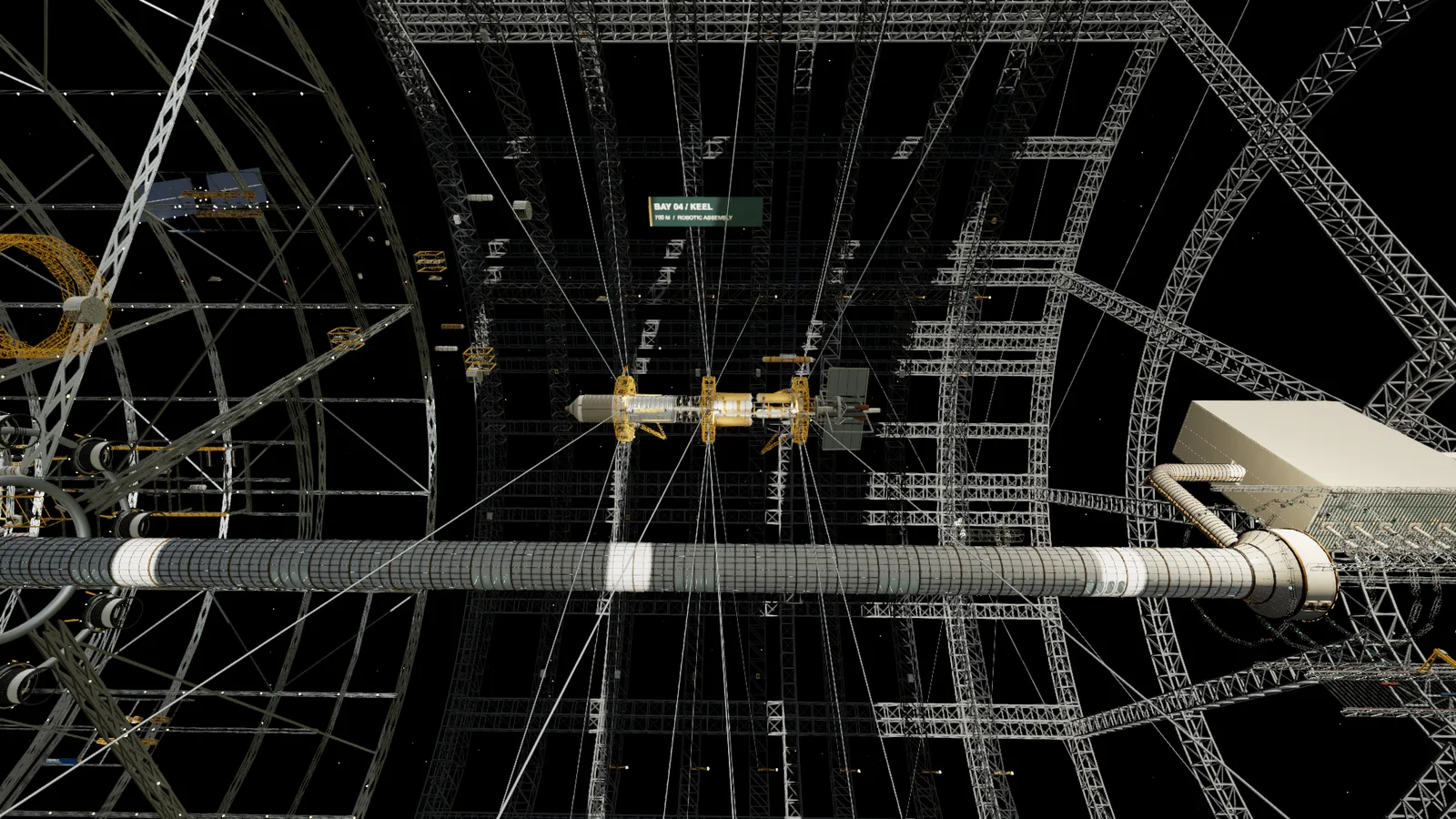
Key numbers
Each rotor is 2,500 m long and spins at about 0.6 rpm, which gives 1 g at the ground. Gravity falls in a straight line toward the axis, to 0.6 g at the 1,000 m farm level and almost nothing at the hub. The full table, with the reason for each value, is on the numbers page.
Open in the simulation: Fly out to the whole station Open in the simulation: Spaceport External Pier
Go deeper: How the pieces connect
People move between systems by three routes. In a rotor, the metro rides a viaduct 45 m above the street. Between the rotor floor and the axis, an ascender lift climbs about 2,380 m in roughly 10 minutes. Along the axis, the express runs at 140 m/s through the stationary spine, a 120 m tube that never spins.
Rotors 1 and 2 are phase-locked and linked by rotating bridges, as are rotors 3 and 4. Everything else, including every trip across the gap between rotors 2 and 3, goes through the spine.
In this section
Five generations of space habitats
Every space habitat has proved one new thing. The first showed people can live in orbit. The second showed someone will pay for it.
How Concordia was built
A city weighs about two billion tonnes. No rocket fleet carries that.
Concordia by the numbers
The values that define Concordia, grouped by system. Each row says what the number is, why it is that number, and where a formula gives it.
Who pays for Concordia
Nothing in the old trend lines builds a city of two billion tonnes in ten years.