Why you cannot launch a city
The station's finished mass is about 2 x 10^12 kg, two billion tonnes: four rotors at 300 million tonnes each, Ehricke (the industrial rotor) at 100 million, and about 750 million tonnes of shielding. The International Space Station weighs 419,725 kg. Concordia is about 4.9 million of them. Design value
Launch got cheap, and it was not enough. In 2018 NASA's Harry Jones put the Space Shuttle at $54,500 per kg to low Earth orbit and Falcon 9 at about $2,720. Established physics By the 2030s fully reusable heavy launchers carry more than 100 tonnes a flight for about $2 million, refuelled in orbit by tankers: about $20 per kg to low orbit and about $100 per kg delivered to L5. At that price two billion tonnes is 20 million full loads and about $200 trillion. Story
So cheap launch carried the start, not the bulk. The haulers, the first mining machines, the seed factory and the construction crews all flew up from Earth, and Earth still sends what only it makes well: electronics, medicines and specialist parts. Everything bulky is made from material that is already in space. Open in the simulation: See the 21 km silhouette
Step 1: feedstock flows, mid 2030s
Two streams of raw material start arriving at L5 in the mid 2030s.
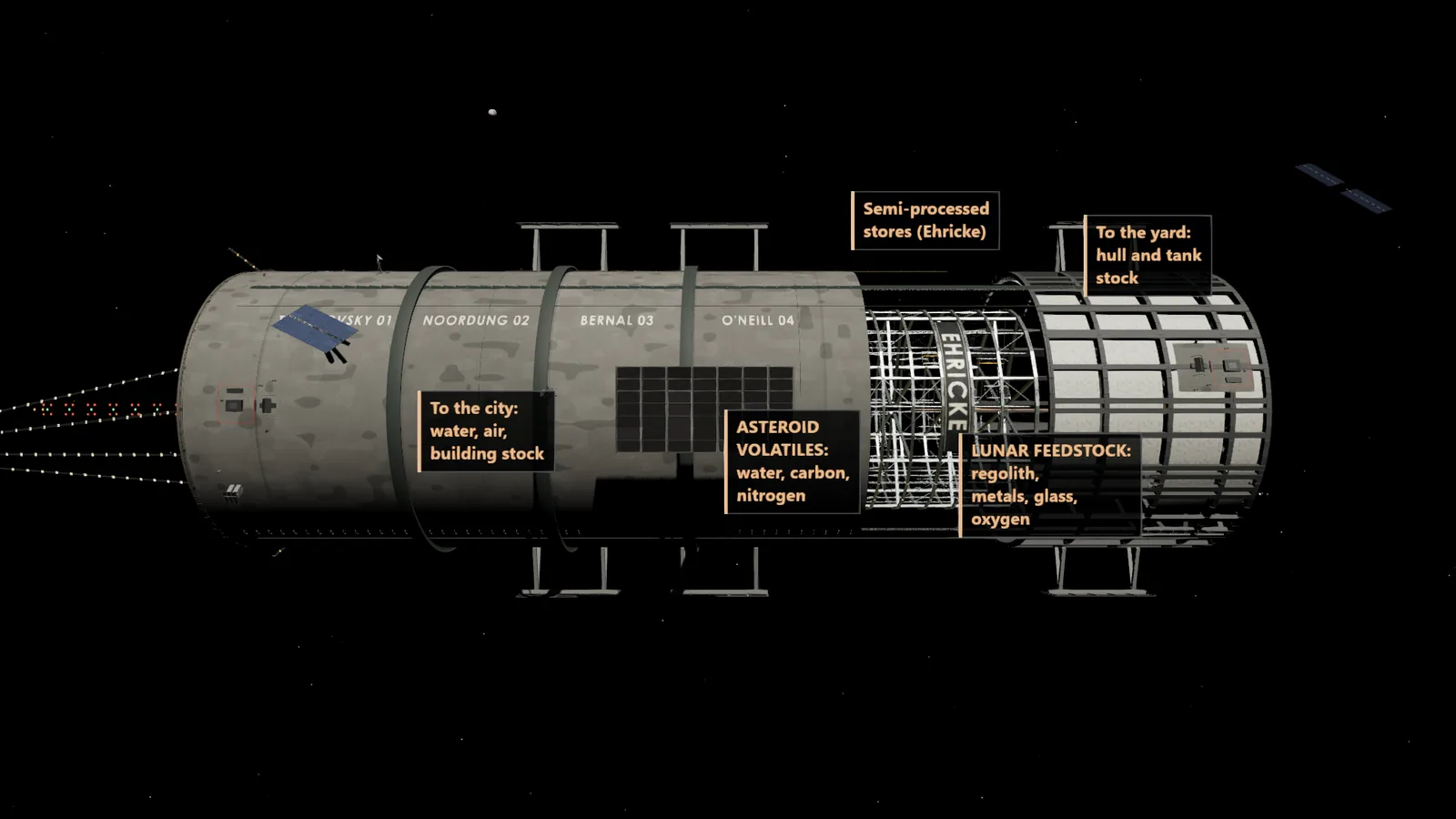
From asteroids, first. The first metal arrives without a single landing. Small metal-rich near-Earth asteroids, tens of metres across, are bagged whole and hauled into the L5 region, where their iron-nickel goes to the yard without smelting. The Moon lacks carbon, nitrogen and hydrogen, so small carbonaceous asteroids follow the same route. The captured carbonaceous bodies run roughly 10 percent water and a few percent carbon by mass. That is a 2045 measurement, not a theory. Story How the haulers work is on Mining the Moon and asteroids.
From the Moon, at scale. Lunar mining and refining, and an electromagnetic mass driver, come up behind the asteroid haulers and soon carry most of the tonnage. The Moon has 1/6 of Earth's surface gravity (1.62 m/s2 against 9.80) and an escape velocity of 2.38 km/s against Earth's 11.2 km/s. It supplies most of the oxygen, silicon, aluminium, iron, glass and shielding mass.
Step 2: the station is its own factory
The first thing built is not a home. It is a factory: the zero-g construction yard, power and radiators, and the first industrial plant. Today those are Ehricke (the industrial rotor) and the shipyard. The seed factory's first product was more factory: AI-designed machines that build the next machines, so output doubled every few months (who paid for it, and why).
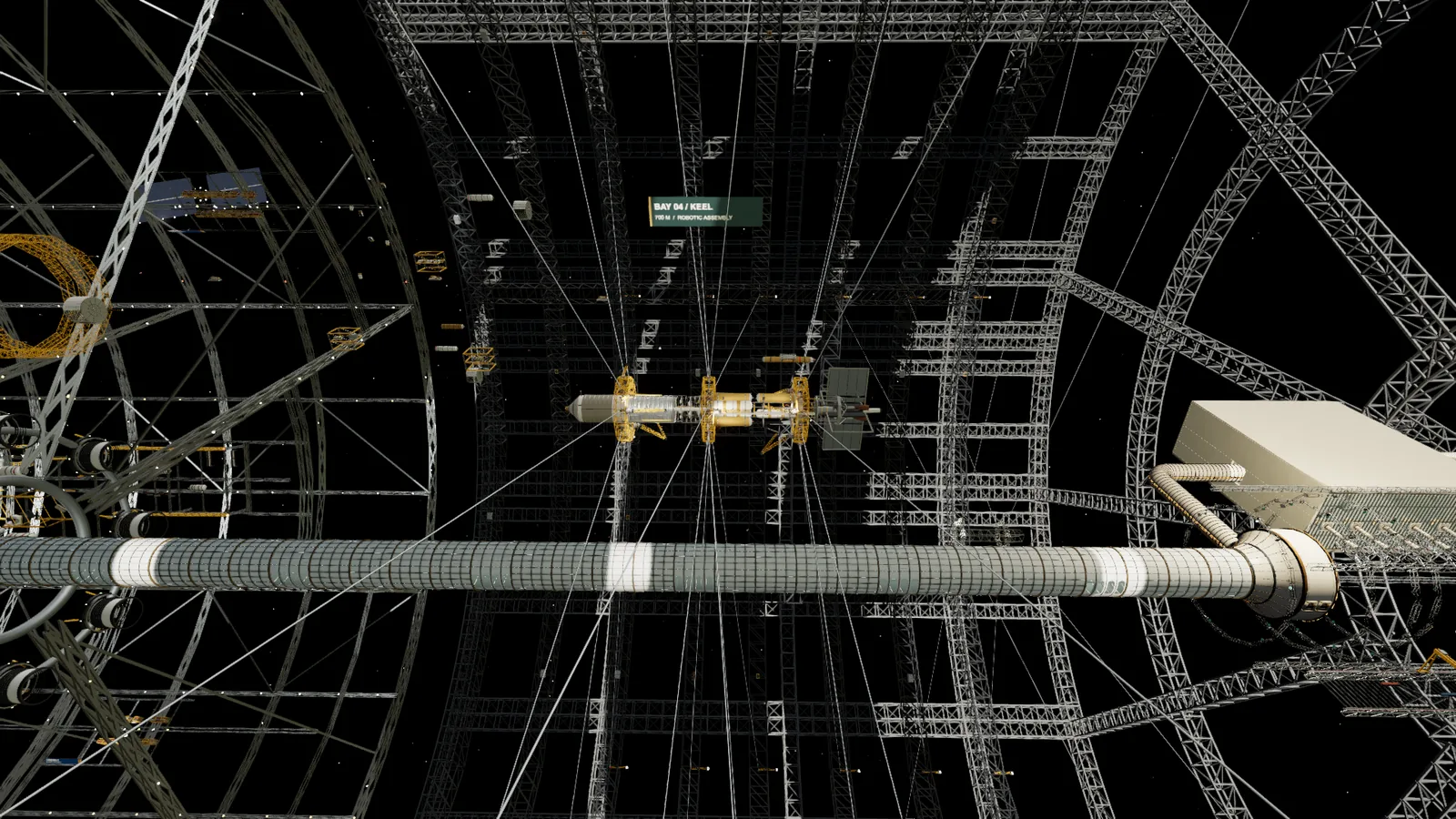
Workers live in small rotating construction rings, a few hundred metres across. The factory turns incoming feedstock into girders, glass, fibre, tanks and cassettes, so that later steps draw on stock held in the station, not on Earth. The industrial rotor still holds stores from both sources: sintered regolith billets, aluminium and iron ingots, glass and basalt fibre and oxygen from the Moon; water ice, carbon feedstock, nitrogen compounds and metal concentrates from asteroids.
Open in the simulation: Ehricke Industrial Rotor, Wide Open in the simulation: Zero-G Shipyard: Hero View
Step 3: the superstructure and the shield
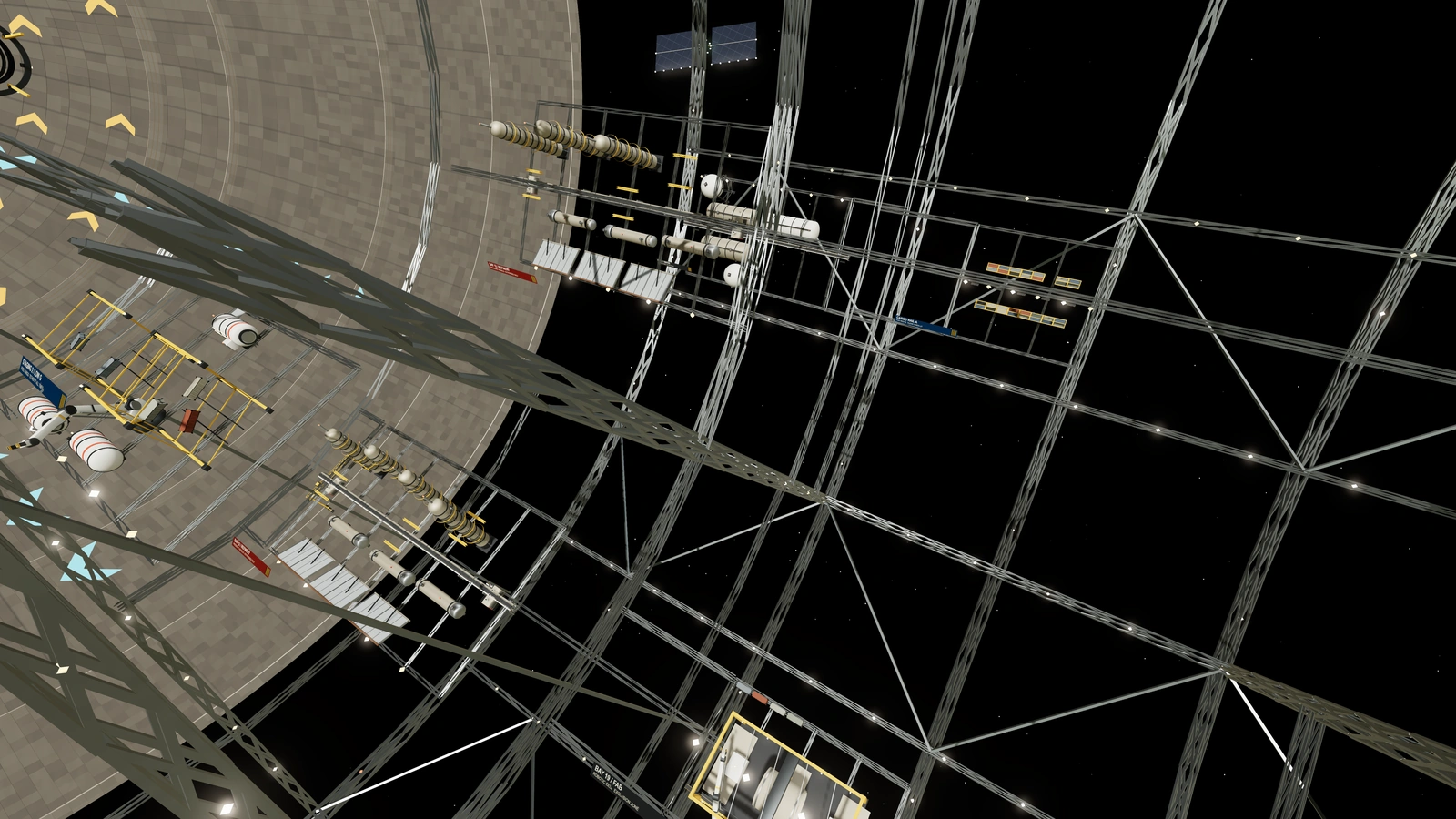
The 21 km stationary truss goes up around the yard. It is a deep spatial truss, not a pressure vessel. Shielding cassettes of compacted regolith and slag are fixed to its outside. For scale, one metre of regolith at 1.6 t/m3 over the 470 km2 of hull is roughly 750 million tonnes. Mass on that scale has to come from the Moon.
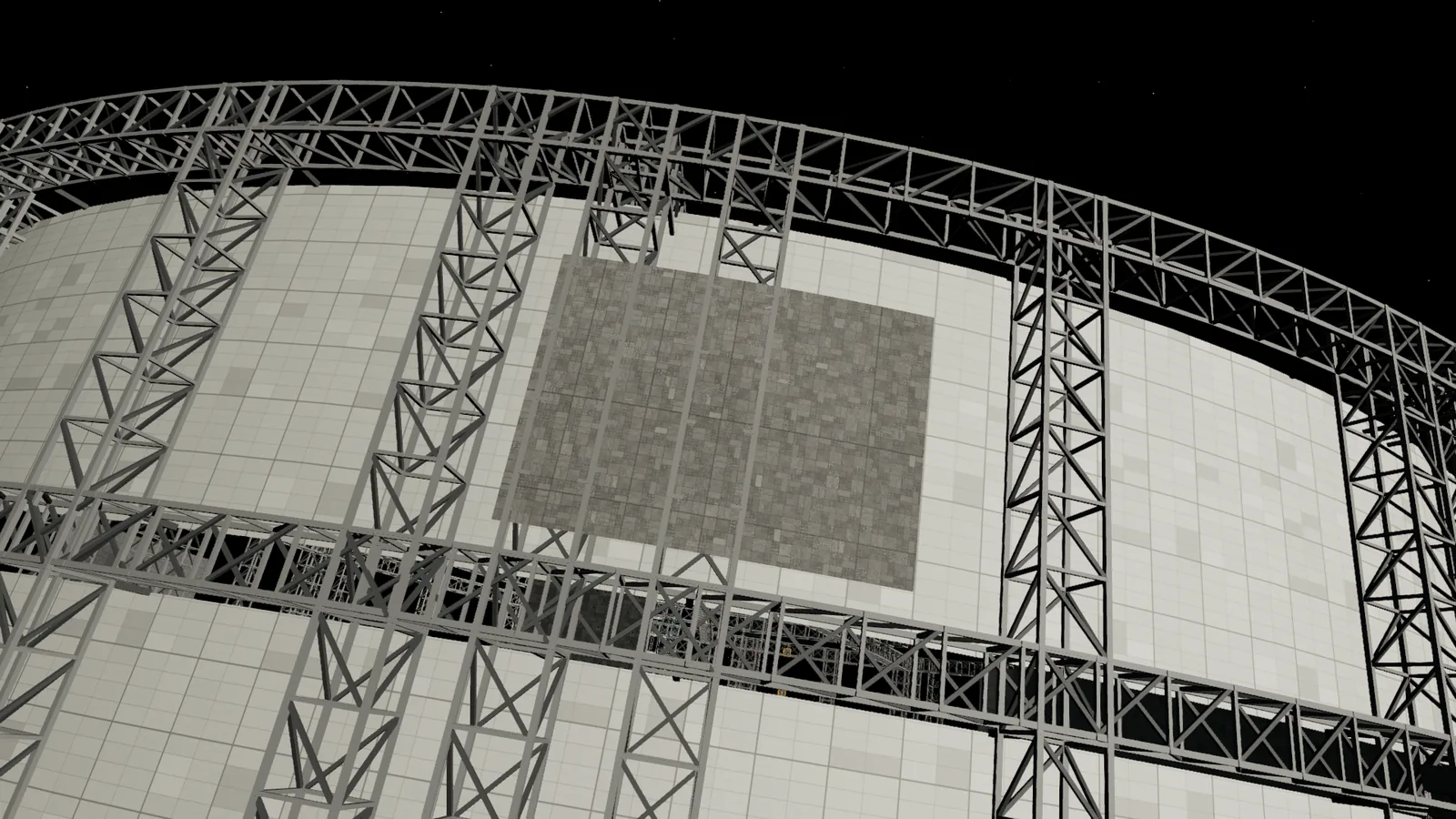
Step 4: Tsiolkovsky (Rotor 1) and the first spin-up
Tsiolkovsky is built stationary. The prebuilt megaframe goes in while the rotor is still, with only construction gravity. The rotor is pressure-tested, then given atmosphere, then spun up.
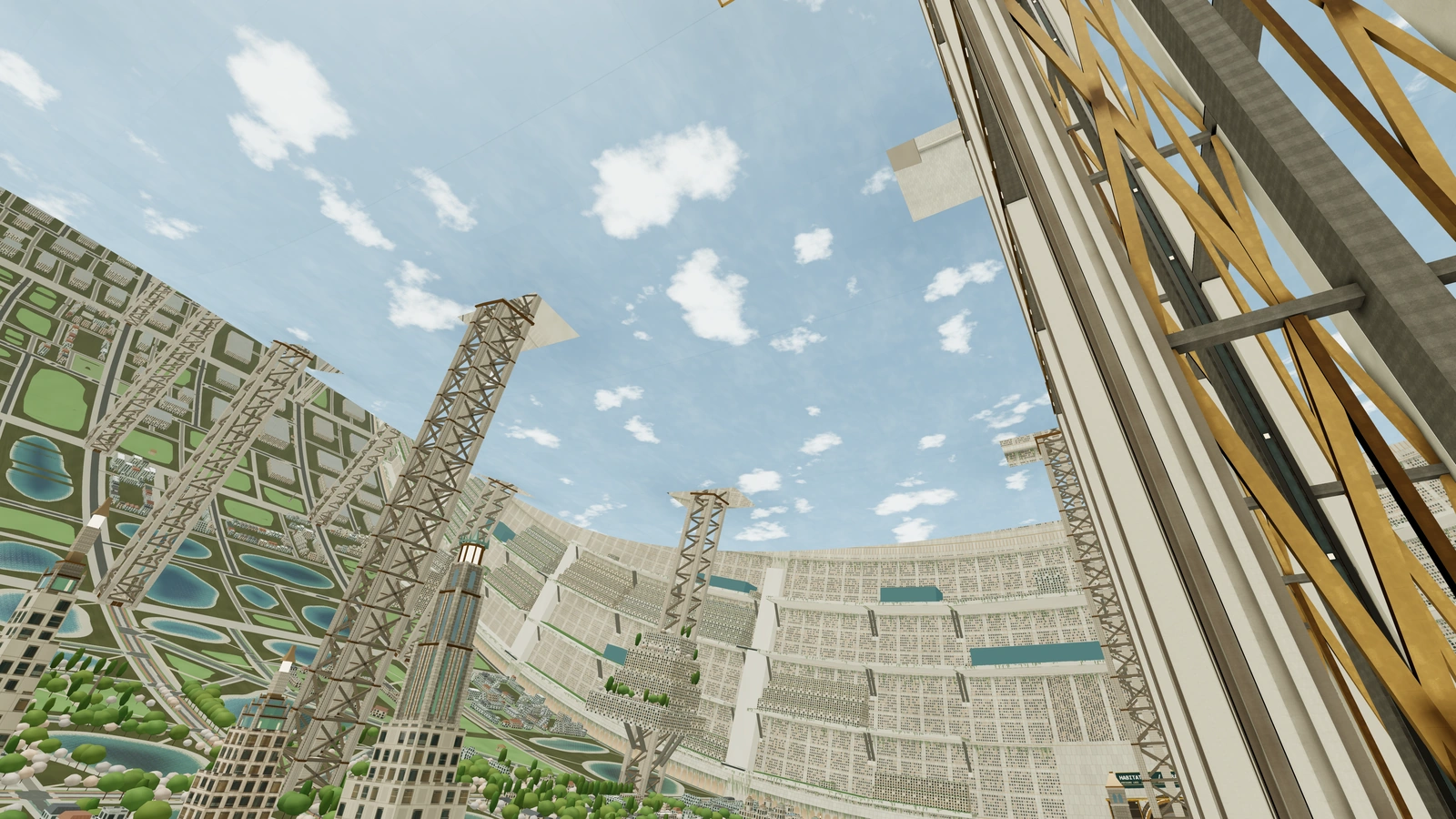
Spin-up is slow on purpose. The first full-speed turn of a structure this large is one of the riskiest events in construction. Speed rises in small increments and dwells at each step to expose resonances. The next increment starts only when the structure behaves as the model says. Temporary construction equipment comes out before full gravity. The campaign takes days to weeks. Story
The air for one rotor is about 45 million tonnes. Most of its nitrogen comes from asteroids. The first residents arrive in 2041.
Step 5: Noordung, Bernal and O'Neill
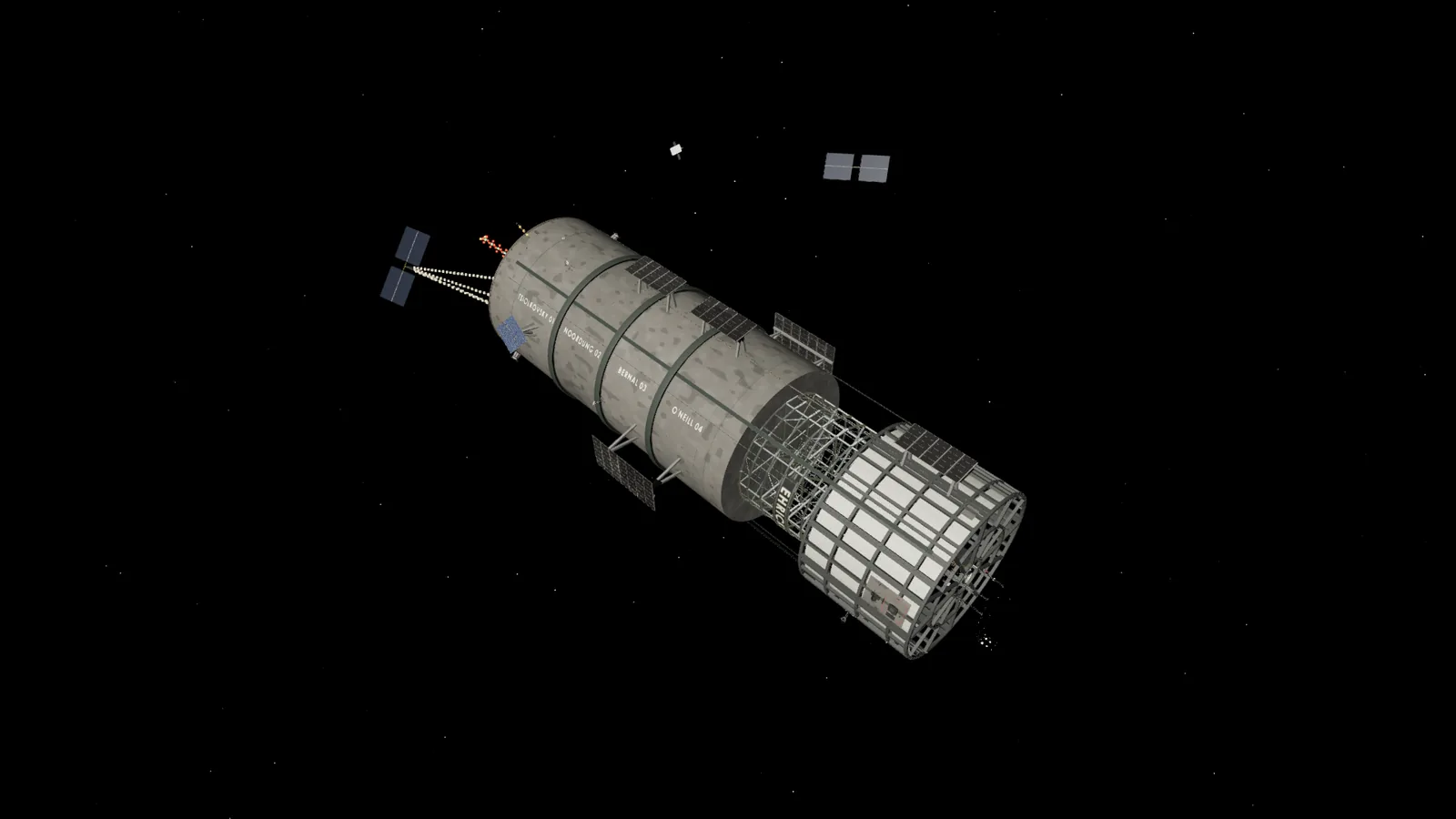
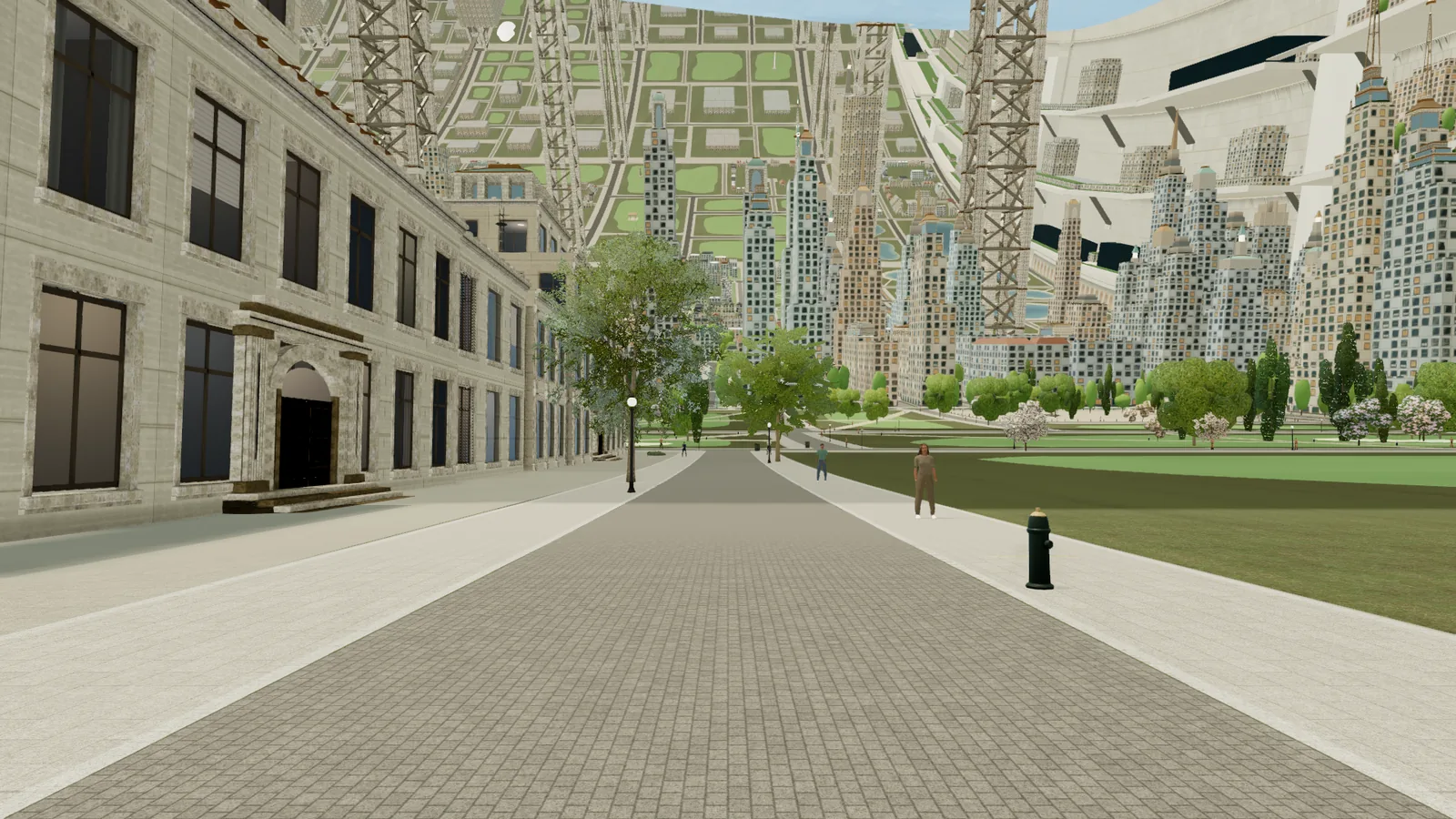
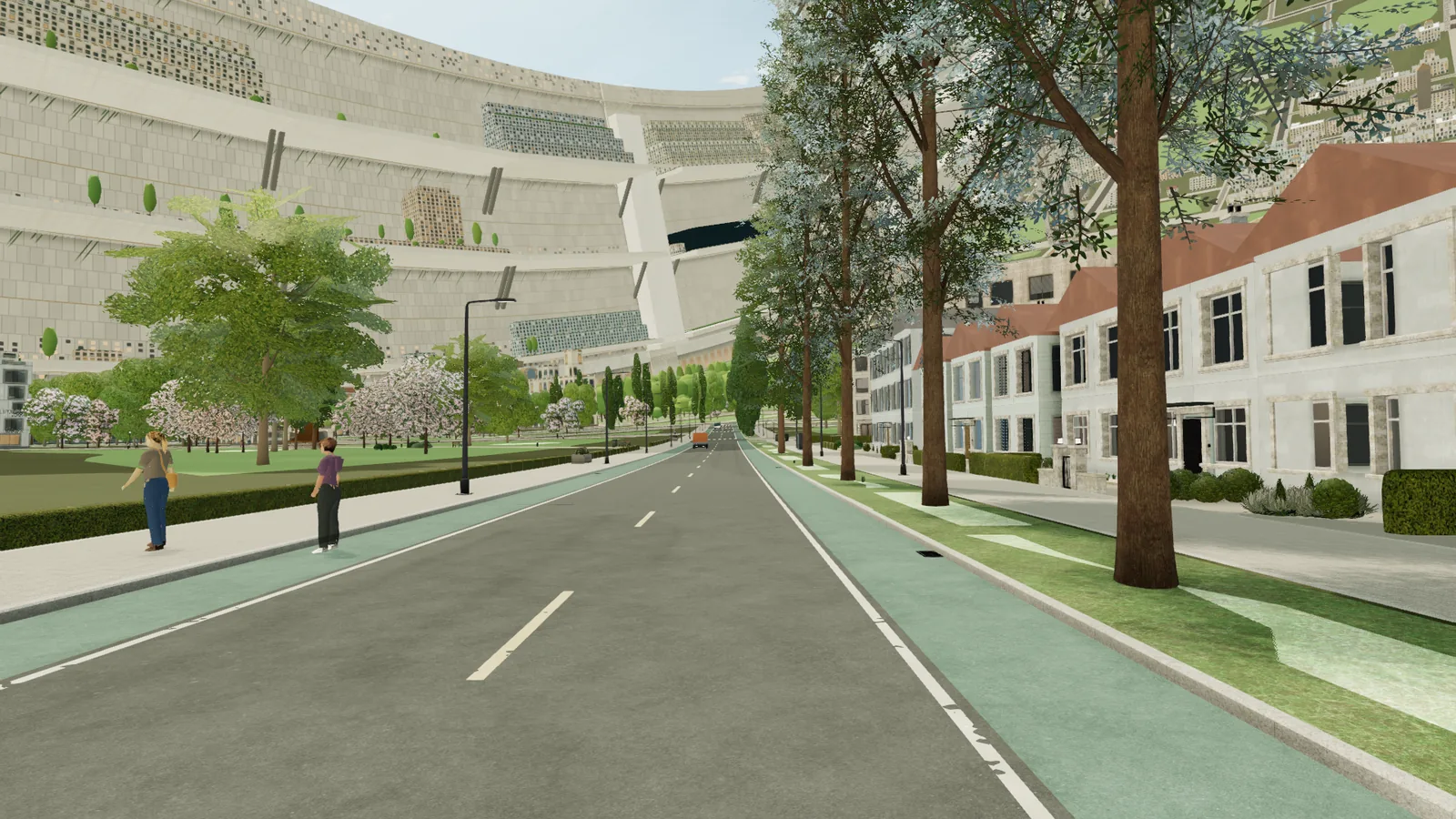
Rotors fill one at a time, so a defect found in rotor 1 can be corrected before the others take people. Rotors 2, 3 and 4 (Noordung, Bernal and O'Neill) follow. The fourth rotor reaches full spin in 2044. The construction rings are not taken apart: they are towed 200 km out to the next build site, where the yards have started the next station (who pays).
Go deeper: The numbers behind the build
- Finished station: about 2.05 x 10^12 kg. Four rotors at 3 x 10^11 kg each (about 45 Mt of air included in each) make 1.2 x 10^12 kg, the industrial rotor 1 x 10^11 kg, and the shielding example 7.5 x 10^11 kg. The full table is on Concordia by the numbers.
- Atmosphere for all four rotors: 150 to 200 million tonnes, in almost 200 km3.
- Shield example: 1 m of regolith at 1.6 t/m3 over 470 km2, about 750 million tonnes.
- Launch price: about $2 million a flight for 100 t is $20/kg to low orbit; four tanker flights per load bound for L5 make it about $100/kg there. 2.05 x 10^12 kg / 100 t = 2 x 10^7 loads; x $100/kg = $2 x 10^14, about $200 trillion. At the 2018 Falcon 9 price it would have been $5.6 x 10^15.
- Escape energy per kg: Earth 0.5 x (11.2 km/s)2 = 62.7 MJ; Moon 0.5 x (2.38 km/s)2 = 2.8 MJ, about 22 times less.
- Partial gravity: long-term data on living at 0.2 to 0.6 g is still being gathered. Engineering challenge Children, pregnancy and routine healthcare stay near 1 g in the rotor cities. Design value
Sources and further reading
- Mike Brown, "SpaceX Starship: Elon Musk outlines an ultra-low price tag for launches", Inverse, 2019 (about $2 million per flight and at least 100 t to orbit, the stated goal used here as the launch baseline): inverse.com.
- Harry W. Jones, NASA Ames, "The Recent Large Reduction in Space Launch Cost", ICES 2018: ntrs.nasa.gov.
- NASA, Moon fact sheet (gravity 1.62 m/s2, escape velocity 2.38 km/s): nssdc.gsfc.nasa.gov.
- NASA, "International Space Station facts and figures" (mass 419,725 kg): nasa.gov.
- Colaprete et al., "Detection of Water in the LCROSS Ejecta Plume", Science 330, 2010: doi.org/10.1126/science.1186986.