The trend line could not get here
Extend the launch prices, construction rates and workforces of the 2020s and you get no city in space by 2045, or by 2100.
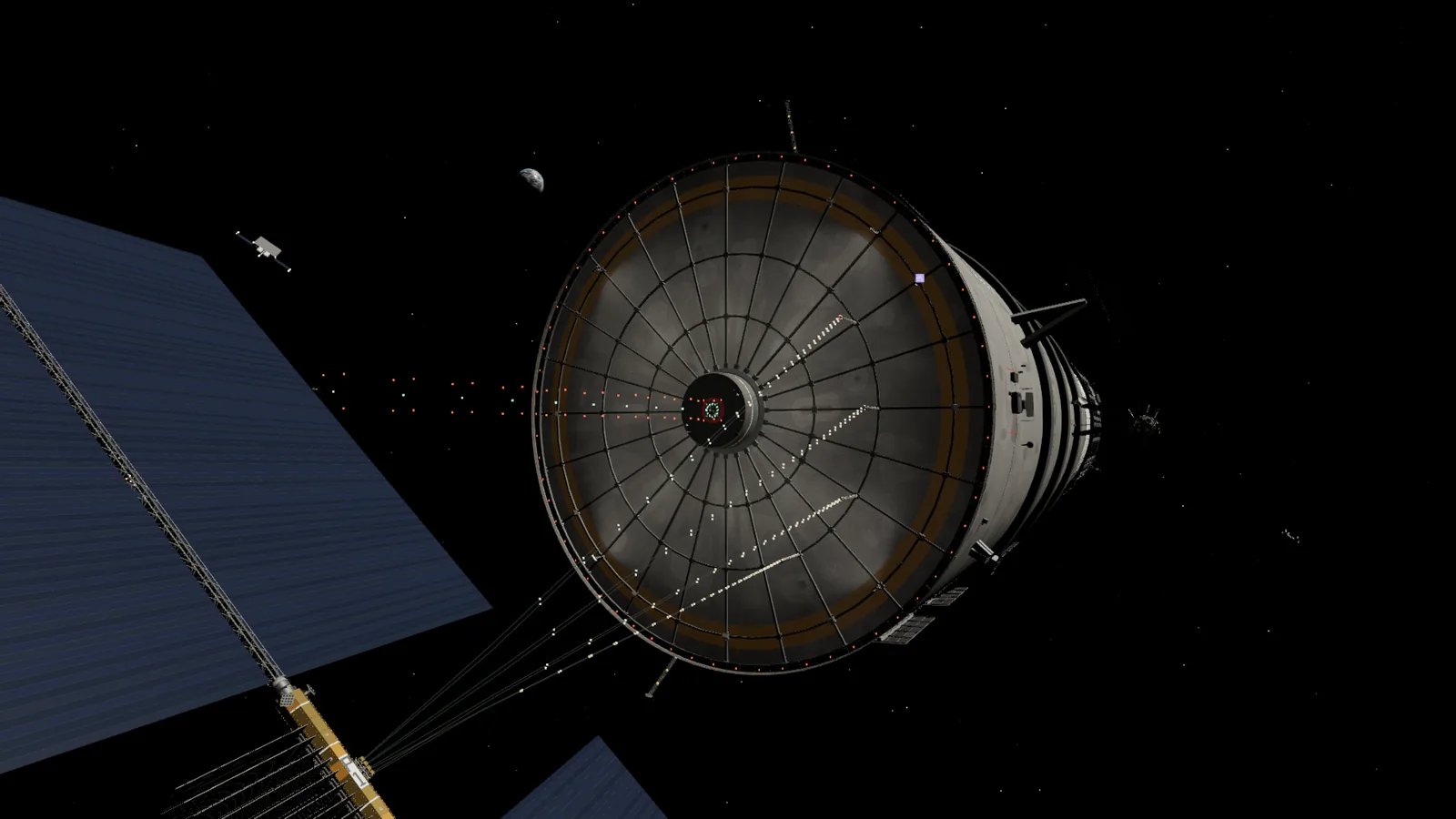
Concordia weighs about two billion tonnes. That is about as much material as all the world's steelworks poured in 2024, 1.88 billion tonnes. Established physics Material started arriving at L5 in the mid 2030s and the fourth rotor reached full spin in 2044, so the station went up in about ten years: about 200 million tonnes a year, more than half a million tonnes a day, in vacuum, 384,400 km from the nearest steelworks. Story
Launched from Earth, even at the 2030s price of about $100 per kg delivered to L5, that mass costs about $200 trillion (the arithmetic). Built by hand, it needs hundreds of thousands of workers in space before there is anywhere for them to live.
Two breaks
Machines that build machines. Artificial general intelligence arrived in 2030. About three years later a seed factory of about a thousand tonnes reached L5. Its first product was more factory. A plant that copies itself grows like a colony: twenty-one doublings take a thousand tonnes to two billion. In about ten years that means doubling every five months or so, a pace no human-designed industry ever came near. It came from AI-designed self-replicating factories that build and repair their own successors. Story
Once machines make machines, a kilogram in space costs about what the energy to make it costs. Assume about 30 MJ to dig, refine and shape a kilogram of mixed regolith and asteroid metal. That is about 8 kWh, under 10 cents at a cent per kWh of space solar. Design value The construction years drew about 200 GW on average, roughly eight times what the finished city uses today. Building Concordia was the biggest power customer it ever had.
Wealth looking for a place to go. When most work on Earth was automated, income moved from wages to whoever owned the machines, the energy and the land. The companies that built artificial intelligence and their founders held more capital than any group before them, and their own industry was limited by one thing: electricity. On Earth, power plants take years of permits and grid connections, and nuclear plants a decade to build. In space the sun never sets on a panel. Story
So Concordia began as a chartered, for-profit venture with no fixed payback date. Its founders bought a power base off Earth, the way aluminium smelters once built their own dams.
What Concordia sells
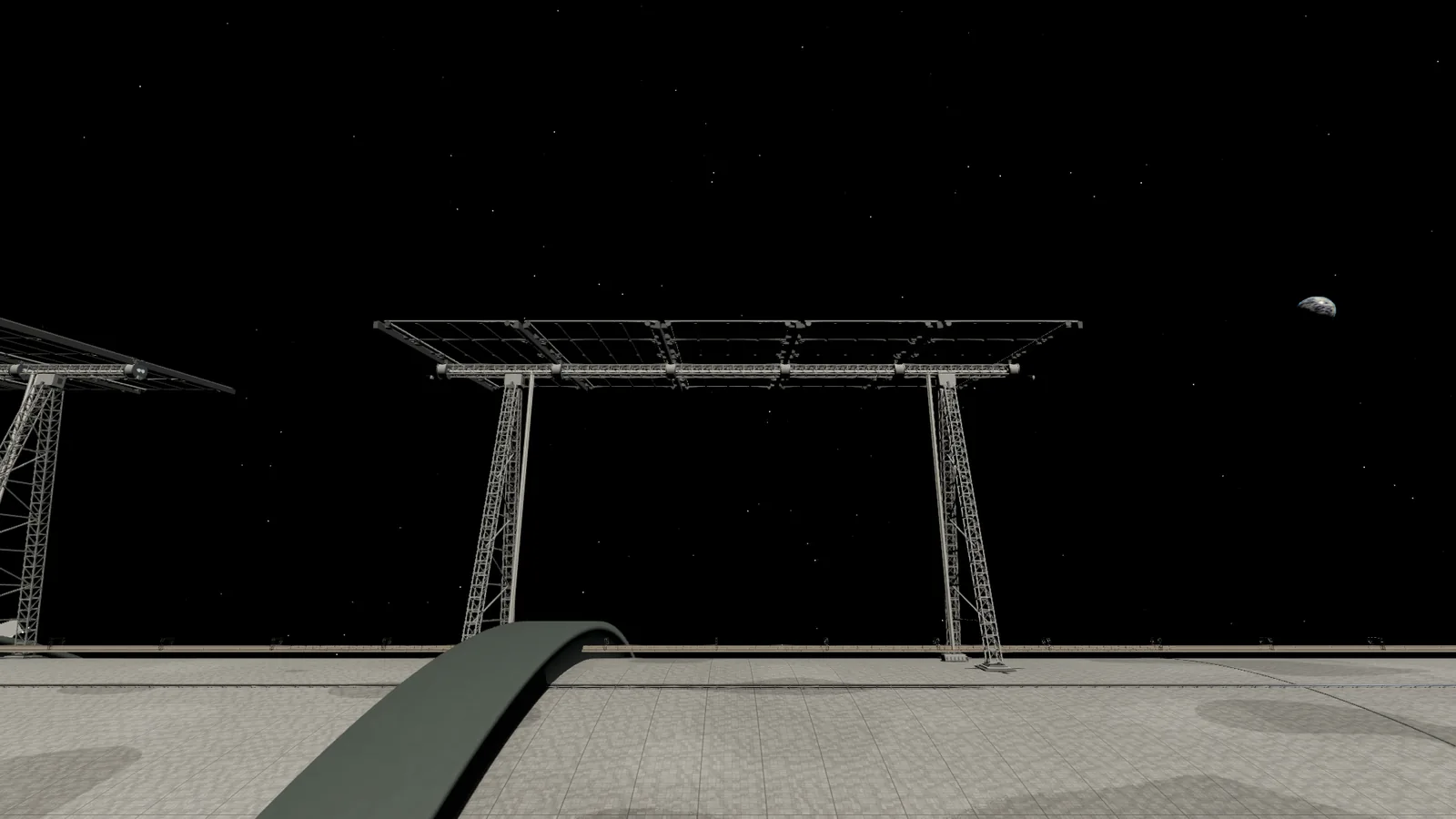
- Energy and computation. Fields of solar platforms with computers behind them, built from local material, draw about 200 GW: eight to ten times the city's own 20 to 25 GW. Earth sends the chips; Concordia makes everything heavy around them: panels, structure, shielding and radiators. Heat is the real limit: in vacuum a computer sheds heat only by glowing it away through a radiator. Design value
- The next build. The yards' biggest customer is whatever gets built next: more platforms, more radiators, more ships, and in time another station.
- Land. The builder owns the ground and floor space it creates and leases it, a version of land value capture: the way some cities pay for a railway by owning the land around its stations.
- Ships and propellant. The shipyard and the tank farm serve traffic across cislunar space and beyond (why space).
Watts leave as bits. Beaming power to Earth needs a receiving field kilometres across and loses energy at both ends. Running the computation here and sending the answers down a laser moves the value of the energy almost for free. NASA's lunar laser test sent 622 megabits per second from lunar orbit in 2013, and its TBIRD cubesat reached 200 gigabits per second from low orbit in 2022. Established physics Training, rendering and long simulations do not mind a few seconds of delay.
Open in the simulation: See the solar platforms Open in the simulation: Radiator Field
Why L5
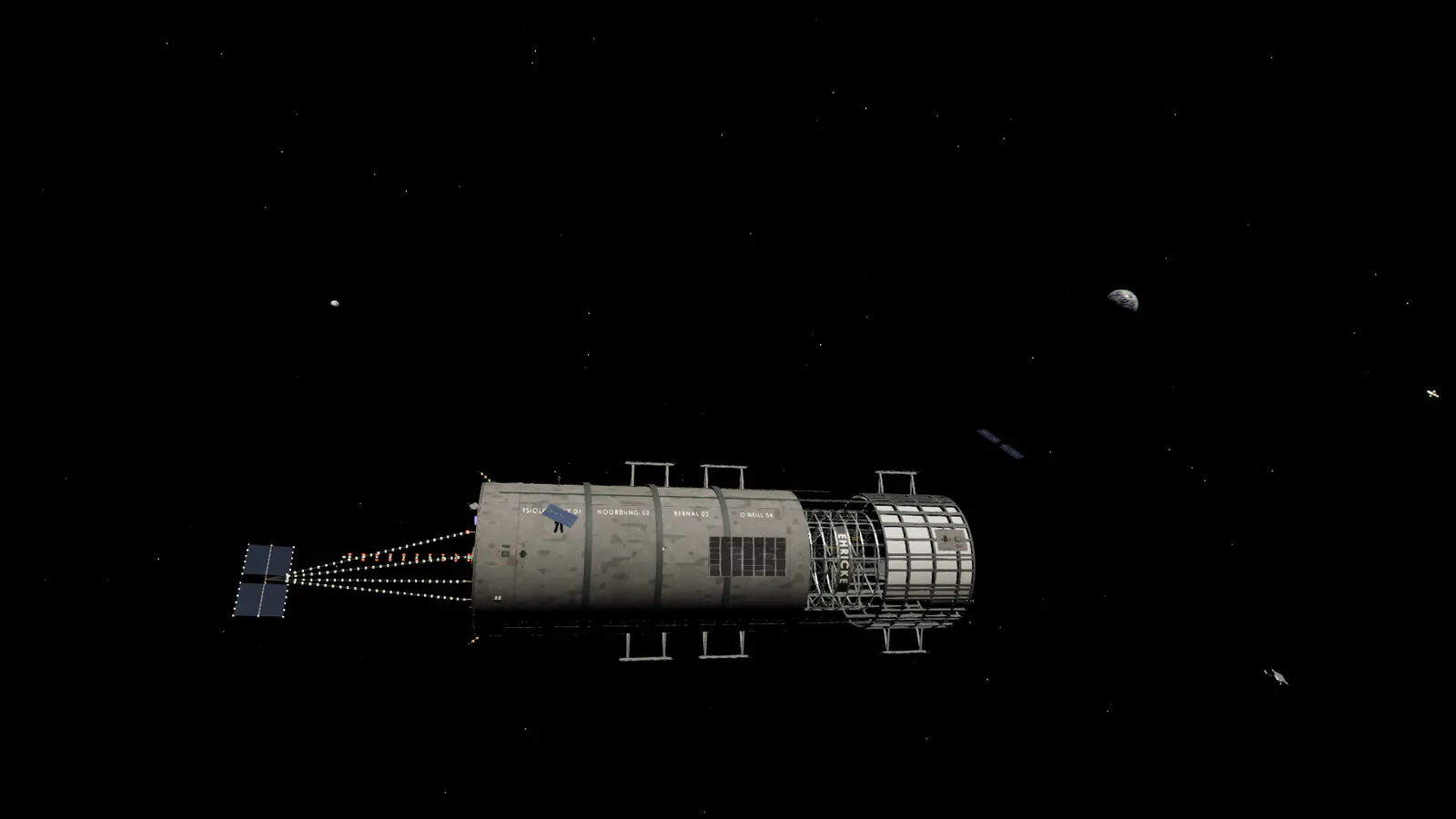
Each orbit near Earth is best for something. Only one suits a city that keeps growing.
| Orbit | Good for | Why not the city |
|---|---|---|
| Earth-Moon L5 region | Room for a station, power fields, depots, parked asteroids and the next build; a short haul from the Moon | 1.28 seconds to Earth, a 15-day trip home |
| Near the Moon | A single yard close to lunar material | Little room for a cluster of objects kilometres across |
| Geostationary | A quarter-second round trip to Earth | Deeper in Earth's gravity for lunar material, crowded and regulated |
| Low Earth orbit | The shortest delay for computing | Drag, debris, no material, and two billion tonnes over people's heads |
The cost is delay: 2.56 seconds for a round trip, so a live call to Earth feels like a bad satellite phone.
Who lives here
Industry needs hundreds of people, not a million. The fabrication lines, mines and yards run themselves, and robots maintain them. So the 400,000 people who live here today did not come for factory jobs. Story
They are owners, the people who direct fleets of AI systems for them, their families, and people who moved for the life. Every resident also holds a share: part of the energy revenue is paid to each of them as a dividend, the way Alaska shares its oil money. Story Two rotors carry the money: Noordung (Rotor 2) is the capital quarter, with the Exchange, Charter Hall and the Court, and O'Neill (Rotor 4) holds the estates. On a habitat the scarcest luxury is open ground under the sky, so the richest districts are lakeside streets with large plots, while the megaframe carries density overhead.
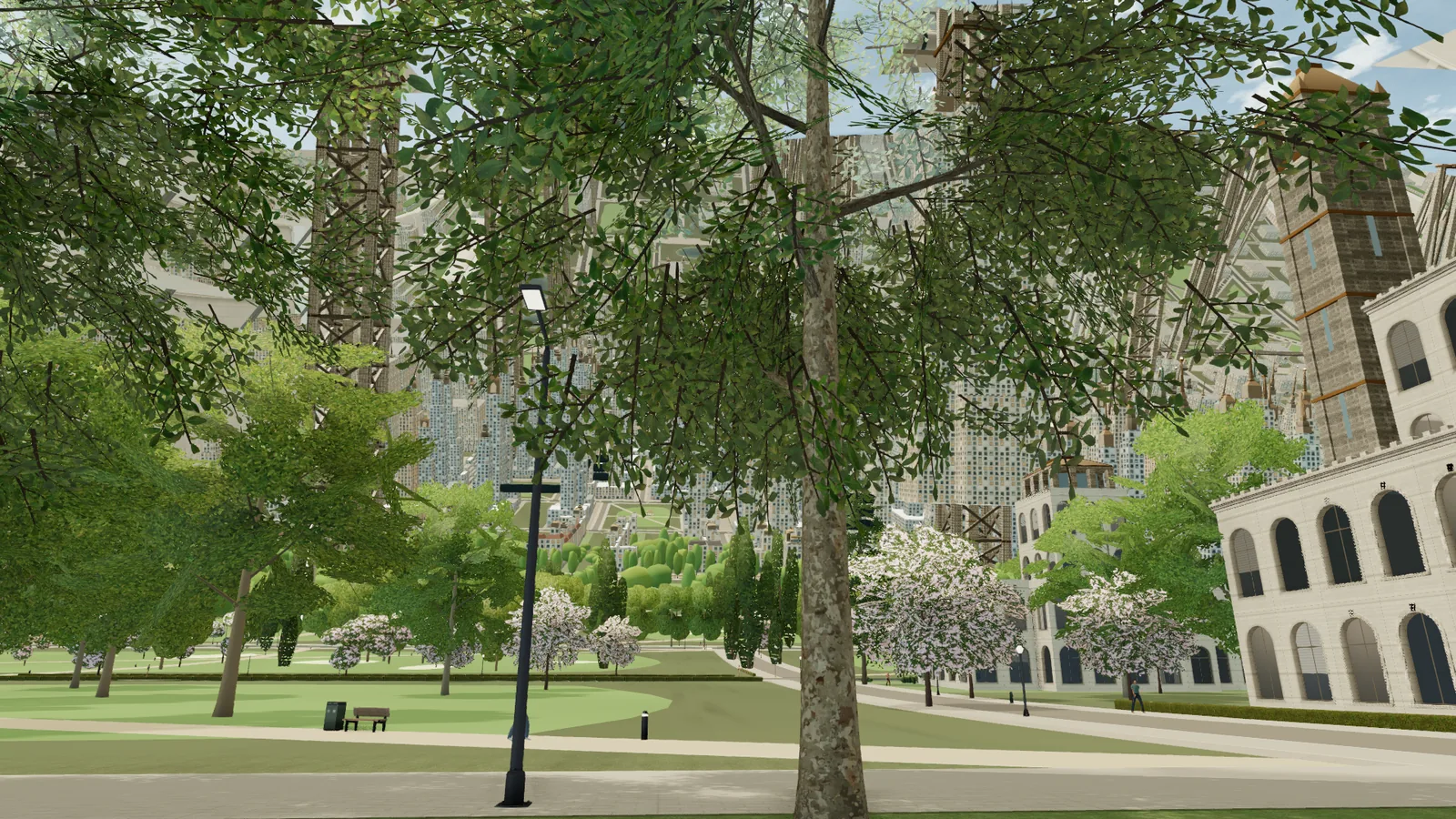
Open in the simulation: District Skyline
Charter and law
The 1967 Outer Space Treaty makes each state answer for its nationals' activities in space, including private ones, which need "authorization and continuing supervision". Established physics Concordia is chartered in Bermuda, a British territory with a long-established ship registry. Story Britain's 1986 Outer Space Act was extended to Bermuda in 2006, with its Governor granting the licences, so under the treaty the United Kingdom answers for anything Bermuda licenses. Established physics Inside, markets run on top of a strict physical constitution, because air, pressure, fire and spin are risks everyone shares. The systems that keep the air and the spin are run by their own control machines, separate from everything else and answerable to a residents' authority, not the developer, with manual valves and breakers people can still turn by hand (safety).
Go deeper: The arithmetic
Construction rate, from the canon schedule (material from the mid 2030s, fourth rotor at full spin in 2044):
2.05 × 10^12 kg / 10 years ≈ 2 × 10^11 kg a year
≈ 560,000 t a day
2.05 × 10^9 t / 1.88 × 10^9 t ≈ 1.1 years
of world crude steel (2024)
Doublings from a 1,000 t seed:
2.05 × 10^12 kg / 10^6 kg ≈ 2^21
10 years / 21 ≈ 5.7 months a doubling
(4.6 months over 8 years)
Energy, assuming 30 MJ per kg:
30 MJ = 8.3 kWh ≈ $0.08 at $0.01/kWh
2.05 × 10^12 kg × 3 × 10^7 J/kg
/ 3.16 × 10^8 s ≈ 195 GW for ten years
Compute field at 200 GW, at the station's 340 W/m² delivered:
2 × 10^11 W / 340 W/m² ≈ 588 km²
588 km² / 4.2 km² ≈ 140 platforms
Radiator at 330 K, ε 0.9, two faces:
2 × 0.9 × σ × 330^4 ≈ 1.21 kW/m²
1.43 GW / 1.21 kW/m² ≈ 1.2 km² a platform
Sources and further reading
- worldsteel, "December 2024 crude steel production and 2024 global crude steel production totals", 2025 (1,882.6 million tonnes in 2024): worldsteel.org.
- NASA, Lunar Laser Communications Demonstration (up to 622 Mbps from lunar orbit, 2013): nasa.gov.
- MIT Lincoln Laboratory and NASA, "Operations and Results from the 200 Gbps TBIRD Laser Communication Mission", 2023: ntrs.nasa.gov.
- Treaty on Principles Governing the Activities of States in the Exploration and Use of Outer Space, 1967, Article VI (NASA history copy): nasa.gov.
- The Outer Space Act 1986 (Bermuda) Order 2006, S.I. 2006/2959: legislation.gov.uk.
- Alaska Department of Revenue, Permanent Fund Dividend Division: pfd.alaska.gov.
- Gerard K. O'Neill, "The Colonization of Space", Physics Today 27(9), September 1974: physicstoday.aip.org.