Power from the Sun
Sunlight at Earth's distance delivers 1,360.8 watts to every square metre facing it. That number, the solar constant, comes from Kopp and Lean's 2011 reassessment of satellite measurements. In cislunar space there are no clouds and no weather, and the intensity barely changes. Established physics
Concordia uses about 20 to 25 GW on average, and its power system is sized toward 40 GW continuous. Solar cells deliver about 340 W per square metre of platform, a quarter of the light that lands on them. To make 40 GW takes about 118 km² of array, which is about 28 platforms of 4.2 km² each. The full build-out is 100 to 150 km² of photovoltaics. Design value
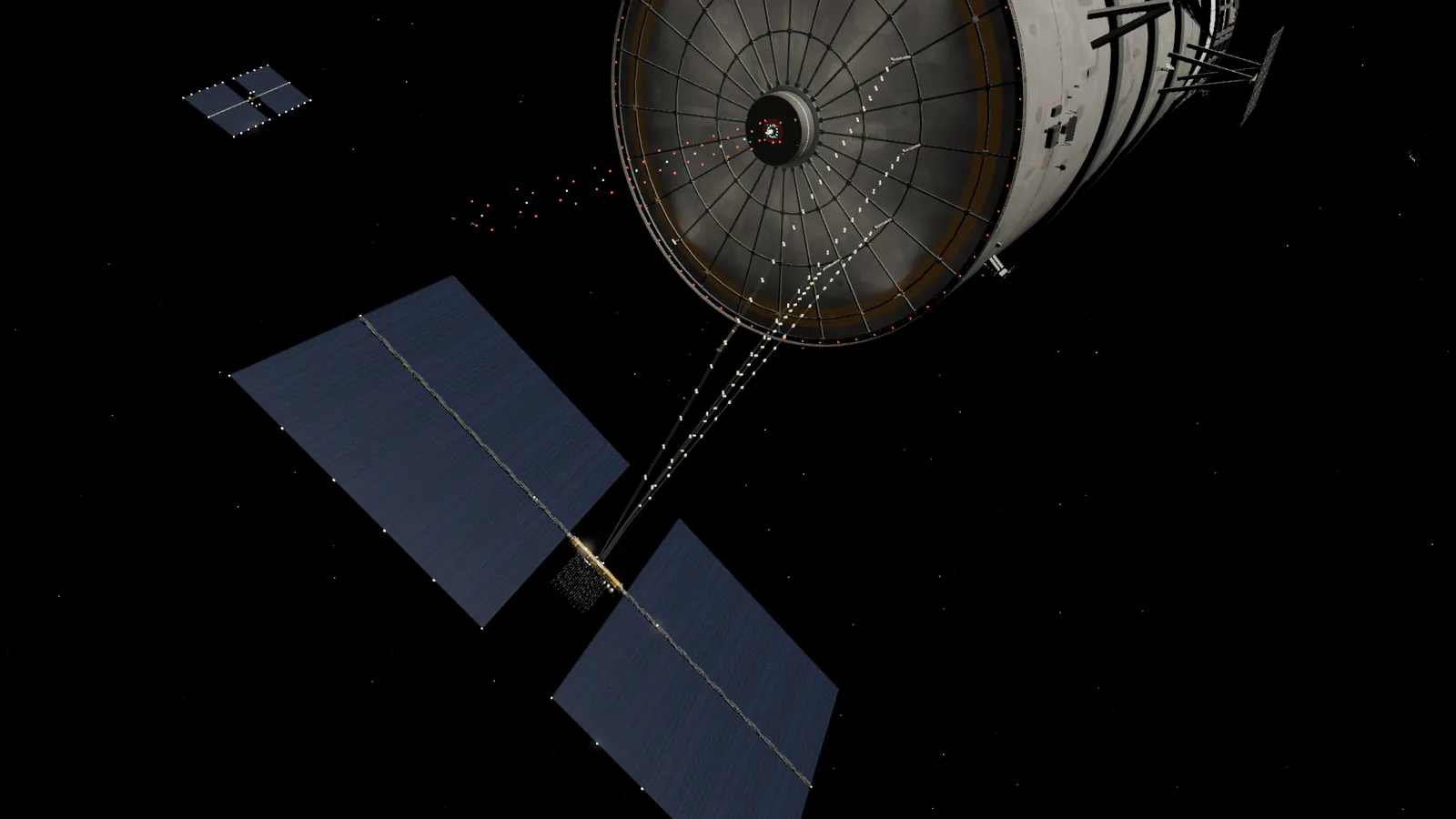
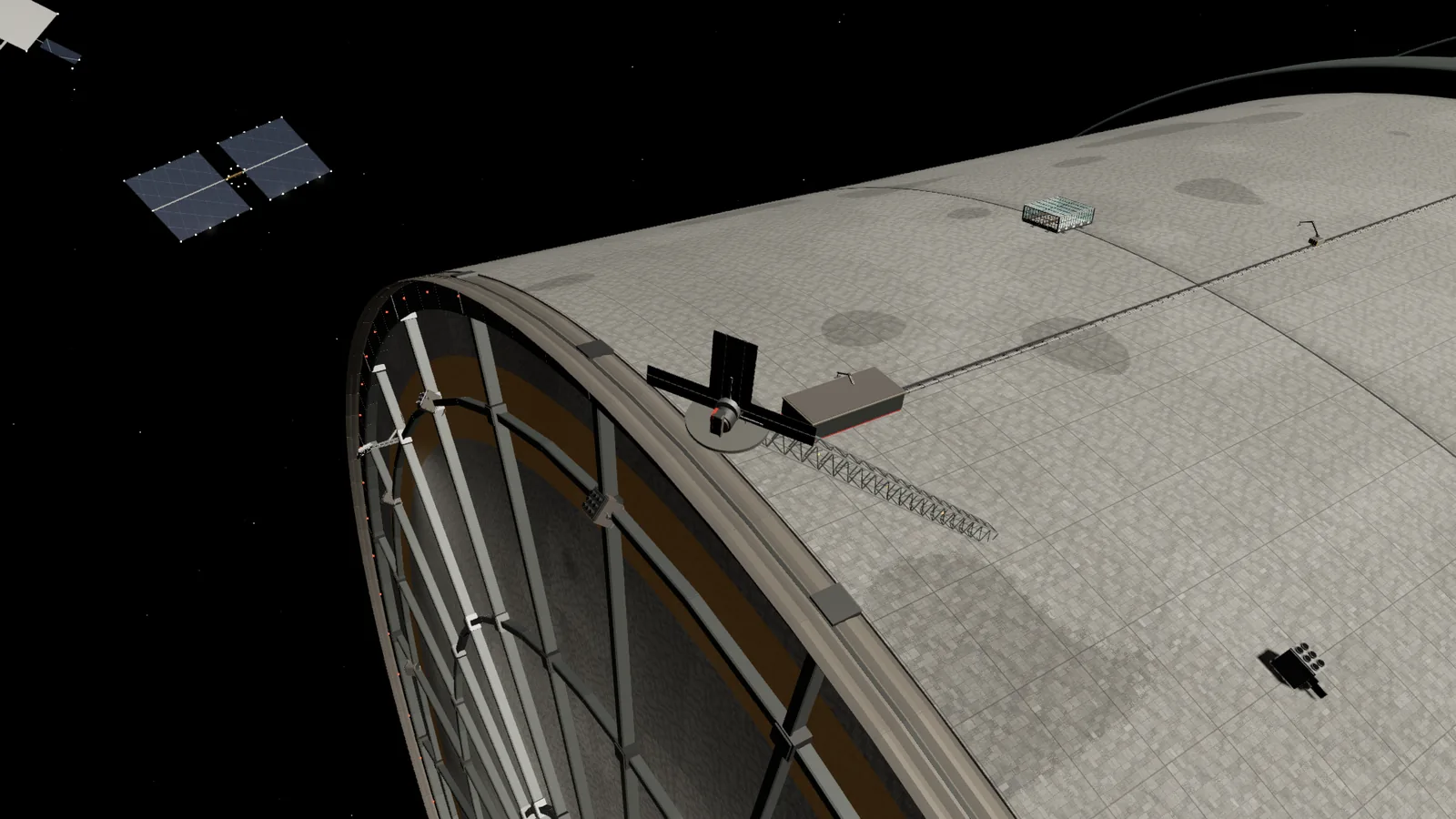
The platforms do not sit on the station. They track the Sun on their own structures, kept at a safe separation, and the farm hub sits about 7 km behind the aft end. The hull carries one small backup collector and nothing more.
HVDC to the aft end
Power arrives at the aft end on four landing masts, each 500 m tall, standing 1,900 m from the axis. Eight tethers carry it from the farm hub. The line is high-voltage direct current: four bipoles at plus and minus 1.2 MV, each conductor carrying 4.2 kA. At that voltage the line loses about 0.02 percent of the power in resistance. Design value
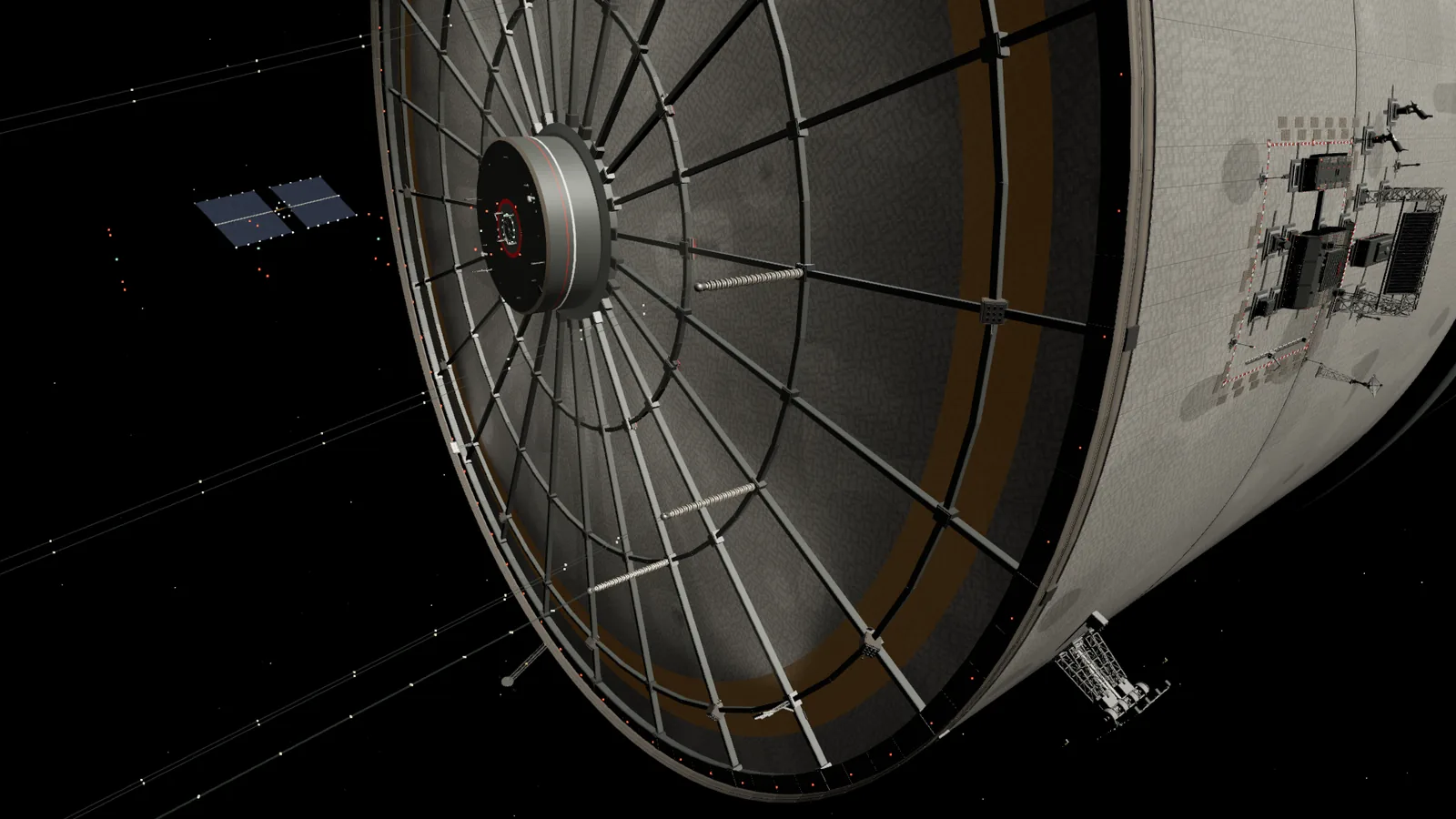
Behind the masts the spine holds the converter hall, rows of valve halls, breaker bays and capacitor banks that turn the line into the station's own grids.
Starting from nothing
If the solar link ever fails, the station needs a way to restart without it. Fission is the conservative baseline for this black start. Two reactors stand on masts at the aft rim, 250 MWe each, behind shadow shields. Each makes about 700 MW of heat and rejects 470 MW of it through radiator petals held edge-on to the Sun. They are the lifeboat for the power system, not its main supply. Engineering challenge
Where all the power goes
Almost every watt the station uses becomes waste heat: lights, motors, computers, kettles, and the body heat of 400,000 people. A station that uses 40 GW must reject about 40 GW. In vacuum, the only way to do it is to glow. A hot surface sheds energy as infrared light, and a radiator is a large flat panel made to do exactly that.
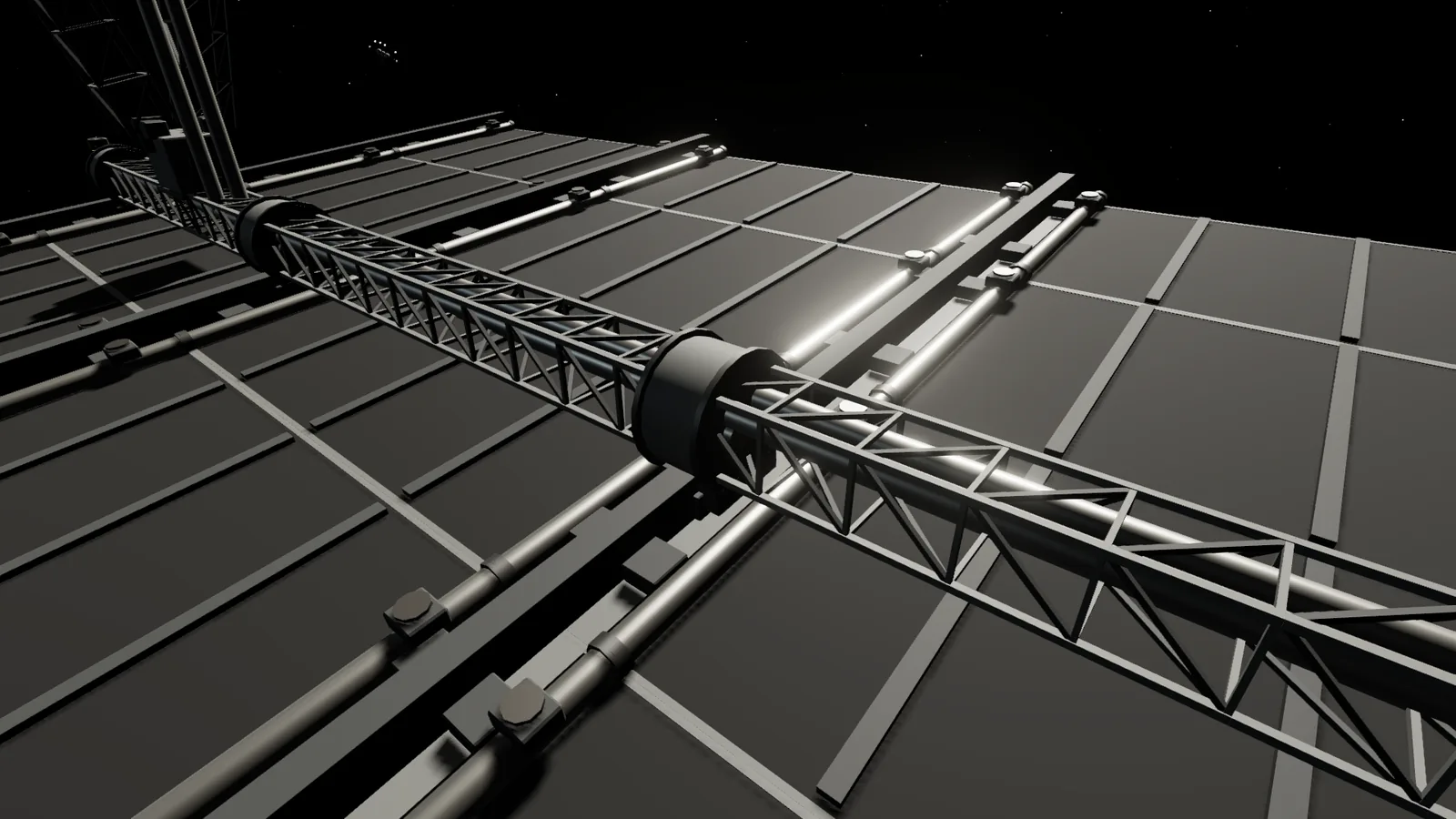
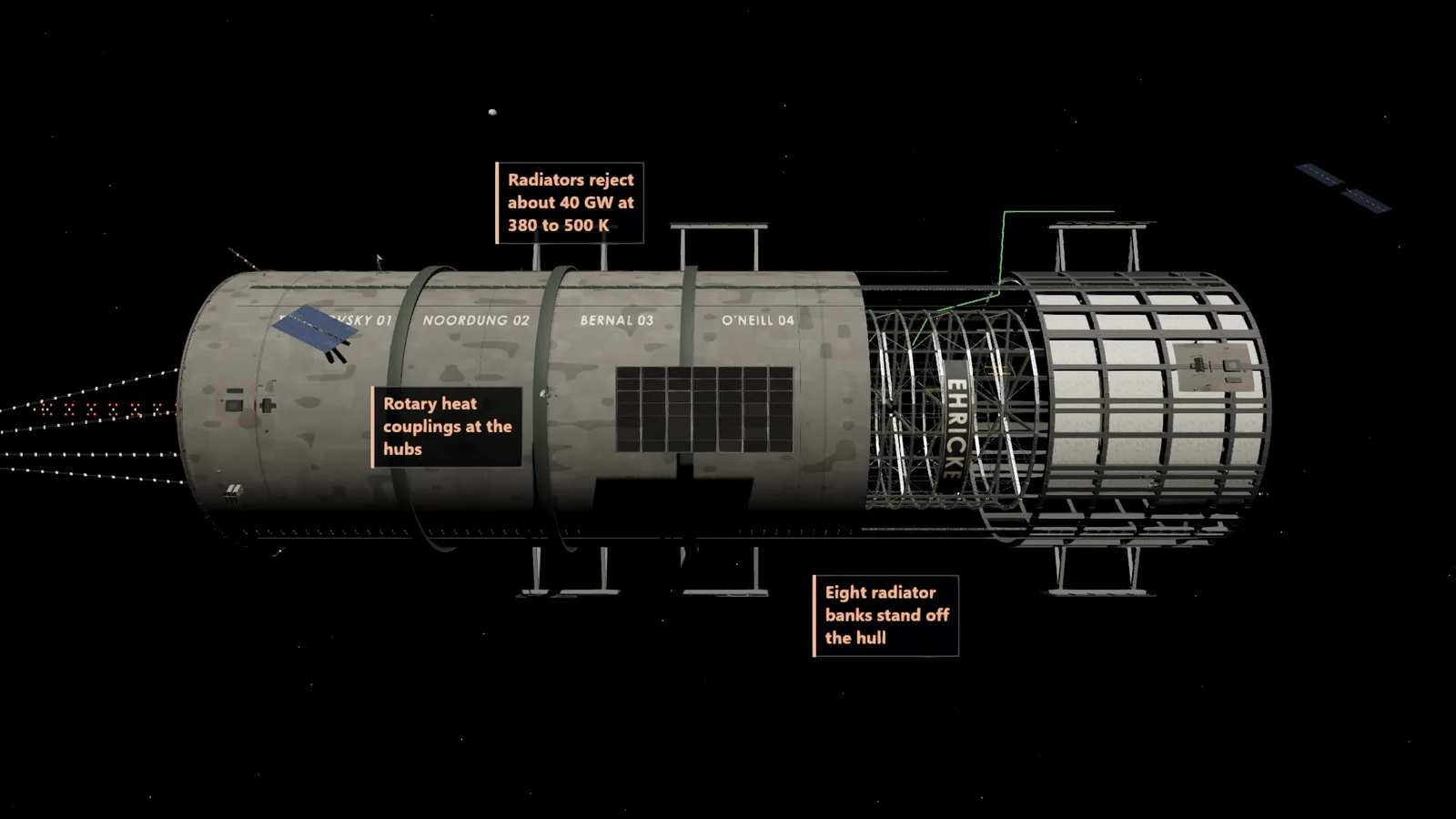
The Stefan-Boltzmann law sets the price. Emitted power per square metre rises with the fourth power of temperature, so a hotter radiator needs far less area. At 450 K, typical for the station's banks, one face sheds about 2.1 kW per square metre. For 40 GW that is about 19 km² of panel. Established physics The station carries eight banks, 248 panel modules of 400 by 200 m, close to that figure. Design value
Radiators run at 380 to 500 K. Heat from homes and farms is low-grade, so heat pumps lift it to a higher temperature before it is rejected, which shrinks the field. The panels turn slowly to keep their edges toward the Sun.
Open in the simulation: Radiator bank, thermal overlay Open in the simulation: Power Platform: Flagship Open in the simulation: Power landing, electrical overlay
Heat out of a spinning city
The hard part is the hand-off. Heat is collected inside rotors that turn once every 100 seconds, and the radiators are stationary. Each rotor gathers its heat locally and passes it through large, redundant rotary fluid joints at its axial hubs into stationary loops. These couplings are the one piece of the thermal system that still counts as a technology-development program. Engineering challenge
Try it
Go deeper: Worked example: 40 GW at 450 K Established physics
The power a surface radiates is
P = ε × σ × A × T⁴
with σ = 5.670374 × 10⁻⁸ W m⁻² K⁻⁴ (the CODATA value), ε the emissivity (0.9 for a good radiator coating) and A the area of one face.
At 450 K: T⁴ = 4.10 × 10¹⁰ K⁴, so a perfect emitter gives σT⁴ = 2,325 W/m². With ε = 0.9 that is 2,093 W/m², or about 2.1 kW/m². The cold sky behind the panel sends back a few millionths of a watt per square metre, which can be ignored.
Area for 40 GW: A = 4 × 10¹⁰ ÷ 2,093 = 1.91 × 10⁷ m², or 19 km².
Raising the temperature by 10 percent raises the emission by 1.1⁴ = 1.46 times, which is why low-grade heat is lifted by heat pumps before it is rejected.
| Temperature | Emitted (ε = 0.9) | Area for 40 GW |
|---|---|---|
| 380 K | 1.06 kW/m² | 38 km² |
| 450 K | 2.09 kW/m² | 19 km² |
| 500 K | 3.19 kW/m² | 12.5 km² |
Solar side: 40 GW ÷ 340 W/m² = 1.18 × 10⁸ m² = 118 km². HVDC side: each bipole carries 2.4 MV × 4.2 kA = 10.1 GW, so four carry 40 GW. Black start: 470 MW rejected at 700 K needs 470 MW ÷ (0.9 × σ × 700⁴) = about 38,000 m² of one-sided panel, and the reactor petals have two faces, so about 19,000 m².
Sources and further reading
Real-world sources
- Greg Kopp and Judith L. Lean, "A new, lower value of total solar irradiance: Evidence and climate significance", Geophysical Research Letters 38, L01706 (2011): doi.org/10.1029/2010GL045777.
- NIST, "CODATA Value: Stefan-Boltzmann constant" (2022 values): physics.nist.gov.
Concordia design documents
- Concordia engineering specification, sections 33 to 37, and the exterior, satellite and aft-end design notes.