On foot and by metro
Walking in a rotor feels like walking on Earth, with one small difference. Because the floor turns, a step in the direction of spin makes you a little heavier and a step against it a little lighter. At a walking pace of 1.5 m/s the change is about 2 percent, which nobody notices (why the spin is so gentle). At train speeds it matters. Established physics
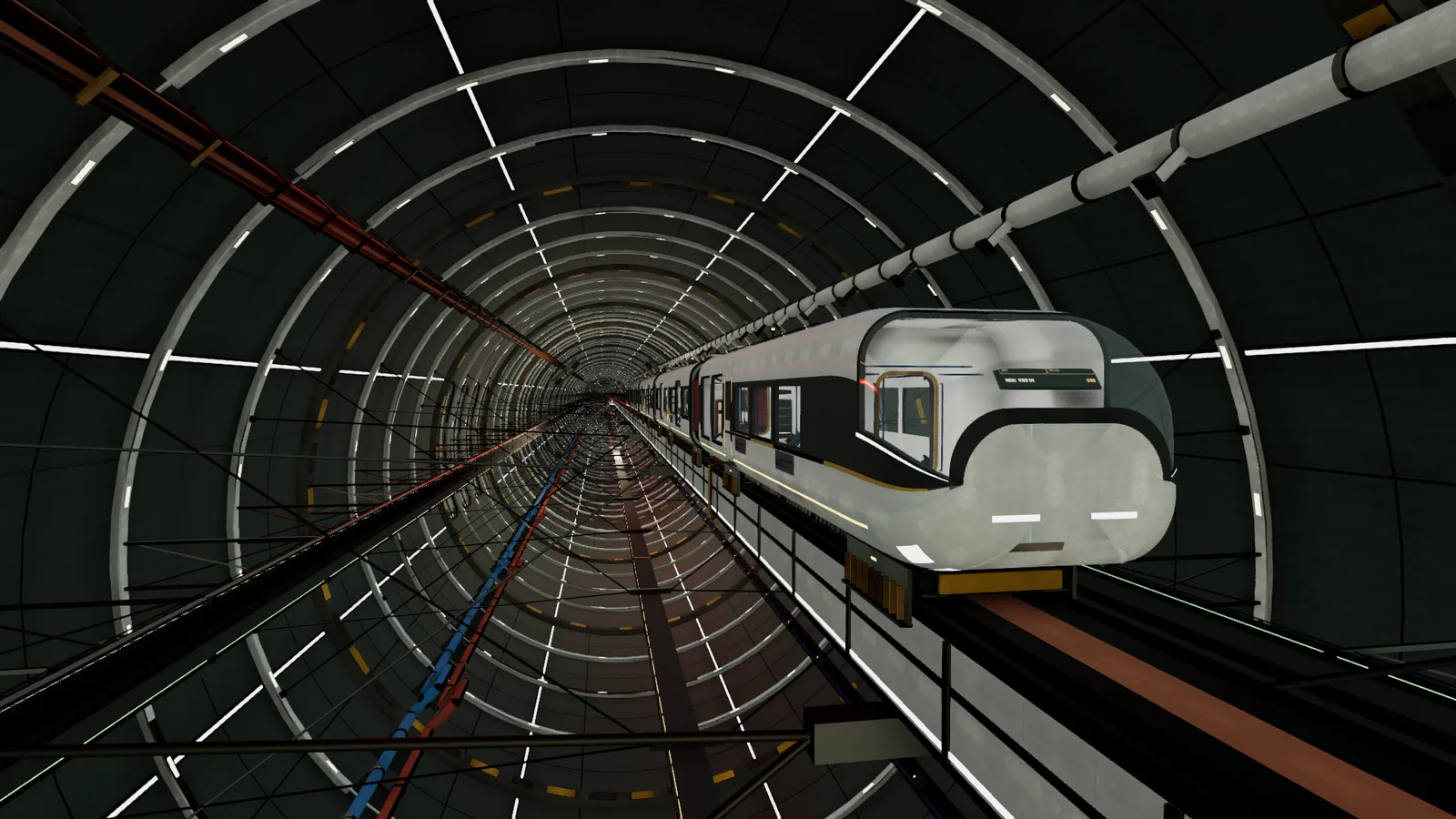
The metro runs on viaducts 45 m above the street, not underground. Its ring line circles the rotor at 2,455 m from the axis, where a standing rider weighs 0.98 g. Design value What you weigh is set by your speed through space, which is the speed of the floor plus or minus the train's own speed. The Coriolis effect is that difference.
Riding against the spin you are lighter, with the spin you are heavier. That is why the two directions run at different speeds: 100 km/h one way (a 13.4 minute lap) and 90 km/h the other (14.3 minutes). The axial lines run parallel to the spin axis, so they add no Coriolis effect and a rider weighs a steady 0.98 g. Which direction is "heavy" flips between Tsiolkovsky and Noordung (Rotors 1 and 2) and Bernal and O'Neill (Rotors 3 and 4), because those pairs spin opposite ways. Established physics
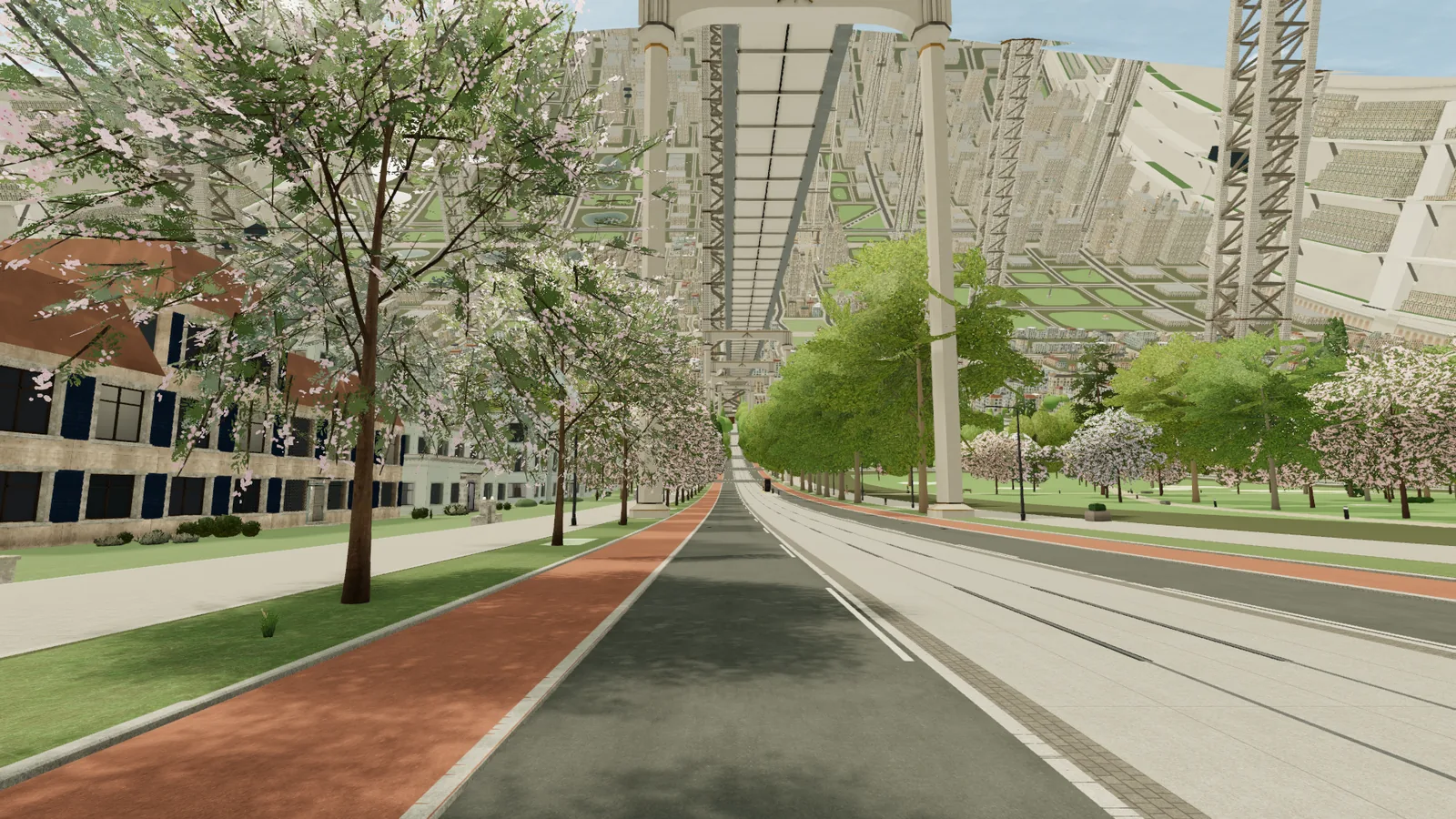
Open in the simulation: Metro Viaduct Over an Arterial Open in the simulation: Ride the metro
Ascenders: gravity as a height
Four ascender towers per rotor lift people from the ground to the axis. A cabin holds about 150 people, 64 seated and 86 standing, and the 2,380 m climb takes 595 seconds, cruising at 5.5 m/s. Design value Gravity falls steadily as you rise: 0.98 g at the boarding deck, about 0.8 g where the cabin passes through the sky, 0.60 g at 1,000 m and 0.40 g at 1,500 m. At the hub terminal it is 0.028 g. Established physics
Two more things change as you climb. The cabin turns with the rotor all the way, so its sideways speed falls from 153 m/s at the deck to 4.4 m/s at the hub, and the guide rails supply the push that makes it slow down. And because the cabin moves toward the axis, the Coriolis effect shoves everything inside sideways, so the apparent vertical leans. The cabin rolls to follow it: 4 degrees at 200 m, 6.7 degrees at 1,000 m, 15 degrees close to the axis, in the opposite sense in the two spin pairs. Established physics
Climbing stores 11.7 kJ in every kilogram, 630 MJ for a loaded 54 t cabin. The descending cabin on the next track returns it through regenerative motors, so the lift needs little net energy. The angular momentum a rising cabin hands to the rotor is 2.1 × 10¹⁰ N m s, under a millionth of the rotor's own, and counter-phased tracks take it back.
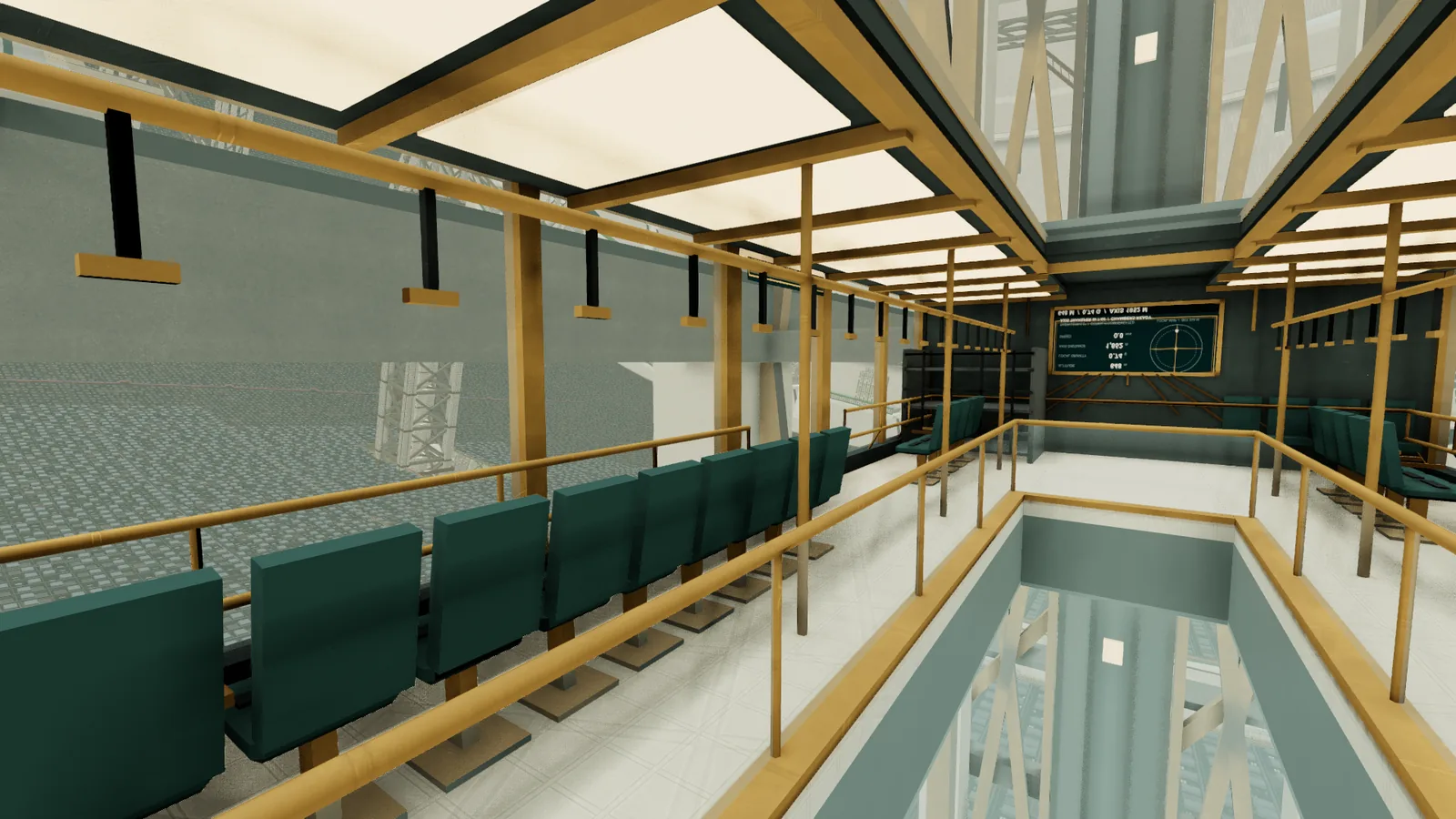
Open in the simulation: Ascender: Cabin Interior Open in the simulation: Ascender: Tower From Outside Open in the simulation: Ride up through the sky
The spin lock at the hub
At the top of the tower you are still turning with the rotor at a few percent of a gravity. The spine, the stationary tube down the middle of the station, is not turning. There is no direct doorway between a floor moving with the rotor and the still axis, so the hub has a spin lock.
Eight chambers, each 90 m long, sit on a magnetic-bearing carousel in the hub. A chamber closes behind you, spins down over 96 seconds at constant angular acceleration, stays under 0.0025 g the whole time, and latches to the spine. Spinning up takes another 96. A full cycle takes about 10 minutes. You step out weightless and stationary. Engineering challenge
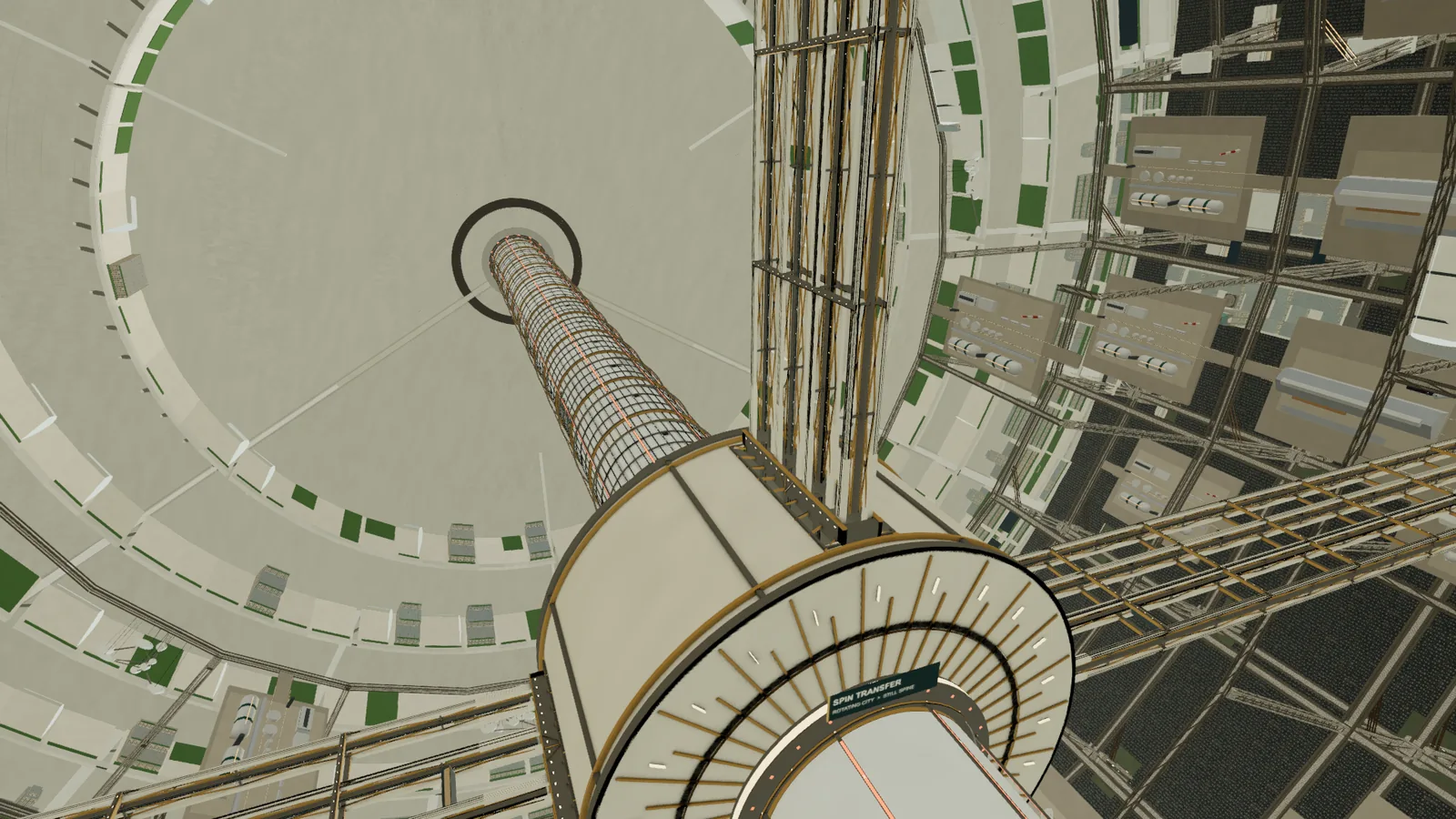
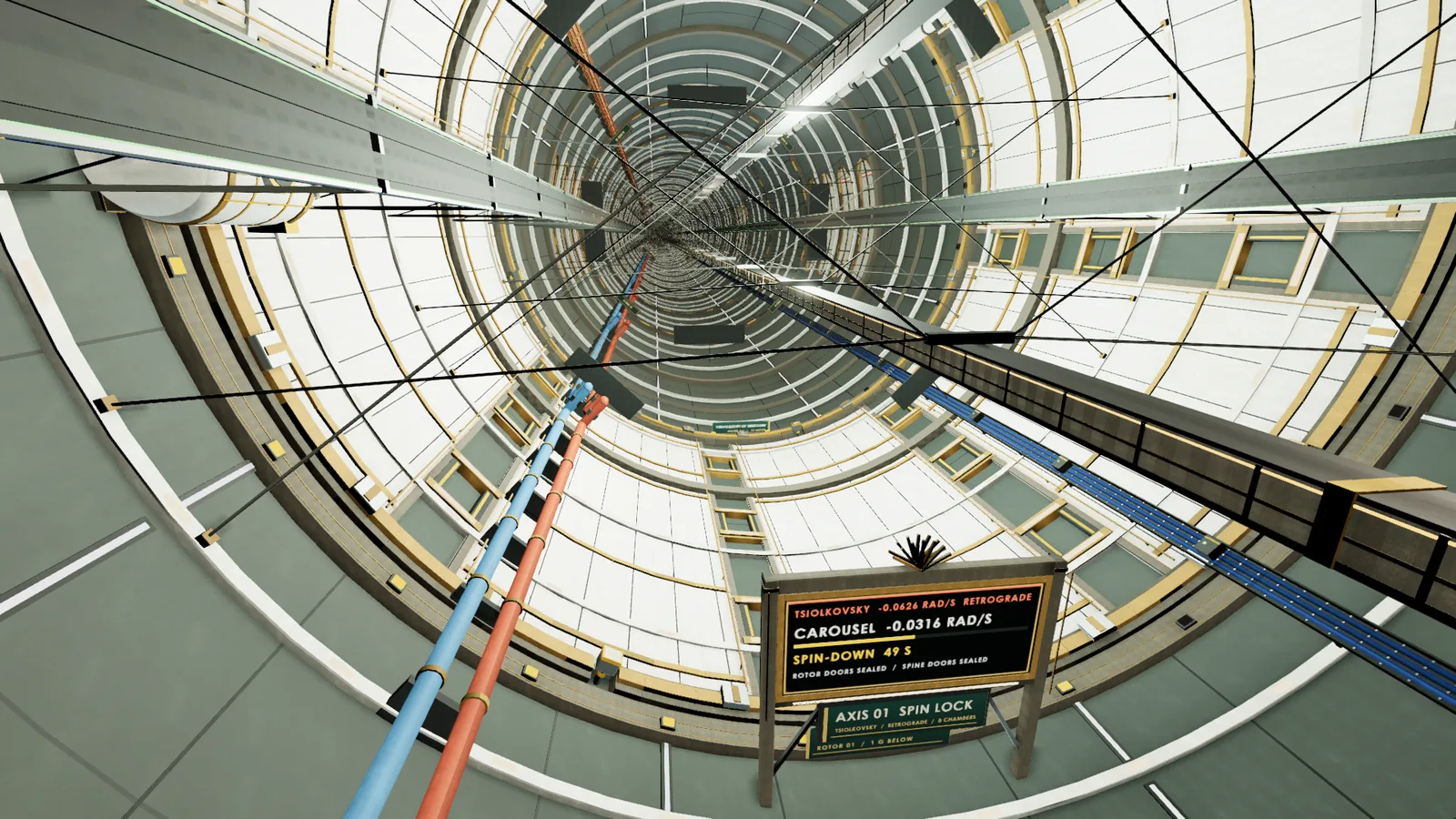
Open in the simulation: Spin-Decoupling Lock, Tsiolkovsky Open in the simulation: First weightlessness
The spine and the express
The spine is a stationary pressure tube about 120 m across, at 1 atmosphere, with no spin and no gravity. It carries power, data, heat transfer and the transport line between all rotors, Ehricke (the industrial rotor) and the spaceport. Its express runs five 25 m cars at 140 m/s, with restraint couches, handholds and panoramic windows. At cruise the spine's full length, almost 20 km, takes about two and a half minutes. Design value
Bridges, and why rotors 2 and 3 have none
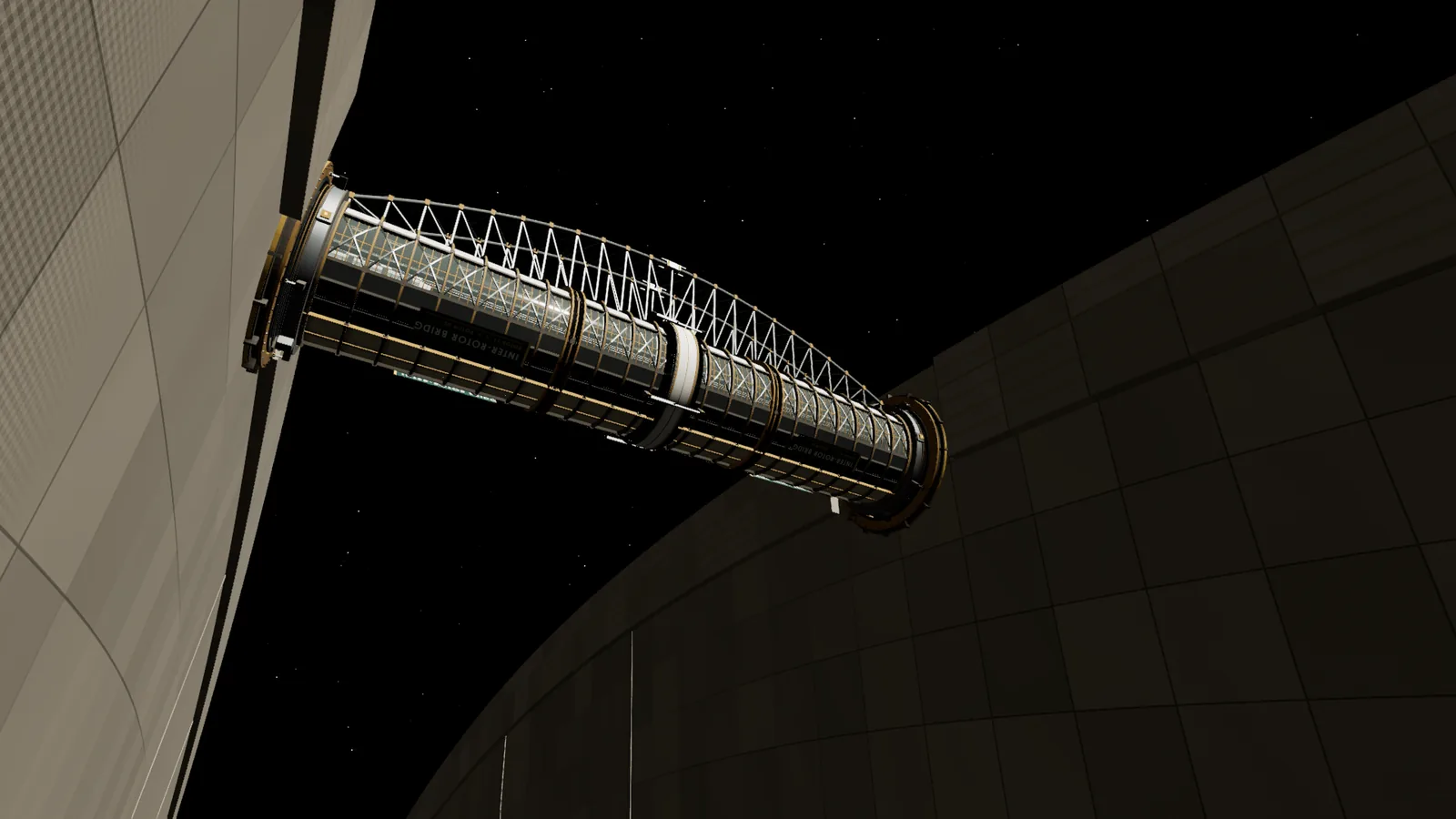
Two rotors that spin the same way hold still relative to each other, so a bridge can join them. Bridges join rotors 1 and 2, and 3 and 4: a through-truss tube 300 m long with its centre 45 m above the ground and 0.98 g on its floor, carrying a promenade and a transit lane. Before either rotor changes speed or phase, traffic stops, doors close and the bridge sections retract. Design value
Rotors 2 and 3 spin opposite ways, and their end walls pass each other at 313 m/s, so nothing can span the gap (counter-rotation explains why). To go from rotor 2 to rotor 3 you climb to the hub, spin down, cross by the spine and spin up on the other side.
Open in the simulation: Counter-Rotating Interface, Noordung and Bernal Open in the simulation: Transportation overlay
Go deeper: Worked example: the ring metro Established physics
The ring line is at r = 2,455 m with ω = 0.0626 rad/s, so the floor moves at ωr = 153.7 m/s. A rider standing feels
g_apparent = (ω × r ± v)² ÷ r
with + for travel with the spin and - for travel against it.
Against the spin at 100 km/h (27.8 m/s): (153.7 - 27.8)² ÷ 2,455 = 6.46 m/s², which is 0.66 g. With the spin at 90 km/h (25.0 m/s): (153.7 + 25.0)² ÷ 2,455 = 13.0 m/s², which is 1.33 g. Standing: 153.7² ÷ 2,455 = 9.62 m/s², which is 0.98 g.
The sideways Coriolis acceleration is 2ωv = 3.5 m/s² (0.36 g) at 100 km/h. For a walker at 1.5 m/s it is 0.19 m/s², 0.02 g.
Ascender energy: climbing from the deck at r = 2,450 m to the hub at r = 70 m raises the rotating-frame energy by ½ω²(2,450² - 70²) = 11.7 kJ/kg. Lean: the sideways acceleration 2ω × 5.5 m/s = 0.69 m/s² against local gravity of 5.9 m/s² at 1,000 m gives tan⁻¹(0.69 ÷ 5.9) = 6.7 degrees.
Sources and further reading
Concordia design documents
- Concordia engineering specification, sections 17 and 22 to 24, and the ascender, spine and metro design notes.