A cylinder 2.5 km in radius gives 1 g at the ground. How fast does it turn?
- Once every 10 seconds
- Once every 100 seconds
- Once every 15 minutes
Show the answer
Once every 100 seconds, 0.6 turns a minute. The ground then moves at 157 m/s, and you feel it as ordinary weight.
Want the numbers first? Jump to the calculators.
Weight from motion
Ride in a car through a sharp bend and you slide toward the door. Nothing pulled you sideways. The car turned, you tried to go straight, and the door pushed you back into the curve. That push is all weight is. On Earth the ground pushes up against gravity. In a rotor the floor pushes you around the circle, and the push feels the same.
Swing a bucket of water over your head and the water stays in. The bucket bottom is the "floor" and the water presses on it. A rotor is the same bucket with a city inside. Your apparent weight is the push of the floor, set by how fast the floor moves in its circle. Physicists call the sideways-turning acceleration centripetal acceleration, and it is the only gravity Concordia has.
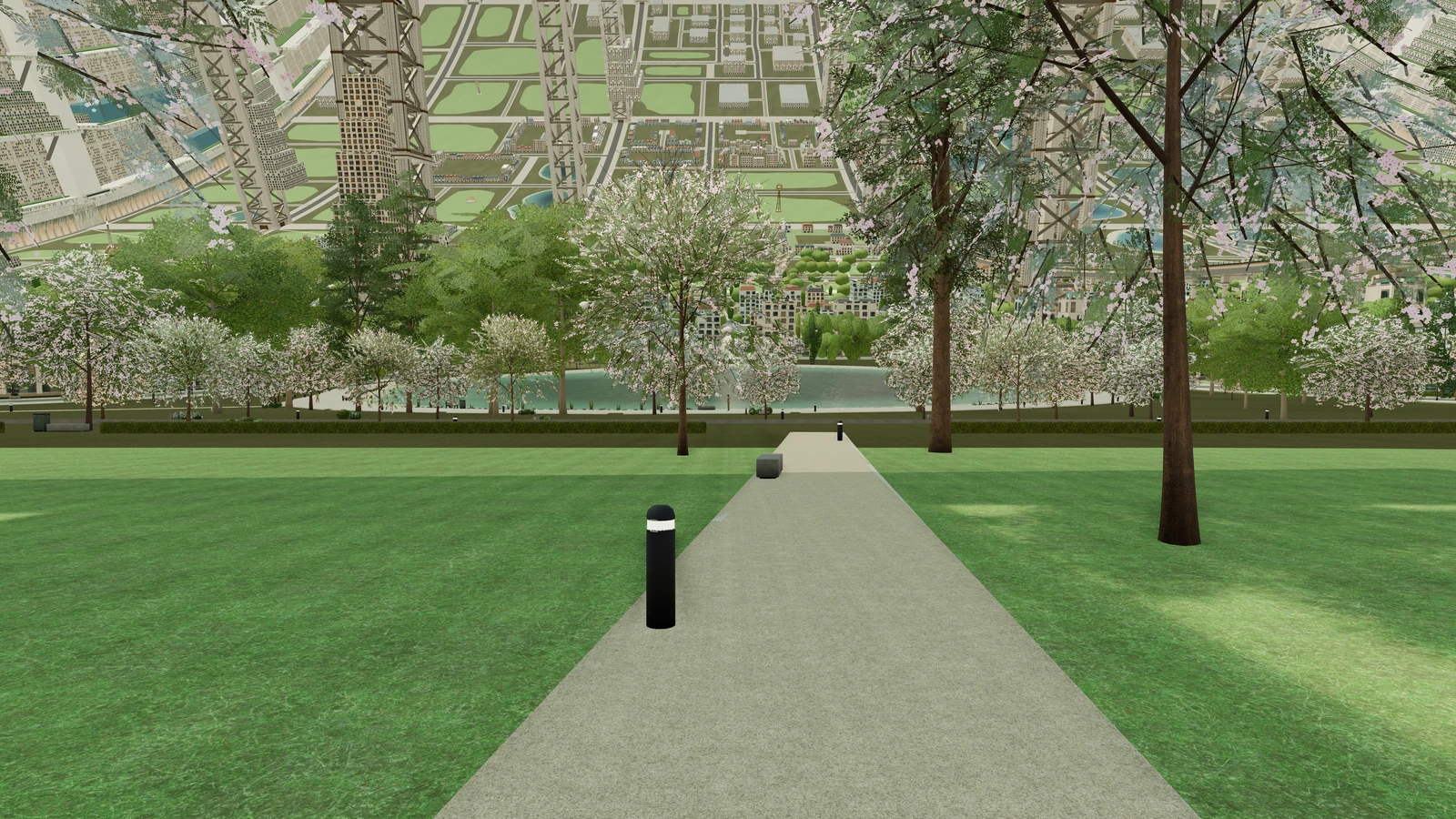
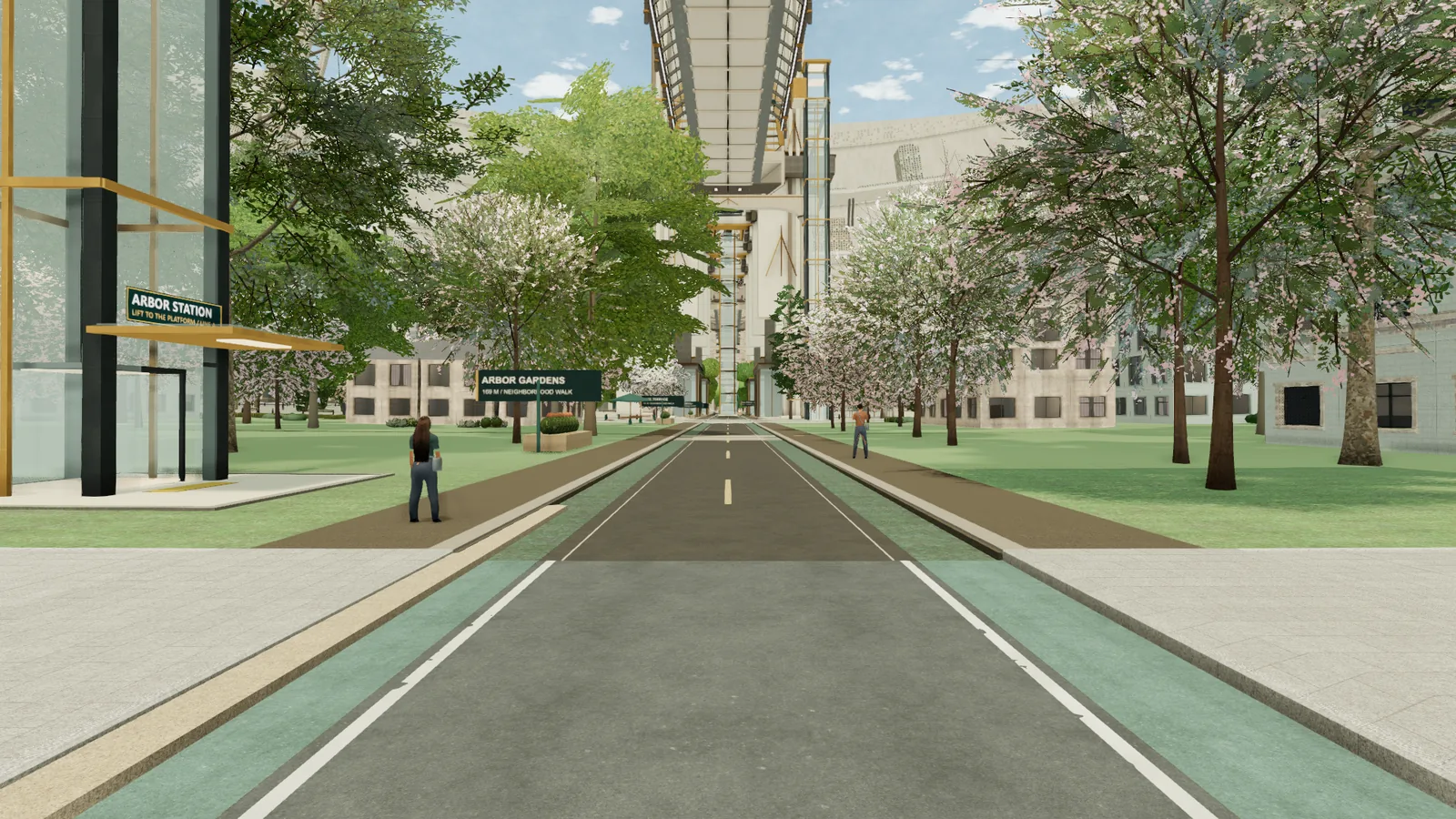
The ground moves at about 560 km/h. You never notice, because everything inside the rotor moves with it, air included. Seen from the axis, the whole city turns slowly around you. Seen from the street, the horizon curves up ahead of you: the ground climbs away along the ring until it meets a bright sky.
Why the rotor is so big
Spin faster and a smaller cylinder gives the same weight, so why not build small? Because people feel the spin when they move their heads. Turn your head in a fast rotor and the Coriolis effect twists the fluid in your inner ear. You get dizzy.
The 1975 NASA summer study, published as SP-413, set 1 turn per minute as the limit for living quarters. In 2017 Al Globus and Theodore Hall reviewed the experiments and recommended up to 2 turns per minute as no problem for residents and little adaptation for visitors, and up to 4 with some training or a few hours to a day for visitors. Established physics Concordia turns at 0.6 per minute, below all three limits, so the spin is expected to go unnoticed. Design value
The size has a second payoff. The gravity gradient across a standing adult, head to foot, is 7 parts in 10,000. Your head weighs almost exactly what your feet do. In a ring of 56 m radius turning 4 times a minute the difference is 3 percent, enough to feel. Established physics
Weight fades with height
Weight depends on how fast you go around, and that falls as you move toward the axis. It falls in a straight line. At the 450 m sky you weigh 82 percent of your ground weight. At 1,000 m, 60 percent. At 2,000 m, 20 percent. At the axis you float. Established physics
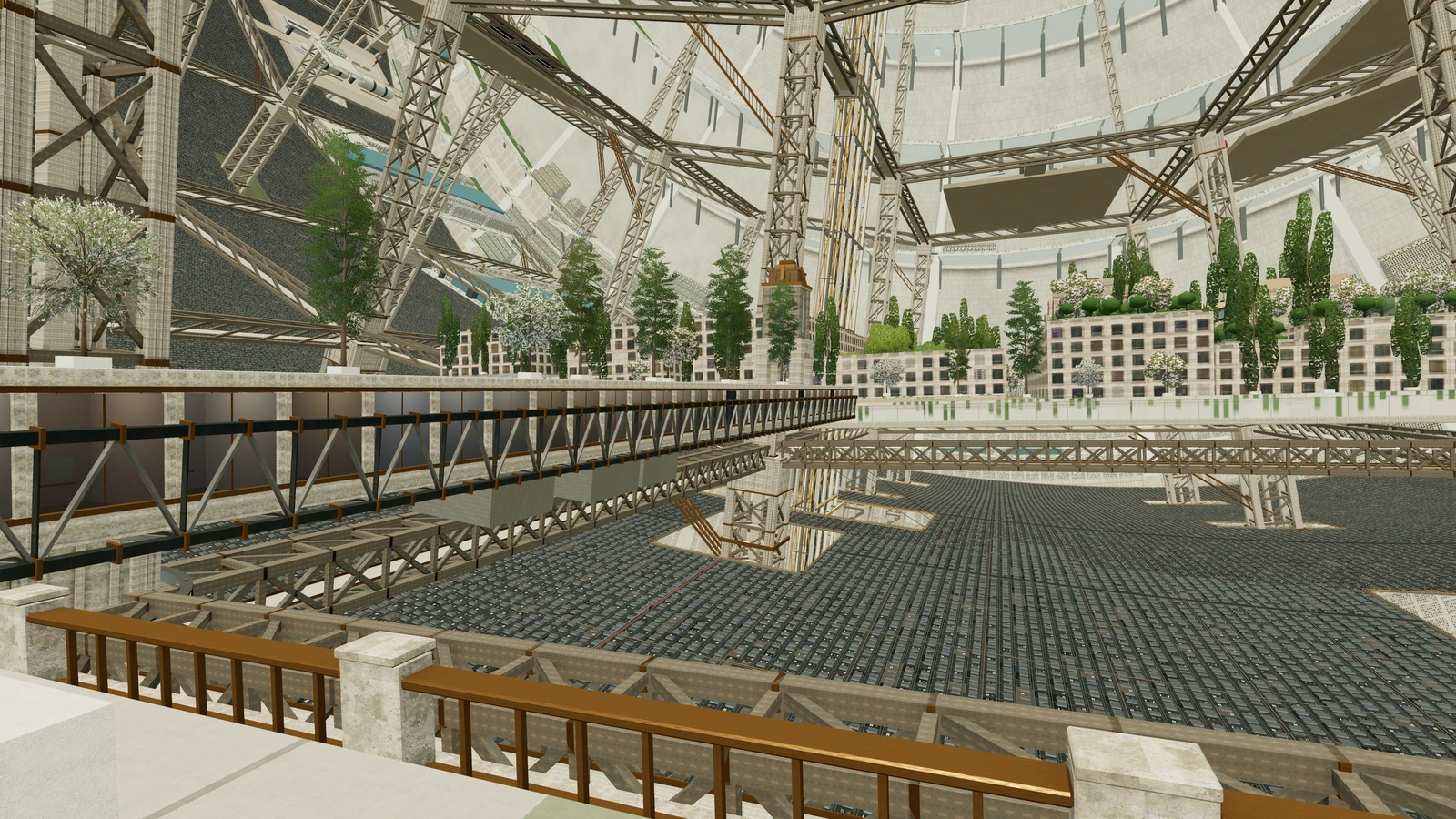
This line decides where things go. Houses, schools, parks and hospitals sit near the ground, where bones and balance work as they always have. Offices and low-gravity entertainment climb higher. Crop galleries and process halls sit at 1,000 m, in the upper fringe above the housing plates. The axis, with no weight at all, is where you transfer between rotors and the stationary spine. Design value
Open in the simulation: Gravity overlay Open in the simulation: Ascender: Artificial Sky Breakthrough Open in the simulation: The sky is machinery.
What it feels like
Mostly nothing. Gravity is steady, down is down, and stairs are stairs. The differences show up in small ways.
- Dropped things curve. Let go of a coin at head height and it lands about 5 cm to one side, against the direction of spin. The coin keeps its sideways speed while the floor swings away.
- Walking changes your weight a little. Walk in the direction of spin and you weigh about 2 percent more. Walk against it and you weigh about 2 percent less. On an 80 kg person that is about 1.4 kg, a bag of groceries.
- Fast travel changes it a lot. On the ring metro at 100 km/h against the spin you weigh 0.66 of normal. Going with the spin at 90 km/h you weigh 1.33. The axial lines run along the spin axis, where this effect vanishes, and weigh 0.98 g throughout.
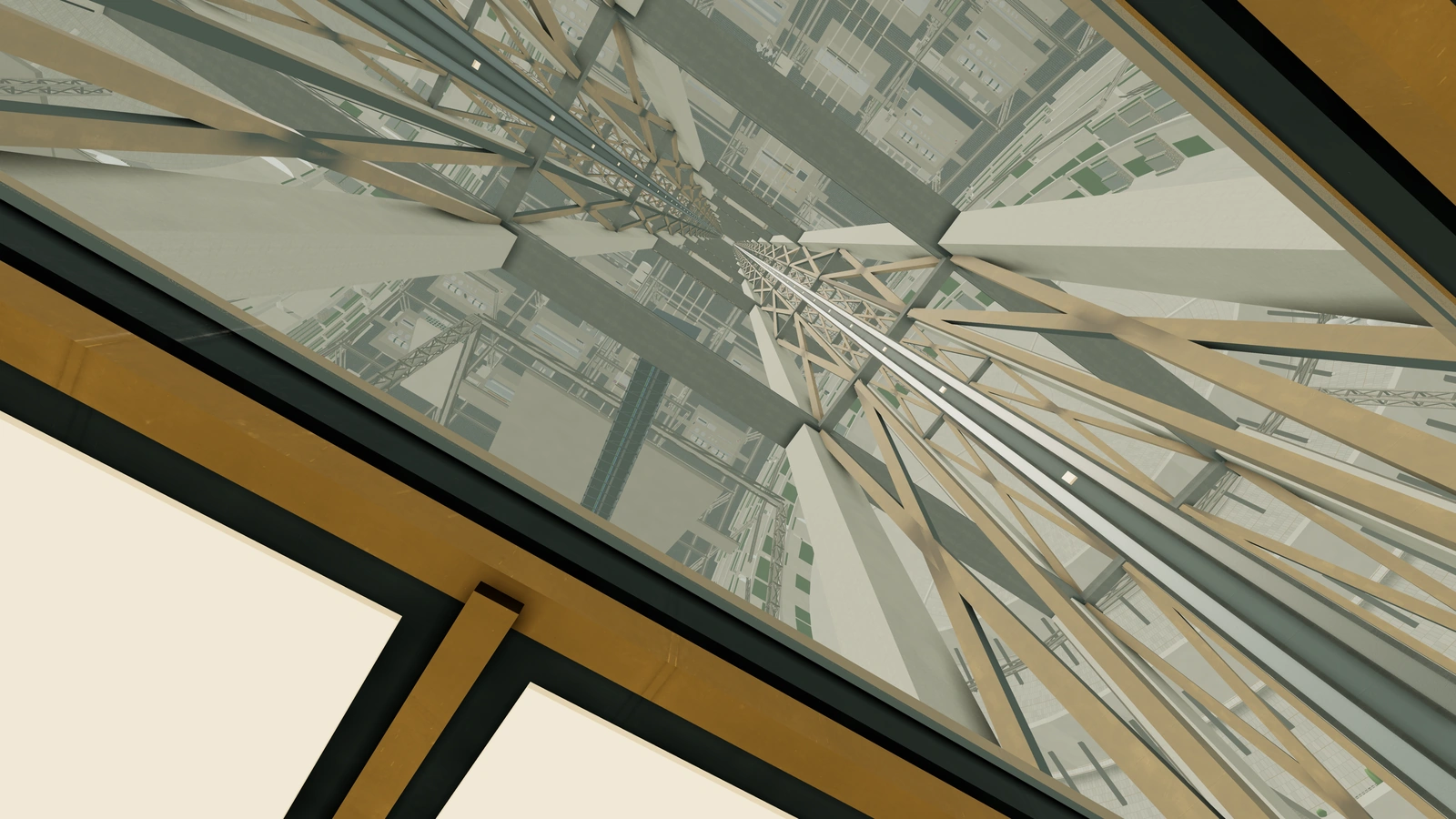
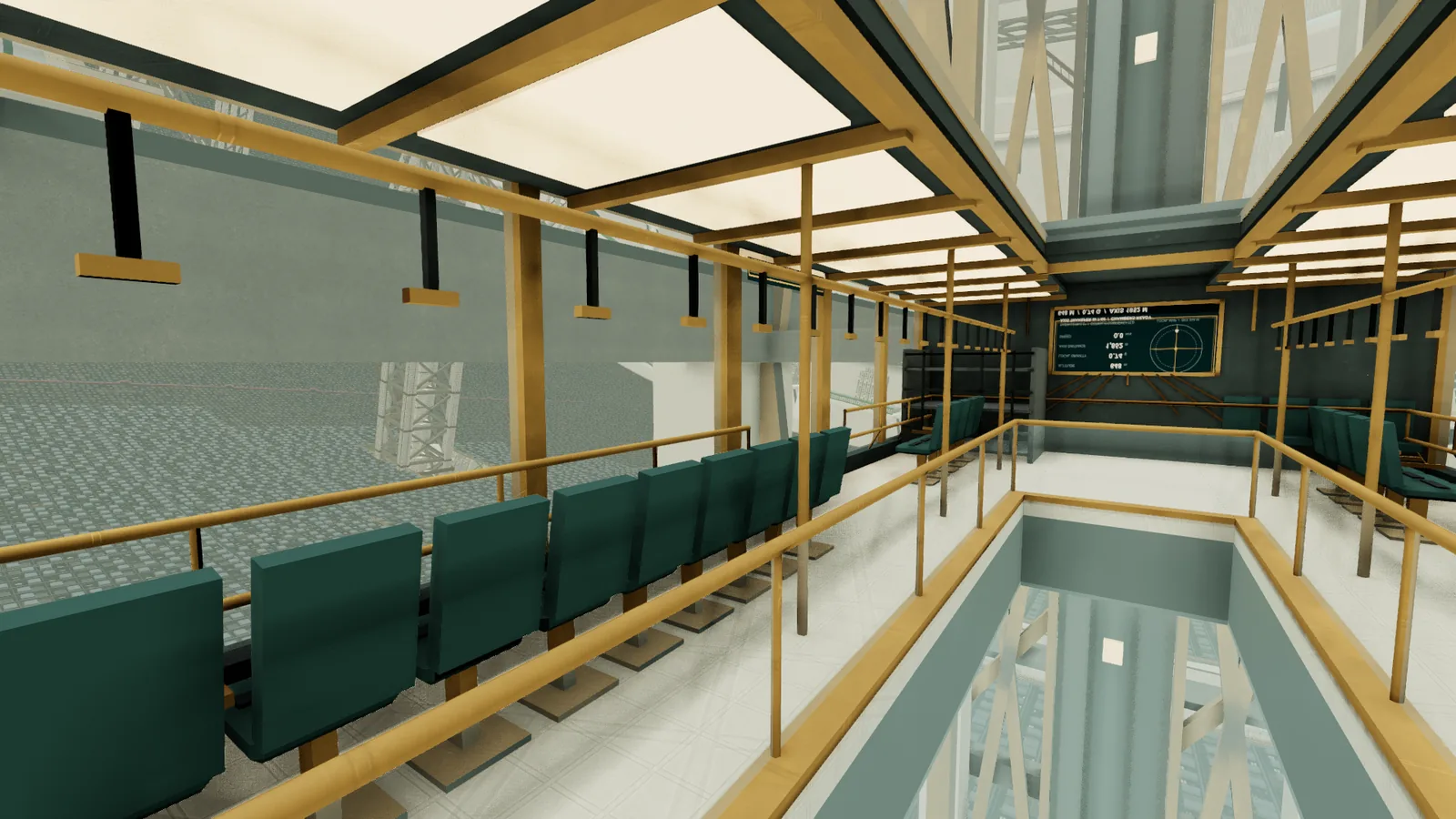
- The ascender leans. The ascender cabin rises 2,380 m in about 10 minutes. It tilts to follow the changing direction of down: 4 degrees 150 m above the deck, 6.7 degrees at 1,000 m, 15 degrees within 656 m of the axis. Design value
Try it
Set a radius and a target gravity, and see how fast the cylinder has to turn. Then slide up the height scale and read off your weight.
Go deeper: The equation Established physics
Centripetal acceleration at radius r, for angular rate ω, is the weight you feel.
g = ω² × r
ω = 2π / T
v = ω × r
For Concordia's rotors T is 100.4 s, so ω is 0.0626 rad/s. At r = 2,500 m, g = 0.0626² × 2,500 = 9.8 m/s², one Earth gravity. The ground speed is v = 0.0626 × 2,500 = 157 m/s. The rate in turns per minute is 60 / 100.4 = 0.598.
Because g is proportional to r, gravity falls linearly with height h above the ground:
g(h) = 1 g × (2,500 − h) / 2,500
| Height | Radius | Gravity |
|---|---|---|
| Ground | 2,500 m | 1.00 g |
| Sky | 2,050 m | 0.82 g |
| Plate quarters | 1,875 m | 0.75 g |
| Crop galleries | 1,500 m | 0.60 g |
| Upper frame | 500 m | 0.20 g |
| Hub terminal | 70 m | 0.028 g |
Go deeper: Worked example: a dropped coin Established physics
Drop a coin from 2 m at the ground. It falls for t = √(2h / g) = √(4 / 9.8) = 0.64 s. While it falls it moves toward the floor, and in the rotating frame that motion picks up a sideways push of 2ω × v, called the Coriolis acceleration. Integrating a radial speed of g × t gives a sideways shift of:
x = ω × g × t³ / 3
x = 0.0626 × 9.8 × 0.64³ / 3 = 0.053 m
The coin lands 5 cm from where it would on Earth, against the spin.
Walking has a smaller effect. At 1.4 m/s the Coriolis acceleration is 2 × 0.0626 × 1.4 = 0.175 m/s², which is 1.8 percent of g. Head to foot, a 1.8 m person sees 0.0626² × 1.8 = 0.007 m/s², or 0.07 percent of g.
Go deeper: Why not spin faster? Established physics
The radius for 1 g at a given rate is r = g / ω².
| Turns per minute | Radius for 1 g |
|---|---|
| 0.6 (Concordia) | 2,500 m |
| 1 | 894 m |
| 2 | 224 m |
| 4 | 56 m |
Studies from the 1970s set the comfort limit at 1 to 2 turns per minute, which forces a radius near 225 to 900 m. Globus and Hall recommend up to 4 turns per minute with some training for visitors, which would allow a 56 m radius. Concordia chooses the slow end on purpose. A million people include children, the elderly and the unwell, so the design stays under the lowest published limit. Design value
Sources and further reading
Real-world sources
- Gerard K. O'Neill, "The Colonization of Space", Physics Today 27(9), September 1974: physicstoday.aip.org/features/the-colonization-of-space.
- Richard D. Johnson and Charles Holbrow (eds.), Space Settlements: A Design Study, NASA SP-413, 1977: ntrs.nasa.gov/citations/19770014162. The 1 turn per minute limit and the design population are in the design basis chapter: nss.org/settlement/nasa/75SummerStudy/Chapt3.html.
- Al Globus and Theodore Hall, "Space Settlement Population Rotation Tolerance", NSS Space Settlement Journal, June 2017: nss.org PDF.
Concordia design documents
- Concordia engineering specification, sections 8 to 11, and the ascender design note.