Fly it
The glider is a light electric hang glider: 120 kg with its pilot, a 16 m² wing and a 4 kW motor. Design value Pick a height, a heading and an airspeed, press Fly, and the autopilot holds them. Press Drop the ball at any time. Switch between the two views to see the same flight twice.
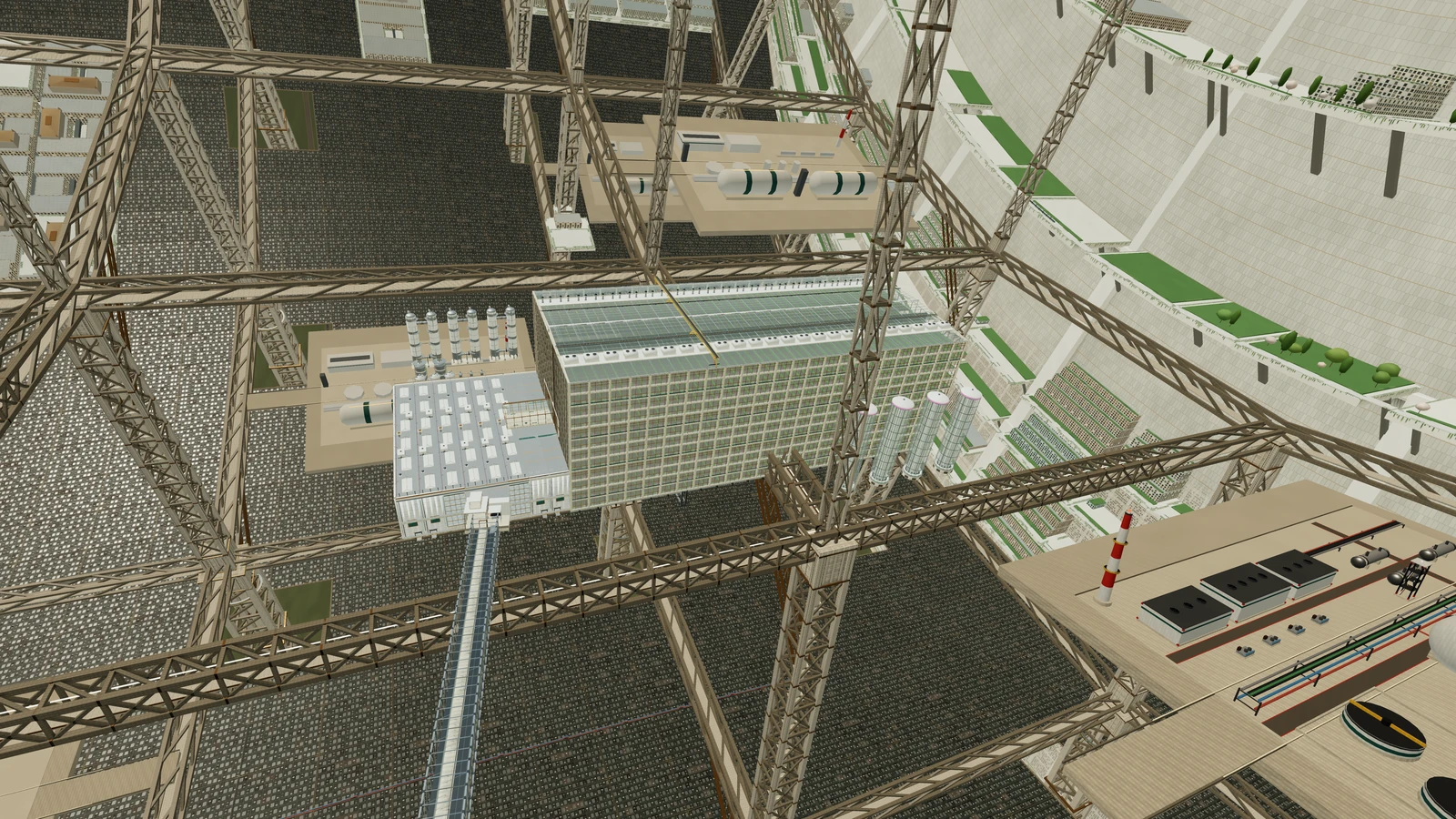
The full simulation has the same glider in the city. Start with Open in the simulation: a take-off run on the road or Open in the simulation: a flight 300 m above the city; both are in the atlas under Glider. Or in Explore mode, inside a habitation rotor, press B to board it, fly it between the towers, and drop the ball over a street.
What you are seeing
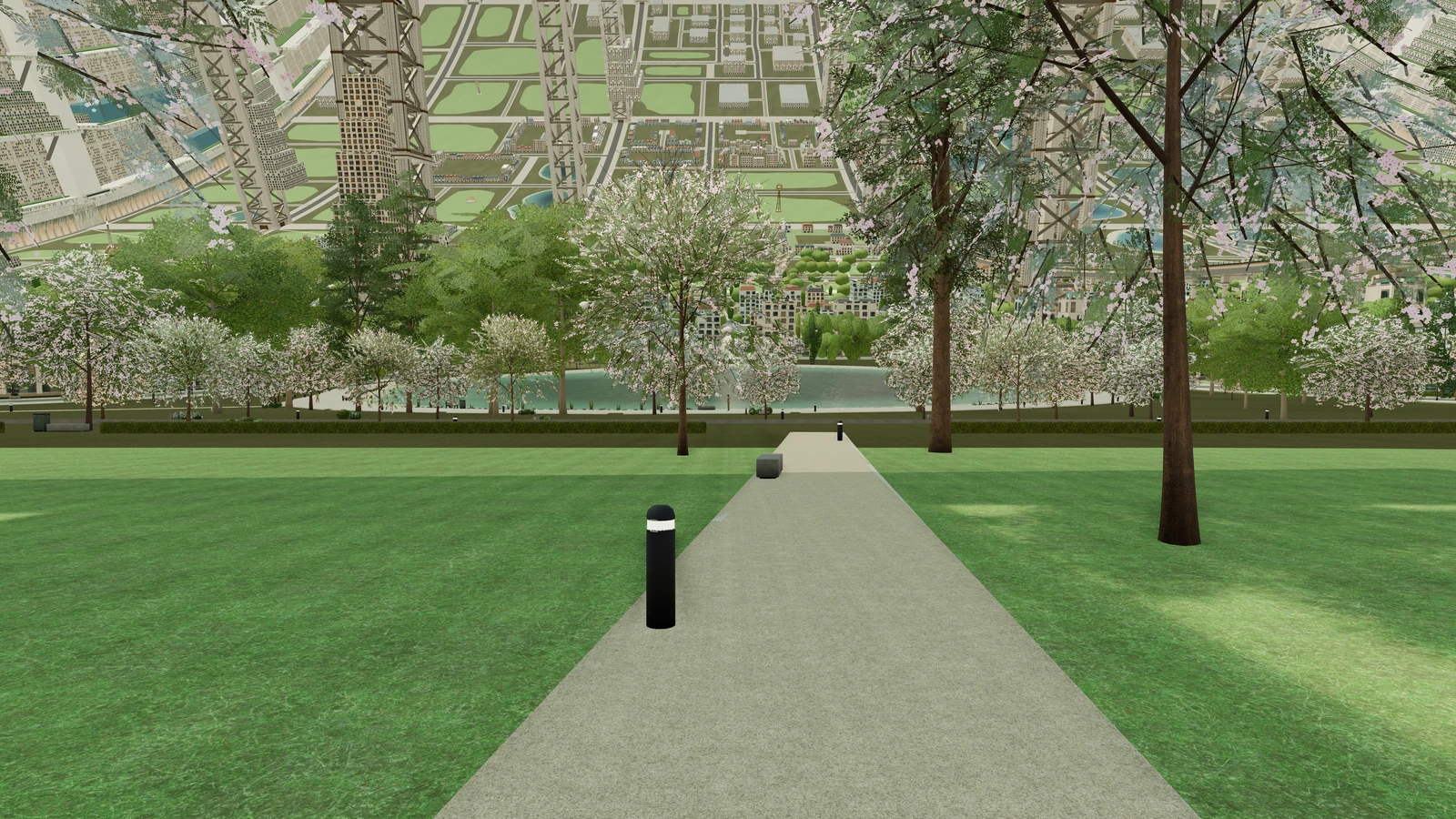
Nothing pulls the glider or the ball toward the floor. In the Outside view the rotor turns once every 100 seconds, and anything let go inside it moves in a straight line at constant speed. The floor curves up to meet it. In the Resident view the floor holds still, and the same ball appears to curve backward as if something pushed it. That push is the Coriolis effect. It is the price of describing a straight line from a turning point of view.
Weight works the same way. The glider is not pulled down. It is pushed into a circle by the lift of its wing, and the pilot feels that push as weight. The centripetal acceleration the wing supplies is the only gravity the glider has. Established physics
Why the ball lands behind you
A ball let go at rest at the sky, 450 m up, moves with the floor at 128 m/s. After release nothing speeds it up or slows it down. It flies a straight line through the air, which turns with the rotor and barely touches it, and the floor reaches it after 11.4 seconds. By then the floor has turned 221 m under it, so the ball lands 221 m antispinward of the spot directly below the release. On Earth the same ball lands on that spot after 9.6 seconds.
Let go from the glider, the ball carries the glider's own speed as well. At 14 m/s with the spin it lands 54 m antispinward of the spot below. Flying against the spin it lands 427 m antispinward. The Resident view draws the curve, and the Outside view draws the line.
Why the direction changes your weight
Spinward means the way the floor is turning. A glider flying spinward at 14 m/s moves through space at 157 + 14 = 171 m/s at the ground. Bending a path at that speed into the rotor's circle takes 1.19 g. Flying antispinward it moves at 143 m/s and takes 0.83 g. The sum is the one that runs the ring metro, where 100 km/h against the spin weighs 0.66 g.
The wing pays for it. At 14 m/s with the spin the glider needs a lift coefficient of 0.74 and 2.4 kW from the motor, against 0.52 and 1.7 kW the other way. Its stall speed is 9.9 m/s with the spin and 8.8 m/s against it.
Thin air, thin weight
Climb and both fall. Weight drops with radius: 0.82 g at the sky and 0.40 g 1,500 m up. The air thins too, to 95 percent of its ground density at the sky and 91 percent at 1,000 m (the table). A lighter glider needs less lift and can fly slower, so the least power it needs falls fast. With the spin it is about 2.0 kW at 10 m/s at the ground and about 250 W at 5 m/s 2,000 m up, an eighth as much.
Standing still in space
Near the axis the floor moves slowly. At 2,200 m, radius 300 m, it moves at 18.8 m/s. A glider flying antispinward at exactly that speed cancels it: the glider hangs motionless in space while the city turns below it. The pilot is weightless and the wing carries no lift. The motor still runs, at about 2.4 kW, because air streams past the wing at 18.8 m/s. Press Stand still in space, then switch to the Outside view and watch the floor go round.
Go deeper: The equations and the model Established physics
The flight is integrated in the inertial frame, where a rotor has no gravity. The air turns with the rotor, so at position r it moves at u = ω × r. The glider's velocity relative to the air is w = v − u, and the only forces are lift, drag and thrust set by w:
q = ½ ρ(r) w²
lift = q S C_L, perpendicular to w, upright
drag = q S (C_D0 + k C_L²), along −w
thrust = throttle × min(300 N, η P / w)
The Resident view is the same flight with the coordinates rotated by ω t. Nothing is added to the physics to draw it. In level flight at height h, radius r = 2,500 − h, flying with the spin (+) or against it (−) at airspeed V, the glider moves through space at ωr ± V and the wing must supply:
a = (ω r ± V)² / r
C_L = 2 m a / (ρ S V²)
Setting C_L to its limit gives the stall speed in closed form. With K = 2 m / (ρ S r) and C_Lmax = 1.4:
V_stall (with the spin) = ω r / (√(C_Lmax / K) − 1)
V_stall (against) = ω r / (√(C_Lmax / K) + 1)
Air density follows the barometric rule with the centrifugal potential in place of g h, as on the air page:
ρ(r) = ρ_ground × exp( −ω² (R² − r²) / (2 R_gas T) )
with R = 2,500 m, ω = 0.0626 rad/s, R_gas = 287 J/(kg K), T = 293 K and ρ_ground = 1.204 kg/m³. A ball dropped from rest is a straight line in this frame. Its landing point solves |p₀ + u₀ t| = R, and the shift is the change in floor angle, R (Δφ − ω t).
| Design value | Glider |
|---|---|
| Mass, pilot and craft | 120 kg |
| Wing area | 16 m² |
| Parasite drag C_D0 | 0.03 |
| Induced drag factor k | 0.06 (aspect ratio 6, efficiency 0.88) |
| Lift coefficient limit | 1.4 |
| Motor | 4 kW shaft, 70 percent propeller efficiency, 300 N static thrust |
| Best glide ratio | about 12 |
| Ball | Value |
|---|---|
| Mass | 20 kg steel |
| Drag area C_D A | 0.0105 m² (17 cm sphere) |
These are design values for the widget, not measurements of a real aircraft. Design value The model flies in the plane across the rotor, so it has no flight along the axis, where there is no Coriolis effect and the glider behaves as on Earth with less weight. It has no turbulence, buildings or ground effect.
Sources and further reading
Real-world sources
- Air density from the same exponent as the pressure table on Air, water and food.
Concordia design documents
- Concordia fact sheet section 13 (glider model, results and the checks that guard them:
npm run site:widgets-test) and the engineering specification, sections 8 to 11.