What the Moon gives
The Moon's surface is covered in regolith, a fine broken rock. About 43 percent of it is oxygen by mass, locked into minerals along with silicon, aluminium, iron and some titanium. That one fact does a lot of work. A tonne of moon dirt holds over 400 kg of oxygen for air and rocket oxidiser, plus the metal and stone to build with. Established physics
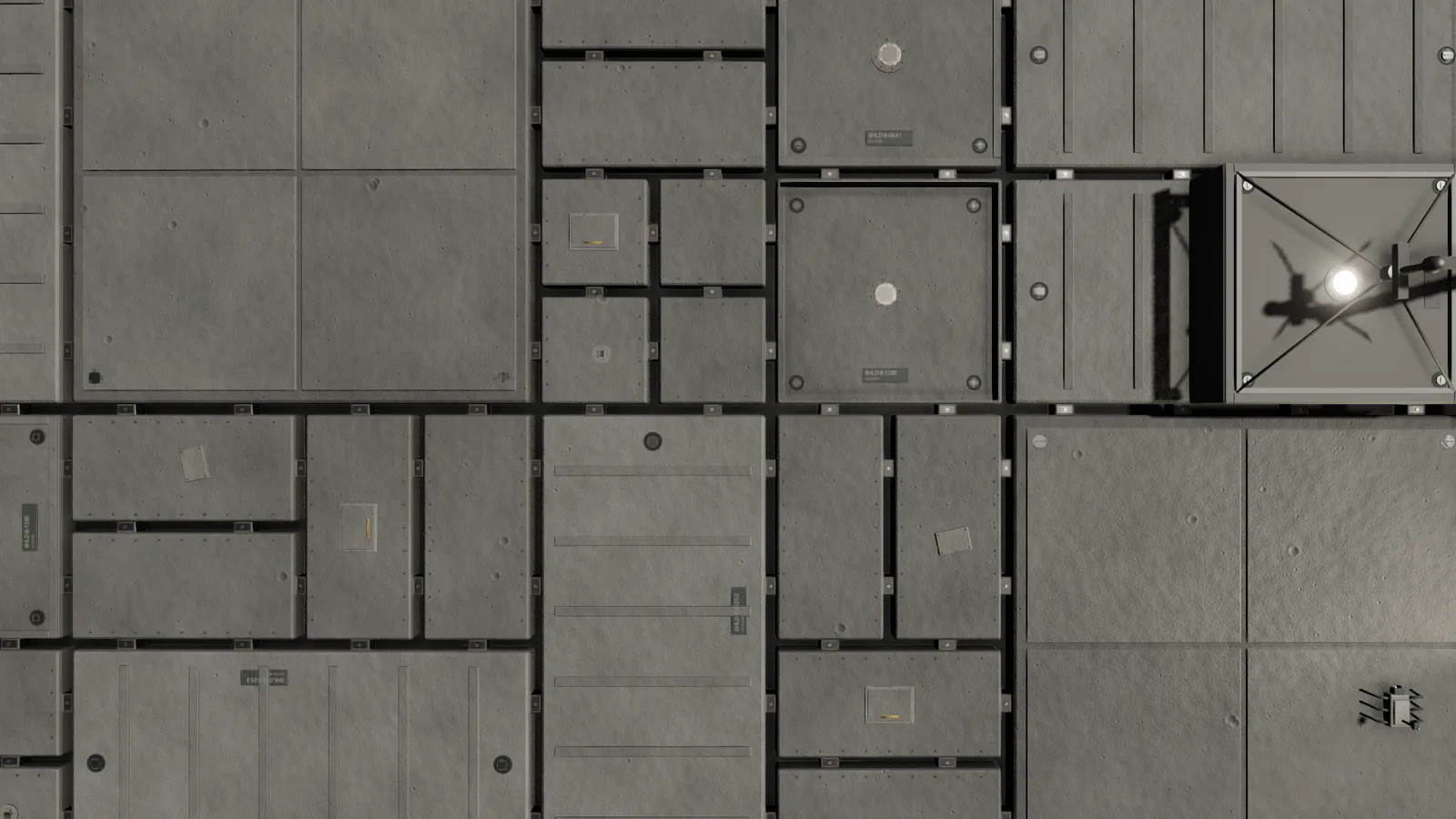
From regolith the station makes aluminium alloys and steel, glass, basalt-like mineral fibres, glass-ceramics and ceramics. Heated until the grains fuse, it becomes sintered regolith, the pale warm-grey stone that city blocks and the megaframe are made of. Compacted regolith and slag fill the cartridges of the hull shield. This is in-situ resource utilization at city scale: almost all bulk material is extraterrestrial, and Earth launch is kept for high-value, low-mass items. Design value
What the Moon lacks
Three things the city needs are scarce on the Moon: carbon, hydrogen and nitrogen. Without them there is no water, no plastic, no food, and no inert gas to dilute the oxygen in the air.
Prospecting in the 2030s found the first partial answer. Water ice sits at a few percent by mass in the upper metres of permanently shadowed regolith across several hundred square kilometres of the lunar poles. Story It agrees with the first hard measurement: when NASA's LCROSS probe struck the crater Cabeus in 2009, Colaprete and colleagues estimated the ejecta was 5.6 percent water ice by mass. Established physics The ice is enough for propellant and for early life support. It is not enough for a million people's air and water, so most of the volatiles come from asteroids.
What asteroids bring
The first asteroids hauled to L5 were metal-rich: almost pure iron-nickel that went to the yard without smelting, before the lunar mass driver ran at scale (how the haulers work). The volatiles came next. A carbonaceous asteroid is a dark, primitive body that never melted. The ones Concordia's haulers capture are small, tens of metres across, and measure roughly 10 percent water and a few percent carbon by mass, like the CI and CM meteorites. They also carry nitrogen compounds and metals. Story
The volatiles they hold are the missing pieces. Water gives drinking water, farm water and hydrogen. Carbon gives plastics, fibre and the CO₂ plants breathe. Nitrogen fills the atmosphere and feeds the farms. A small asteroid cannot arrive on its own. A hauler bags it whole and pushes it, slowly and steadily, into the L5 region, where it is processed far from the station. The 2012 Keck Institute study for asteroid retrieval found that a roughly 7 m body of 250 to 1,000 tonnes is within reach of a robotic mission with a solar-electric tug. Established physics Concordia's captures are larger, tens of metres across.
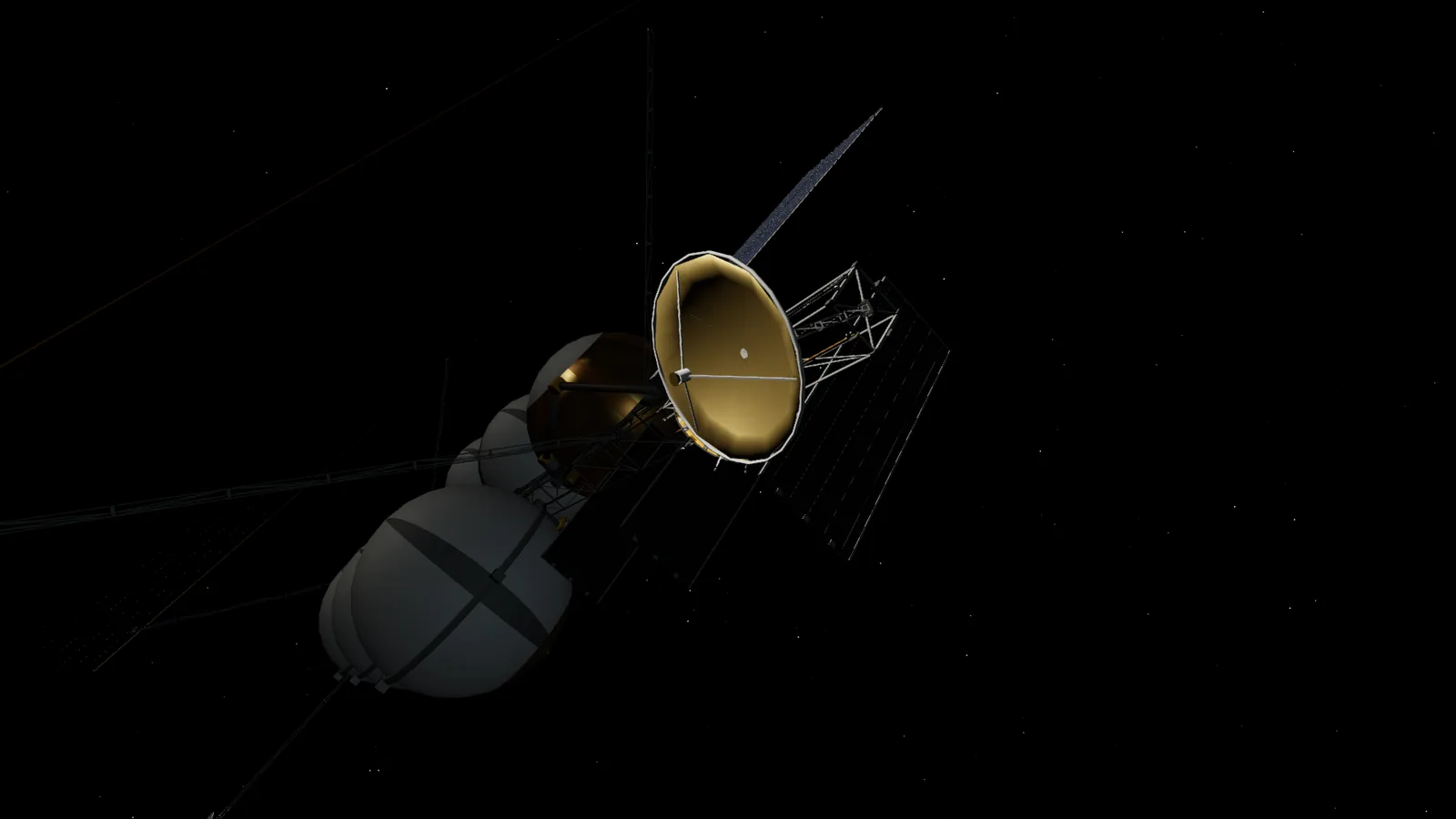
This chain was running before anyone lived on the station. The first asteroid captures came in the mid 2030s, metal-rich bodies first, with lunar mining and an electromagnetic mass driver close behind. The station started as its own factory. How the rock is found, bagged and mined is on Mining the Moon and asteroids; the full build is on Building Concordia. Story
Catching cargo, not receiving it
A mass driver is an electromagnetic catapult. On the Moon it reaches the 2.4 km/s escape speed with no propellant, so packaged feedstock leaves the surface on electricity alone and arrives fast. Engineering challenge So the station never receives cargo directly. Capture facilities tens or even hundreds of kilometres away catch each shipment, slow it, and hand it to tugs that bring it in gently. Nothing high-speed is ever aimed at the habitat.
The station launches cargo too, on two mass-driver tracks about 15 to 16 km long on opposite sides of the stationary exterior. Launches go out in opposing pairs, and the momentum rings absorb any imbalance (see counter-rotation).
The stores in the industrial rotor
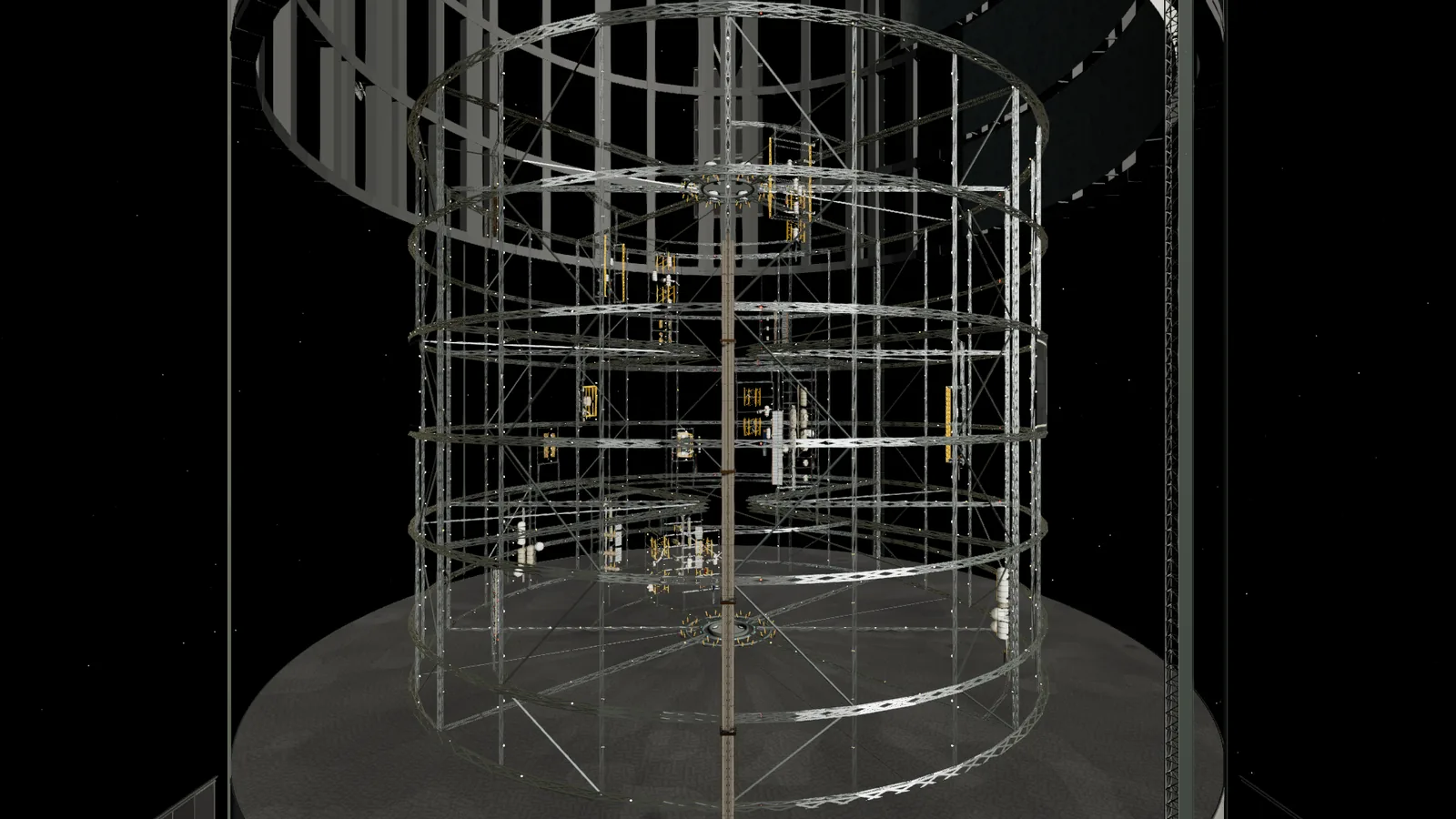
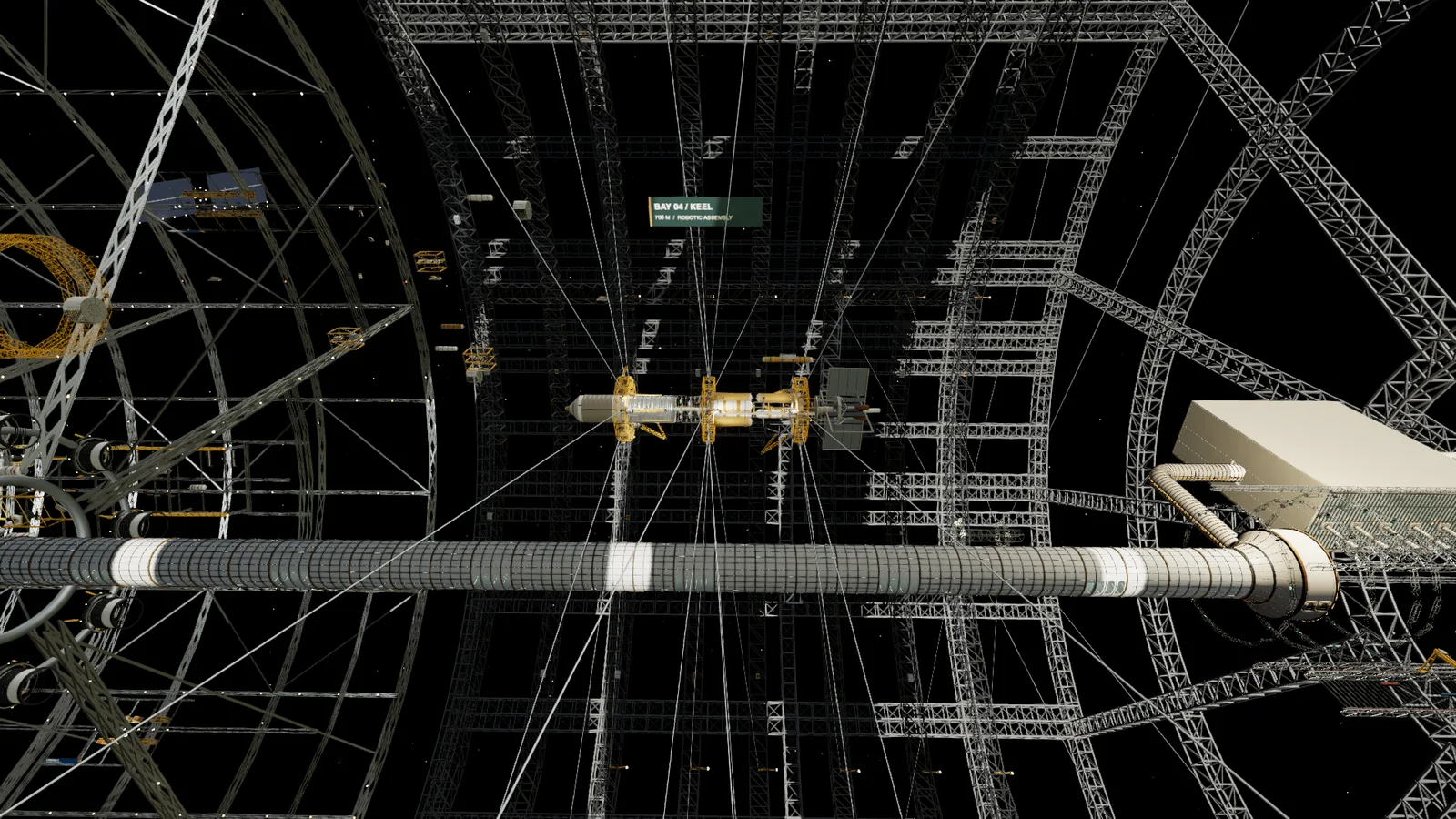
Both streams end in Ehricke (the industrial rotor), 3,500 m long and 2,300 m in radius, turning slowly enough that its rim has 0.45 g. It is mostly an open framework carrying pressurized modules: refineries, chemical plants, a recycling line, a cargo rail yard, and a water and volatile tank farm of spherical tanks. Robots do the work. Design value
The lunar stores hold sintered regolith billets, aluminium and iron ingots, glass and basalt fibre, and oxygen. The asteroid stores hold water ice, carbon feedstock, nitrogen compounds and metal concentrates. Everything is semi-processed, ready for the shipyard, the hull shield, the farms and the recycling loop. Nothing is thrown away: the station tracks water, carbon, nitrogen, phosphorus, metals and glass by element and recovers them.
Open in the simulation: Material-flow overlay Open in the simulation: Exterior QA: 25 m Materials Open in the simulation: Visit the industrial hub
Go deeper: Scale and arithmetic Established physics
Shielding is the biggest single use. One metre of regolith at 1.6 t/m³ over the 470 km² hull is roughly 750 million tonnes. The four atmospheres hold 150 to 200 million tonnes of gas, and the water inventory is tens of millions of tonnes spread over lakes, tanks, farms and shielding.
If the water comes from asteroids that are 10 percent water by mass, every 10 million tonnes of water needs 100 million tonnes of carbonaceous rock. Lunar ice at 5.6 percent gives 56 kg of water per tonne of regolith, asteroids at 10 percent give 100 kg per tonne of rock.
| Element or product | Mostly from |
|---|---|
| Oxygen | Moon (about 43 % of regolith) |
| Silicon, aluminium, iron, titanium | Moon |
| Glass, ceramics, sintered stone | Moon |
| Hydrogen and water | Asteroids, plus lunar polar ice |
| Carbon | Asteroids |
| Nitrogen | Asteroids |
| Specialty alloy constituents | Earth, in small amounts |
Lunar escape speed is v = √(2GM ÷ R) = √(2 × 4,902.8 km³/s² ÷ 1,737 km) = 2.38 km/s.
Sources and further reading
Real-world sources
- Anthony Colaprete et al., "Detection of Water in the LCROSS Ejecta Plume", Science 330, 463 to 468 (2010): experts.arizona.edu.
- John R. Brophy, Fred Culick and Louis Friedman et al., "Asteroid Retrieval Feasibility Study", Keck Institute for Space Studies, Caltech and JPL (2012): final report and the interim paper Asteroid retrieval feasibility.
- Universe Today, "Air From Moonrocks": 43 percent of lunar soil by mass is oxygen (NASA Goddard work on oxygen extraction): universetoday.com.
Concordia design documents
- Concordia engineering specification, sections 5, 30, 31 and 47, and the industrial rotor design note.