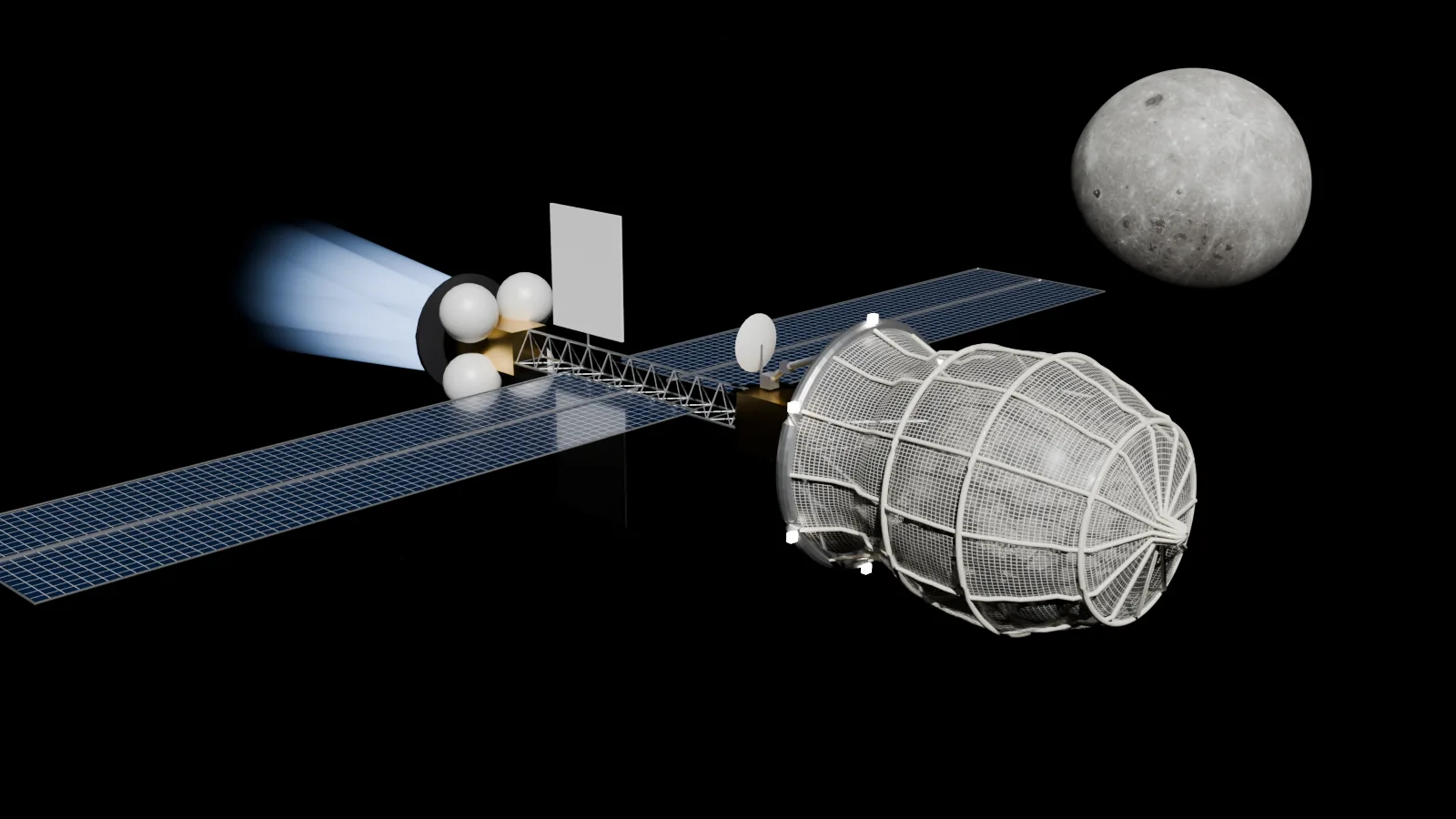
The economics: what comes from Earth
Every kilogram that leaves Earth has to be lifted out of a deep gravity well. Escaping Earth takes 62.7 megajoules per kilogram. Escaping the Moon takes 2.8, about 22 times less. Leaving a small asteroid takes almost nothing: the surface escape speed of a body tens of metres across is a few centimetres per second, slower than a walk. Established physics
Launch is cheap by the standards of the 2010s. Fully reusable heavy launchers carry more than 100 tonnes to low orbit for about $2 million a flight, and tanker flights refuel them in orbit. That is about $20 a kilogram to low orbit. L5 costs more, about $100 a kilogram, because every load bound there needs four tanker flights to fill the ship for the climb. Cheap launch is what made Concordia possible: the haulers, the first mining machines, the seed factory and the crews all flew up from Earth. Story
It is still far too dear for bulk. Two billion tonnes is 20 million full loads, about $200 trillion delivered to L5. So the rule on Concordia is simple: Earth sends the machines that make things, and things that are light, rare and hard to make. Everything heavy is dug up in space. Design value
| Bring from Earth | Make in space |
|---|---|
| Chips, sensors and fine electronics | Shielding, the largest single mass |
| Medicines and laboratory reagents | Steel, aluminium and glass for structure |
| Seeds and starter cultures for the farms | Oxygen for air and rocket oxidiser |
| Small amounts of specialty alloy constituents | Water, carbon and nitrogen for life support |
| Precision instruments, and people | Propellant, ships and solar arrays |
| The first machines: haulers, excavators, furnaces | Copies of those machines, once the factory runs |
The left column is light and expensive per kilogram. The right column is heavy and cheap per kilogram. Almost all of Concordia's two billion tonnes sits in the right column (see Building Concordia).
Where the elements are
Earth, the Moon and the asteroids are made of the same elements in very different proportions. The Moon's surface is rich in oxygen, silicon, aluminium, iron, calcium and titanium, but it holds only traces of hydrogen, carbon and nitrogen, mostly implanted by the solar wind. Carbonaceous asteroids are the opposite: primitive rock that never melted, with water, carbon and nitrogen locked in its minerals. Metal-rich asteroids are pieces of the cores of shattered small worlds: almost pure iron-nickel alloy with cobalt and the platinum-group metals dissolved in it.
Earth has everything, but at the bottom of the deepest well. That is why Concordia mines the Moon for bulk, carbonaceous asteroids for volatiles, and metal-rich asteroids for the alloy it needed first.
First: metal-rich asteroids, bagged and hauled to L5
The first feedstock to reach L5 was metal, and it arrived without a single landing. A near-Earth asteroid is an asteroid whose orbit brings it close to Earth's. A few of the small ones pass so slowly that they can be steered into the Earth-Moon system for a tiny change in speed. In 2013 García Yárnoz, Sánchez and McInnes searched the known population and already found 12 such easily retrievable objects that could be brought into near-Earth space for less than 500 m/s. Established physics A well-timed swing past the Moon can supply part of the change for free. Most of the small ones had not been found yet; prospecting telescopes and small probes filled in the list and measured what each rock is made of.
Metal-rich bodies were worth going for first, even though they are uncommon: in a 2019 survey of more than 1,000 near-Earth objects, about one in ten fell in the X class that includes the metal bodies. Their iron is already metal. Lunar iron is locked in oxides and has to be smelted, which takes a plant on the Moon and a lot of power. Asteroid iron-nickel only needs cutting and melting. A metal body of 20 m holds about 30,000 tonnes of alloy, enough steel for the first frames of the yard.
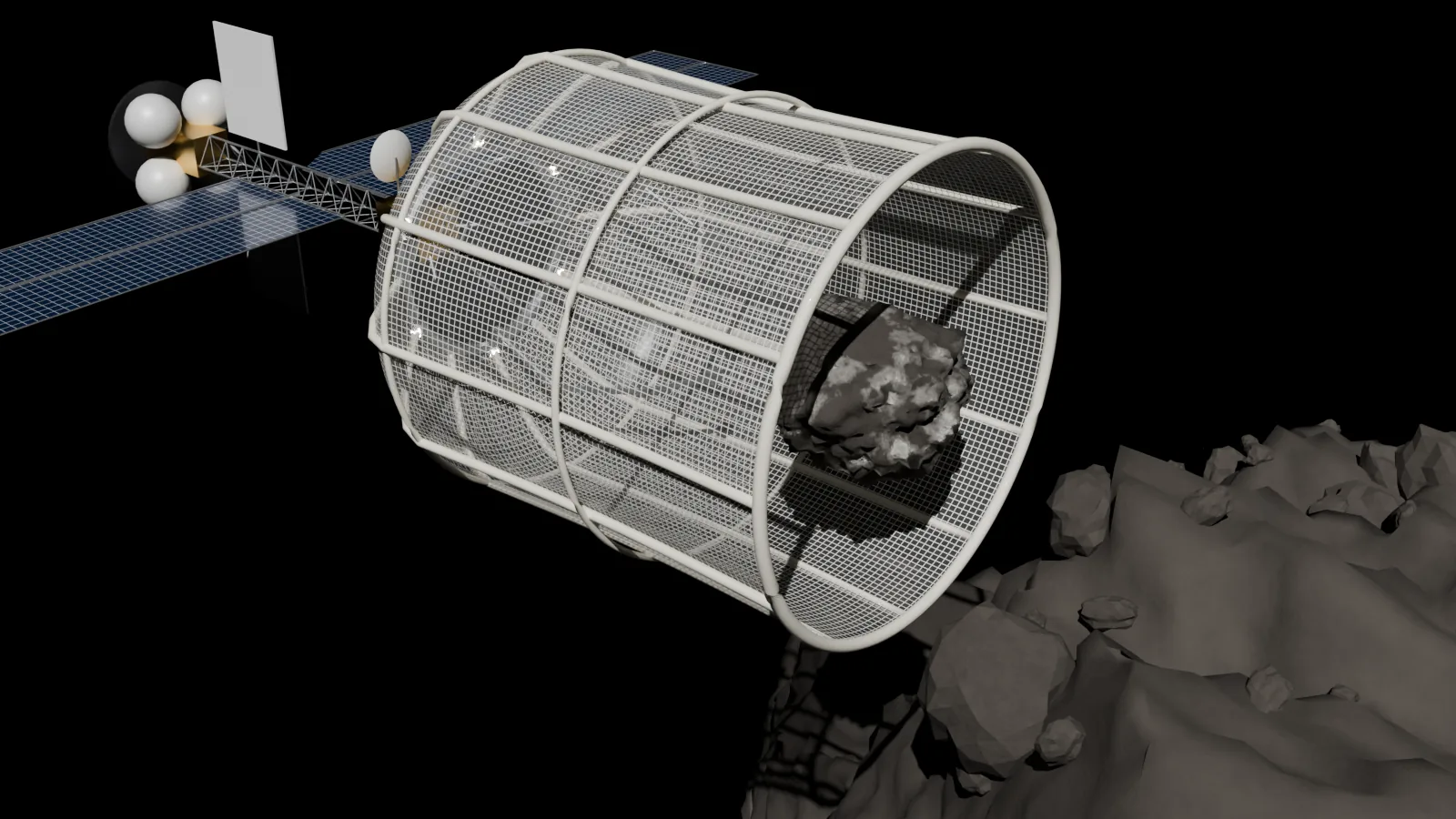
The machine that does the work is the bag hauler, and it is built to be cheap per tonne, not to be clever. The 2012 Keck Institute study sized a robotic tug with a 15 m bag and 40 kW of solar-electric power to bring back one 500 tonne asteroid. The hauler is the industrial version: 25 times the power, 60 times the cargo, and it goes back for more. It is a solar-electric tug about 110 m long. Two solar wings, 60 m each, give about 1 MW. Seven electric thrusters at the stern run at a specific impulse near 3,000 s, the same class as the station's own station-keeping thrusters. At the bow is the bag: a woven net of high-strength fibre with a thin liner, 40 m across at the mouth, held open by inflatable ribs. Engineering challenge
A capture goes in four steps. The hauler matches the rock's spin. It slides the open bag over the rock, or over a loose boulder on a bigger rubble pile, and the arms guide it in. Cinch lines draw the net tight, so the rock and every chip it sheds stay inside. Then the thrusters take out the spin and start the long push home.
The push is gentle. With about 37 newtons of thrust on 30,000 tonnes, the hauler gains about 40 m/s per year, so a well-chosen target reaches the L5 region in about three years. The trip burns roughly 120 tonnes of propellant to move 30,000 tonnes of metal. Shipping the same metal up from Earth would take about 1,500 launches, cargo and tankers together, and about $3 billion. The hauler itself went up folded in one launch, and it goes back for the next rock. Design value
At L5 the bagged rocks are parked well away from the station and cut up in vacuum. The bag stays on as a dust and debris catcher. Carbonaceous asteroids come in the same way. Inside their bags, mirrors focus sunlight onto the rock and bake out its water, which freezes onto cold plates; the dry residue still holds carbon and nitrogen for the chemical plants. NASA funded studies of this optical mining in a bag from 2017. Carbon monoxide made from asteroid carbon then carries iron and nickel out of the metal chunks as carbonyl gases, which deposit pure metal again when heated. Cobalt and the platinum-group metals stay behind as a rich residue for catalysts and electronics. Engineering challenge
Open in the simulation: Bag Hauler: Under Tow Open in the simulation: Bag Hauler: Stern Open in the simulation: Exterior QA: 25 m Materials Open in the simulation: Zero-G Shipyard: Hero View
Then: the Moon, at industrial scale
Haulers cannot build a city. One metre of regolith shielding over the 470 km² hull weighs about 750 million tonnes. At 30,000 tonnes a trip that is 25,000 hauls. The bulk had to come from the Moon, days away instead of years, where the rock is already crushed and lying on the surface. Design value
Lunar regolith needs no blasting. Refuelled heavy landers set down the first excavators, furnaces and power plants. Scrapers skim the top metres. Magnets pull out the grains of native iron that meteorite impacts have scattered through the soil, and electrostatic sorters separate the minerals. Plants on the surface split oxygen out of the rock, about 43 percent of it by mass, and leave metals and slag behind. Then an electromagnetic mass driver throws the packaged product off the Moon at the 2.4 km/s escape speed, using only electricity. The idea is old: a 1977 NASA Ames summer study sketched a lunar launcher throwing 10.5 kg loads four times a second, 650,000 tonnes a year. Engineering challenge Capture facilities far from Concordia catch each load and hand it to tugs (see materials).
Open in the simulation: Follow both streams in the material-flow overlay
Lunar dust, melted into brick
Lunar dust is the Moon's worst hazard. It is not weathered like sand on Earth. Micrometeorites have broken it into sharp, glassy shards, and sunlight charges it so it clings to everything. On the Apollo missions it wore through the outer layers of spacesuits, made seals leak, and irritated eyes and lungs; Harrison Schmitt complained of hay fever. After three moonwalks Pete Conrad's Apollo 12 suit was more worn than training suits after 100 hours. Rocket exhaust is worse: it throws surface grains at hundreds of metres per second or faster. Established physics
The answer is to stop the dust from being dust. A solar furnace is a field of mirrors that focuses sunlight on one small spot, hot enough to fuse rock. In 2017 the German Aerospace Center (DLR), working for the European Space Agency, used one at Cologne: 147 curved mirrors baked simulated moondust at 1,000 °C in layers 0.1 mm thick, and finished a 20 × 10 × 3 cm brick in about five hours. NASA engineers at Kennedy had already shown in 2008 that a solar concentrator melts and sinters simulant to about 6 mm deep in two to three minutes, and proposed it for lunar landing pads. On the Moon the same trick paves the ground: landing pads, roads and the mass driver apron are sintered into glassy crust so rocket exhaust and wheels cannot raise a cloud. Mobile solar ovens melt regolith into blocks for berms and blast walls. Established physics
The cargo is treated the same way. Loose dust never rides the mass driver. Regolith leaves the Moon fused into sintered regolith billets, cast basalt and glass, so nothing sheds in flight or at the catcher. The pale billets stacked in Ehricke's stores are, in a sense, the solution to the dust problem. Design value
Go deeper: The hauler and the haul, worked through Design value
These are the design figures for the bag hauler (facts section 11).
Power: two wings of 59.6 × 17.6 m, 2,100 m² in all, at 1,361 W/m² and 33 percent cell efficiency give about 0.94 MW.
Thrust: an electric thruster turns power P into thrust F = 2ηP ÷ vₑ. At 3,000 s, vₑ = 3,000 × 9.807 = 29.4 km/s. With η = 0.6 and 0.9 MW to the thrusters, F = 2 × 0.6 × 900,000 ÷ 29,420 = 37 N.
Payload: a 20 m metal body is about 4/3 × π × 10³ = 4,190 m³. At 7.8 t/m³, the density of iron meteorites, that is 32,700 t. Call it 30,000 t with the hauler.
Speed gained: a = 37 ÷ 3.0 × 10⁷ kg = 1.23 × 10⁻⁶ m/s². Over a year of 3.16 × 10⁷ s, Δv = 39 m/s.
Propellant: by the rocket equation, 120 m/s on 30,000 t needs m = 30,000 × (1 − e^(−120 ÷ 29,420)) = 122 t. The payload is about 250 times the propellant.
Escape energy: ½v². Earth: 0.5 × (11.2 km/s)² = 62.7 MJ/kg. Moon: 0.5 × (2.38 km/s)² = 2.8 MJ/kg. A 20 m rock of density 7.8 t/m³ has surface escape speed √(2GM ÷ r) = √(2 × 6.674 × 10⁻¹¹ × 3.27 × 10⁷ ÷ 10) ≈ 0.02 m/s.
Bulk: 750,000,000 t of shield ÷ 30,000 t per haul = 25,000 hauls.
Launch from Earth: a fully reused heavy launcher at about $2 million a flight and 100 t a load is $20/kg to low orbit. Low orbit to L5 is 3.97 km/s. With 3.73 km/s exhaust the ship needs a mass ratio of e^(3.97 ÷ 3.73) = 2.9, so a 120 t ship with 100 t of cargo burns about 420 t of propellant: four tanker loads. Five launches per 100 t delivered gives about $100/kg. Two billion tonnes is 20 million cargo loads and about $200 trillion.
Sources and further reading
Real-world sources
- Mike Brown, "SpaceX Starship: Elon Musk outlines an ultra-low price tag for launches", Inverse, 2019 ( about $2 million per flight and at least 100 t to orbit, the stated goal used here as the launch baseline): inverse.com.
- "Delta-v budget", Wikipedia (low Earth orbit to Earth-Moon L4/L5, 3.97 km/s): en.wikipedia.org.
- NASA, Moon and Earth fact sheets (escape velocities 2.38 and 11.19 km/s): moonfact, earthfact.
- D. García Yárnoz, J. P. Sánchez and C. R. McInnes, "Easily Retrievable Objects among the NEO Population", Celestial Mechanics and Dynamical Astronomy 116, 2013: arxiv.org/abs/1304.5082.
- Shane Hasnain, Christopher Lamb and Shane Ross, "Capturing near-Earth asteroids around Earth", Acta Astronautica 81, 2012 (lunar flyby capture): PDF.
- Richard P. Binzel et al., "Compositional distributions and evolutionary processes for the near-Earth object population", Icarus 324, 2019: arxiv.org/abs/2004.05090.
- John R. Brophy, Fred Culick, Louis Friedman et al., "Asteroid Retrieval Feasibility Study", Keck Institute for Space Studies, 2012: authors.library.caltech.edu.
- NASA NIAC, "Optical Mining of Asteroids, Moons, and Planets" (Joel Sercel, 2017): nasa.gov.
- Greg Kopp and Judith L. Lean, "A new, lower value of total solar irradiance", Geophysical Research Letters 38, 2011: doi.org/10.1029/2010GL045777.
- Element abundances: CRC Handbook values for the continental crust, as tabulated at Abundance of elements in Earth's crust; Heiken, Vaniman and French, Lunar Sourcebook (1991), table 7.15 of lunar soil compositions: USGS; Ian A. Crawford, "Lunar Resources: A Review", 2015 (solar-wind hydrogen, carbon and nitrogen): arxiv.org/abs/1410.6865; Katharina Lodders, "Solar System Abundances and Condensation Temperatures of the Elements", ApJ 591, 2003 (CI chondrites): PDF; S. J. Ostro et al., "Asteroid 1986 DA: Radar evidence for a metallic composition", Science, 1991 (about 8 percent nickel and 10 ppm platinum-group elements in meteoritic metal): ntrs.nasa.gov.
- G. K. O'Neill, H. Kolm, W. Arnold et al., "Mass Drivers III: Engineering", NASA Ames summer study, 1977: nss.org.
- James R. Gaier, "The Effects of Lunar Dust on EVA Systems During the Apollo Missions", NASA/TM-2005-213610: PDF; John T. James and Noreen Kahn-Mayberry, "Risk of Adverse Health Effects from Lunar Dust Exposure", NASA Human Research Program, 2009: PDF.
- NASA Kennedy, "Particle Ejection and Levitation Technology" (ejecta speeds under a lander): PDF.
- ESA, "Printing bricks from moondust using the Sun's heat", 2017: esa.int.
- Paul Hintze, Jerome Curran and Teddy Back, NASA Kennedy, "The Use of Solar Heating and Heat Cured Polymers for Lunar Surface Stabilization", 2008: ntrs.nasa.gov.
Concordia design documents
- Concordia engineering specification, sections 4, 5 and 47, and the fact sheet section 11 (bag hauler design figures).