Why L5
A Lagrange point is a spot where the pull of two bodies and the motion of the orbit balance. L5 trails the Moon by 60 degrees on its orbit, at the same 384,400 km from Earth, forming an equilateral triangle with Earth and Moon. In the idealised picture, with Earth and Moon on circular orbits and nothing else pulling, L4 and L5 are stable: a small push sends an object into a slow loop around the point instead of carrying it away. The other three points are not. L4 and L5 stay stable only because Earth is more than 25 times heavier than the Moon; it is 81 times heavier. Established physics
The real world is messier. The Sun pulls, the Moon's orbit is not circular, and ship traffic and cargo launches all push on a station of this size. So Concordia is station-kept: continuous navigation, and low-level correction by high-efficiency electric thrusters. Twelve thruster pods ring the aft face, with a combined power around 108 MW and a specific impulse near 3,000 s. Large manoeuvres take days or weeks. Engineering challenge
L5 was chosen for five reasons: low-energy access to lunar material, access to Earth and the cislunar network, no planet below, a huge volume for construction, and a staging point for travel onward. The station moves around Earth at 1.018 km/s. Established physics
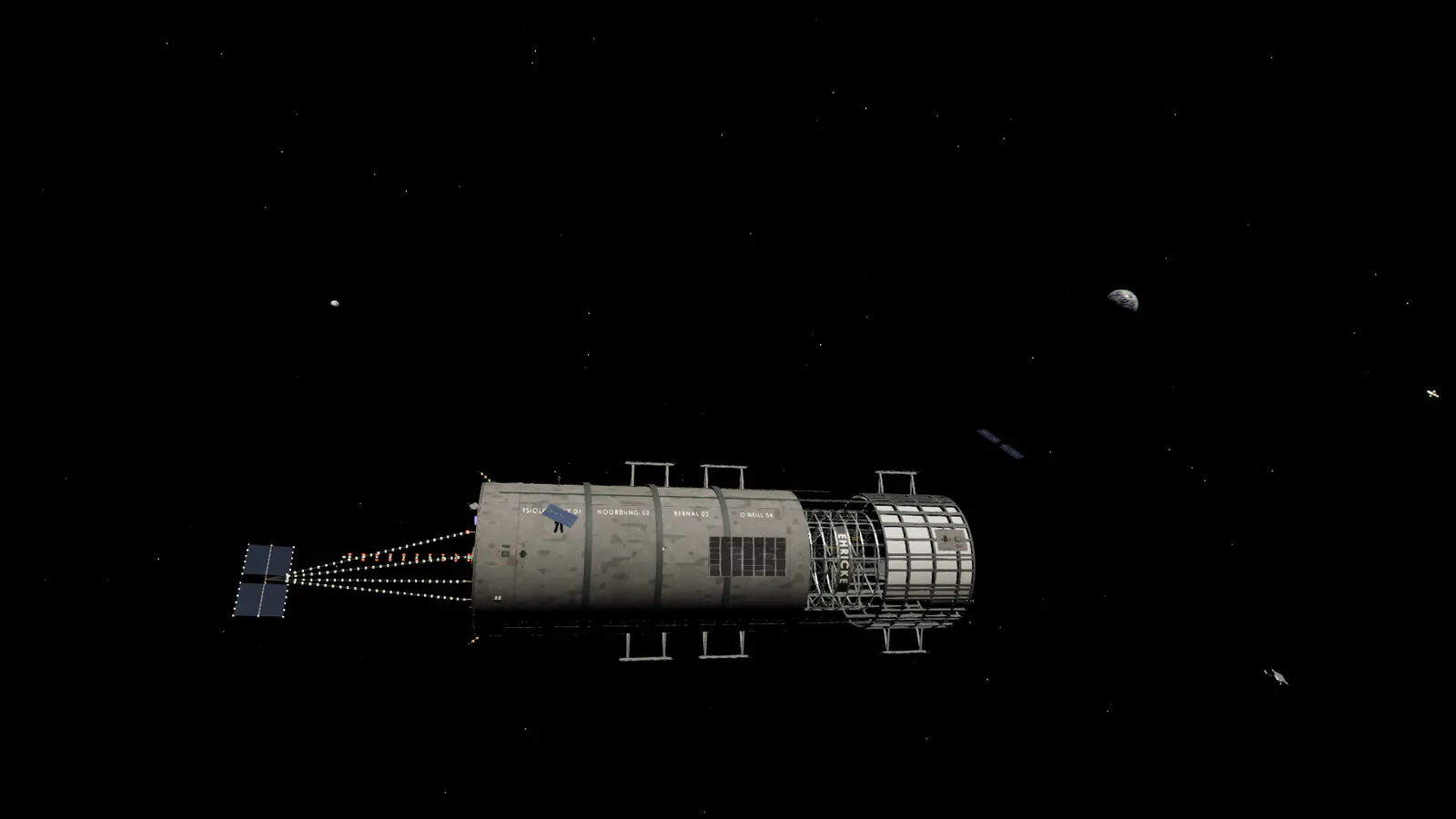
The launcher: first leg only
The passenger launcher is a track about 10 km long on the outside of the hull. A carrier on a levitated keel accelerates at 1.5 g for 37 seconds and leaves the end at about 540 m/s. Nothing touches the track at speed. Engineering challenge
It costs 28.5 GJ per launch, 0.77 GW on average and 1.56 GW at the peak, a few percent of the station's power. In return the shuttle saves about 30 tonnes of propellant. It does not reach Earth by itself. 540 m/s is a fraction of what the trip needs, and everything after it comes from the shuttle's own engines and the Moon. The station does not turn quickly, so launches go in scheduled windows. Design value
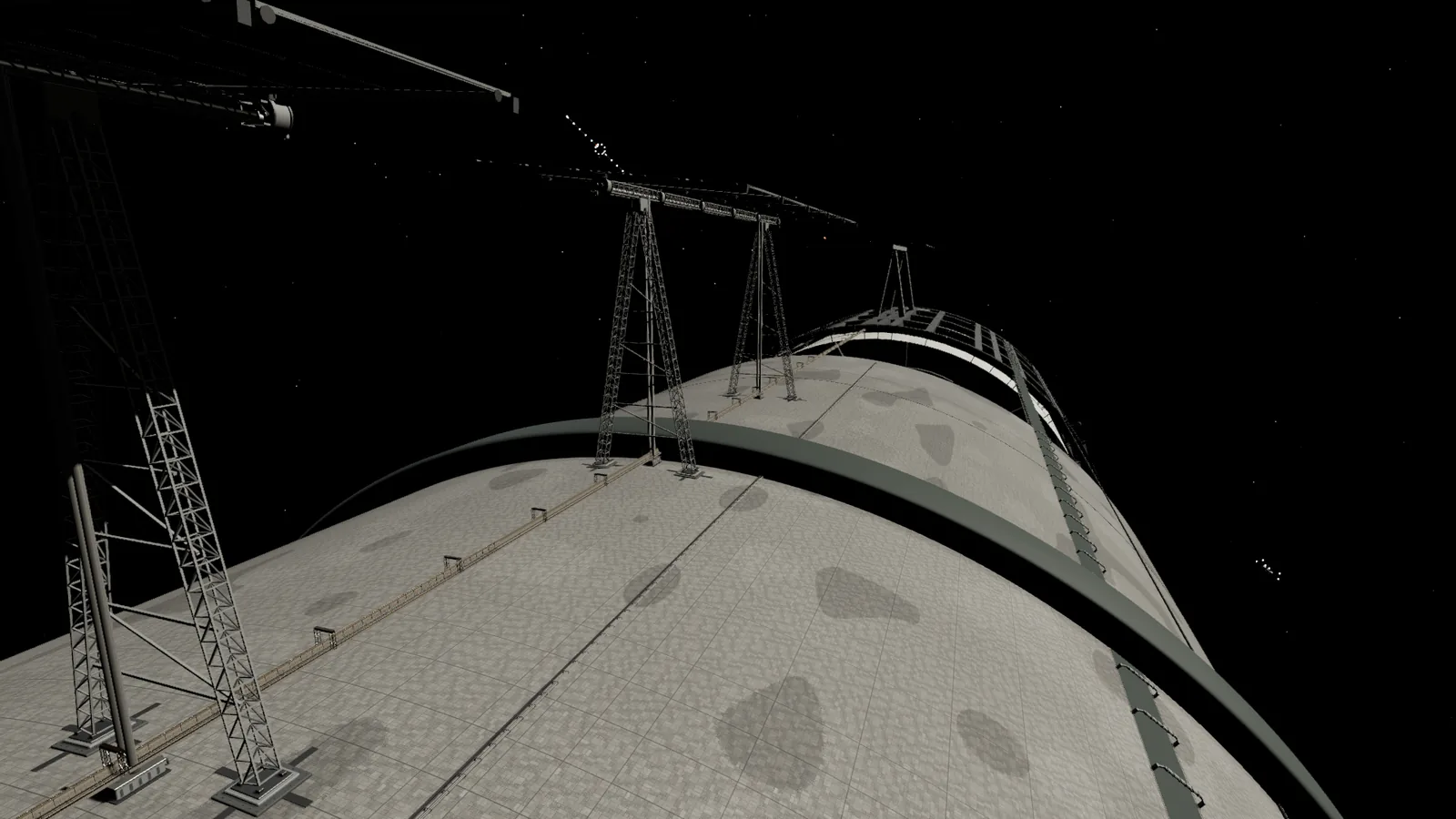
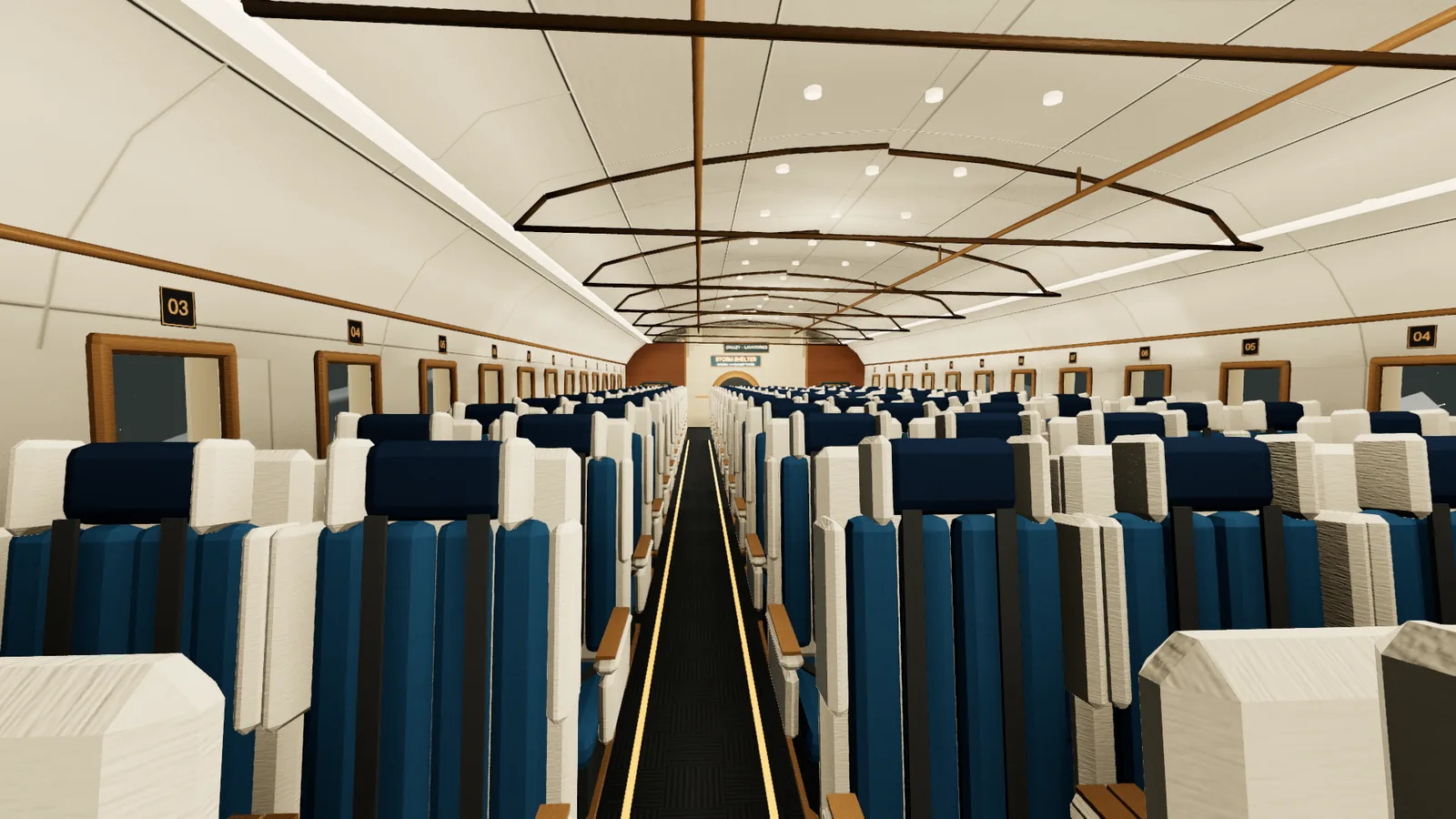
Open in the simulation: Ride the launch Open in the simulation: Launcher Track: External Open in the simulation: See the whole habitat
The delta-v budget
Delta-v is the change in speed a ship can make, the standard currency of spaceflight. After the launcher, the shuttle spends about 665 m/s on a one-way trip to Earth capture.
| Step | Delta-v | Where |
|---|---|---|
| Launcher | 540 m/s | The track, no propellant |
| Departure burn | about 250 m/s | Leaving L5 |
| Lunar swing-by | 0 | The Moon bends the path |
| Midcourse | about 20 m/s | Trim |
| Earth capture | 395 m/s | At 400 km perigee |
The return leg is estimated at 780 m/s. With methane and oxygen engines at 380 s specific impulse, the shuttle burns 68 tonnes of propellant for a round trip, 53 t of oxygen and 15 t of methane. The oxygen is the part that comes from the Moon. Only the carbon and hydrogen for the methane have to come from elsewhere (see materials). Established physics
Fifteen days and a Moon
The path takes 15 days. A transfer orbit is a path from one orbit to another. This one is slow on purpose: the shuttle spends time instead of propellant. At day 6, 42 percent of the way, the shuttle swings past the Moon with its engines off. A gravity assist lets the Moon's gravity bend the path, at no cost in propellant. From the window the Moon is huge: at the closest approach it is about 50 degrees across, a hundred times wider than it looks from Earth. Earth starts at 1.9 degrees and grows to about 10 degrees later in the trip. Established physics
Then comes the capture. At a perigee of 400 km the shuttle fires its engines for 395 m/s and enters a long orbit that reaches out to 70,000 km from Earth's centre, one lap in about 21 hours. This burn is what turns a fly-by into an arrival.
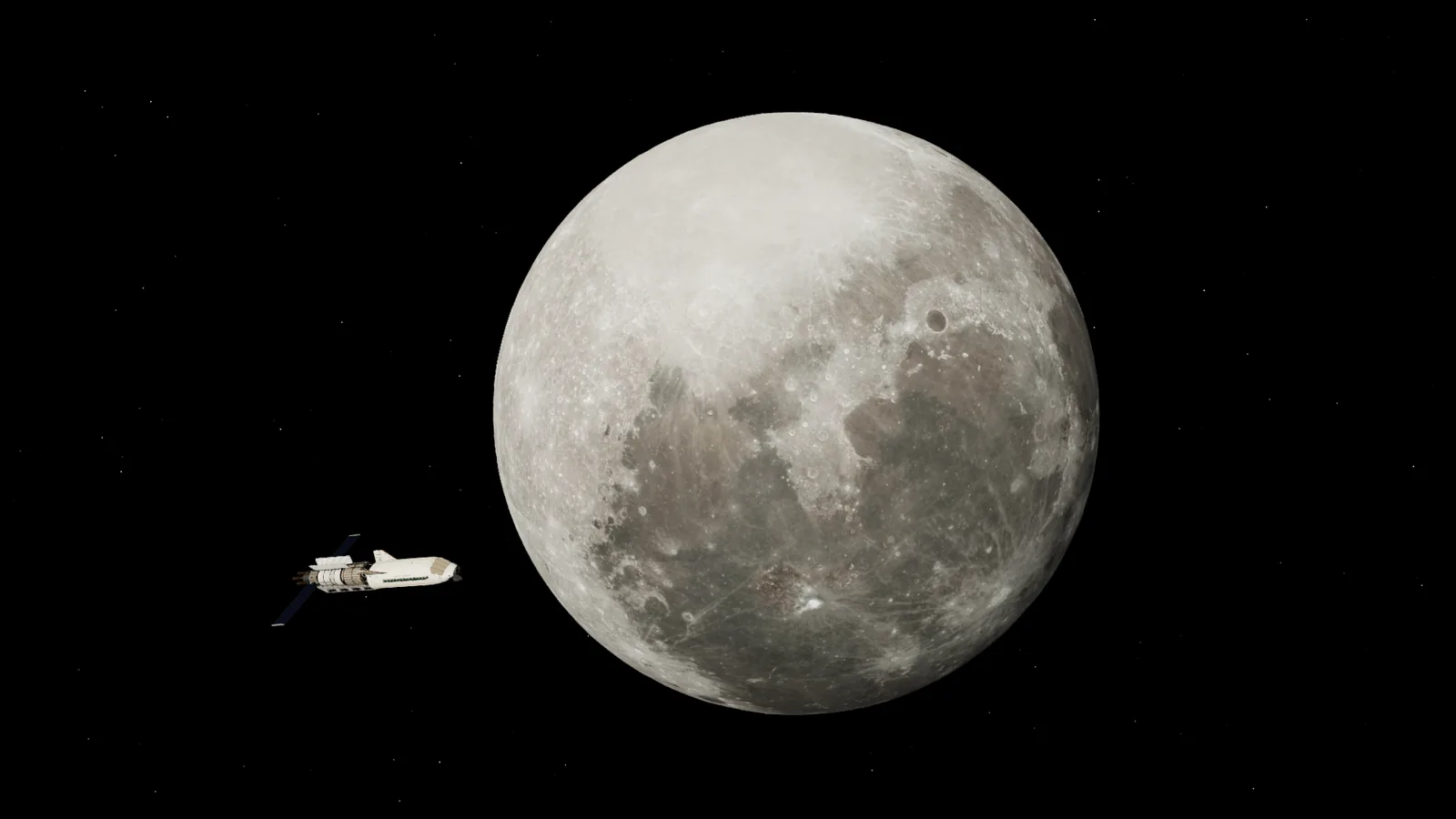
Open in the simulation: Fly past the Moon Open in the simulation: Home, seen from afar. Open in the simulation: Earth / Moon / Habitat Context
Entry and the shuttle
The Earth shuttle is a 64 m stack of two parts. The carrier holds propellant and four 160 kN methalox engines and never enters an atmosphere. The coach holds 98 couches, 96 passengers and 2 attendants, is built as a lifting body, and lands on a runway. The stack weighs 196 tonnes at launch and carries an 18 tonne water storm shelter. Design value
At the end of the transfer the coach separates and meets the air at 11 km/s. That is almost Earth's escape speed, the speed anything falling in from far away reaches, and it is the hardest part of the trip for the heat shield.
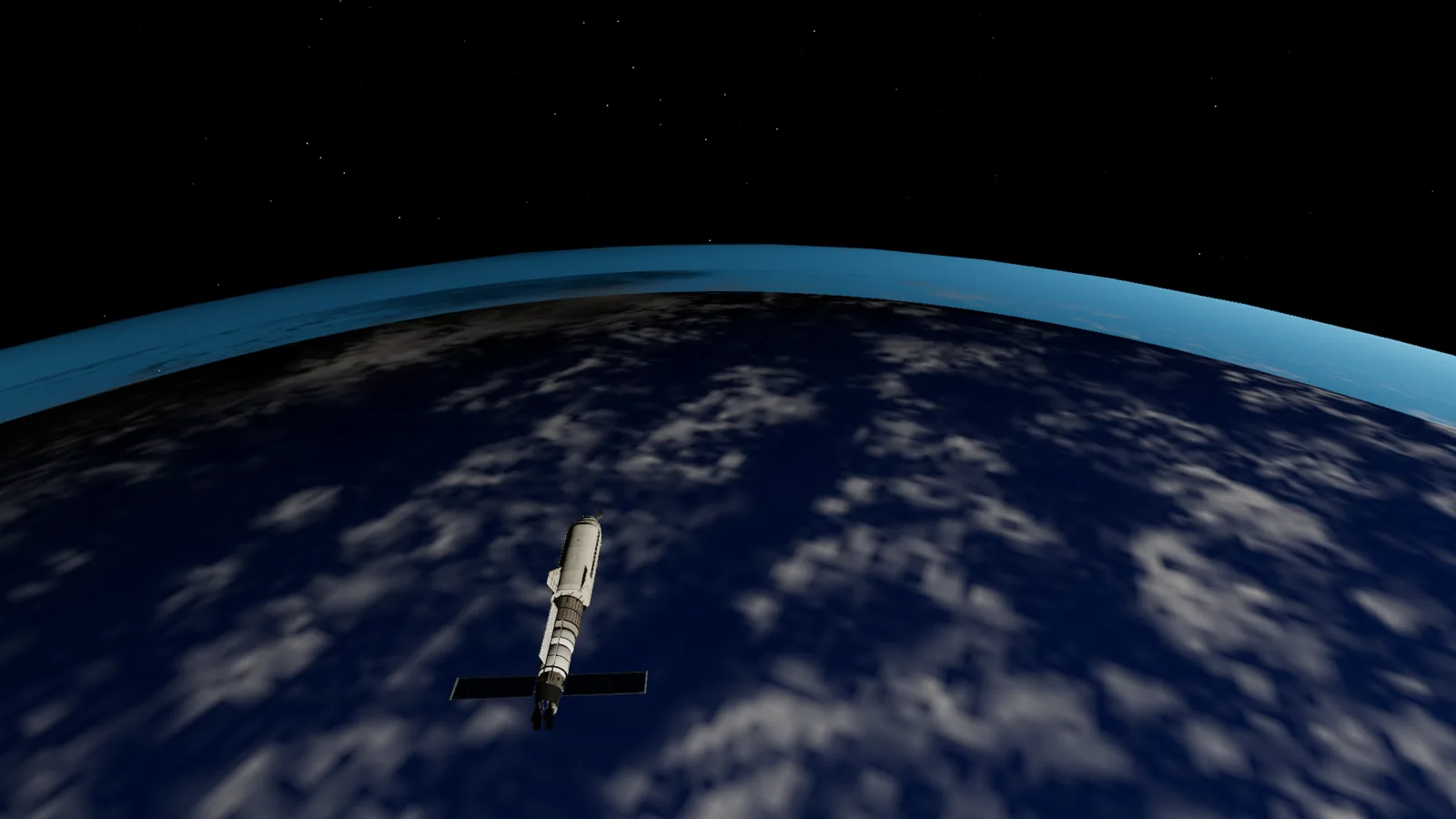
Open in the simulation: Arrive at Earth
Go deeper: Worked example: launch and entry Established physics
Launcher: a = 1.5 × 9.807 = 14.7 m/s². Over L = 10 km, v = √(2aL) = √(2 × 14.7 × 10,000) = 542 m/s, in t = v ÷ a = 36.9 s. The energy for a 196 t stack is ½mv² = 0.5 × 196,000 × 542² = 28.8 GJ, in line with 28.5 GJ over 37 s, an average of 0.77 GW.
Propellant: the exhaust speed of a 380 s engine is 380 × 9.807 = 3.73 km/s. By the rocket equation, Δv = vₑ ln(m₀ ÷ m₁), so 665 m/s needs m₀ ÷ m₁ = e^(0.665 ÷ 3.73) = 1.195, which is about 16 percent of the starting mass in propellant, one way, before the return.
Entry: a body falling from the Moon's distance to a perigee 120 km above the surface (r = 6,498 km) reaches, by the vis-viva equation,
v = √( μ × (2 ÷ r - 1 ÷ a) )
with μ = 398,600 km³/s² and a = (6,498 + 384,400) ÷ 2 = 195,449 km, v = 10.98 km/s. Earth's escape speed at that altitude is √(2μ ÷ r) = 11.08 km/s.
Sources and further reading
Real-world sources
- "Lagrange Points of the Earth-Moon System", HyperPhysics, Georgia State University: hyperphysics.gsu.edu.
Concordia design documents
- Concordia engineering specification, sections 2, 31, 32 and 42, and the Earth shuttle and aft-end design notes.