What you see
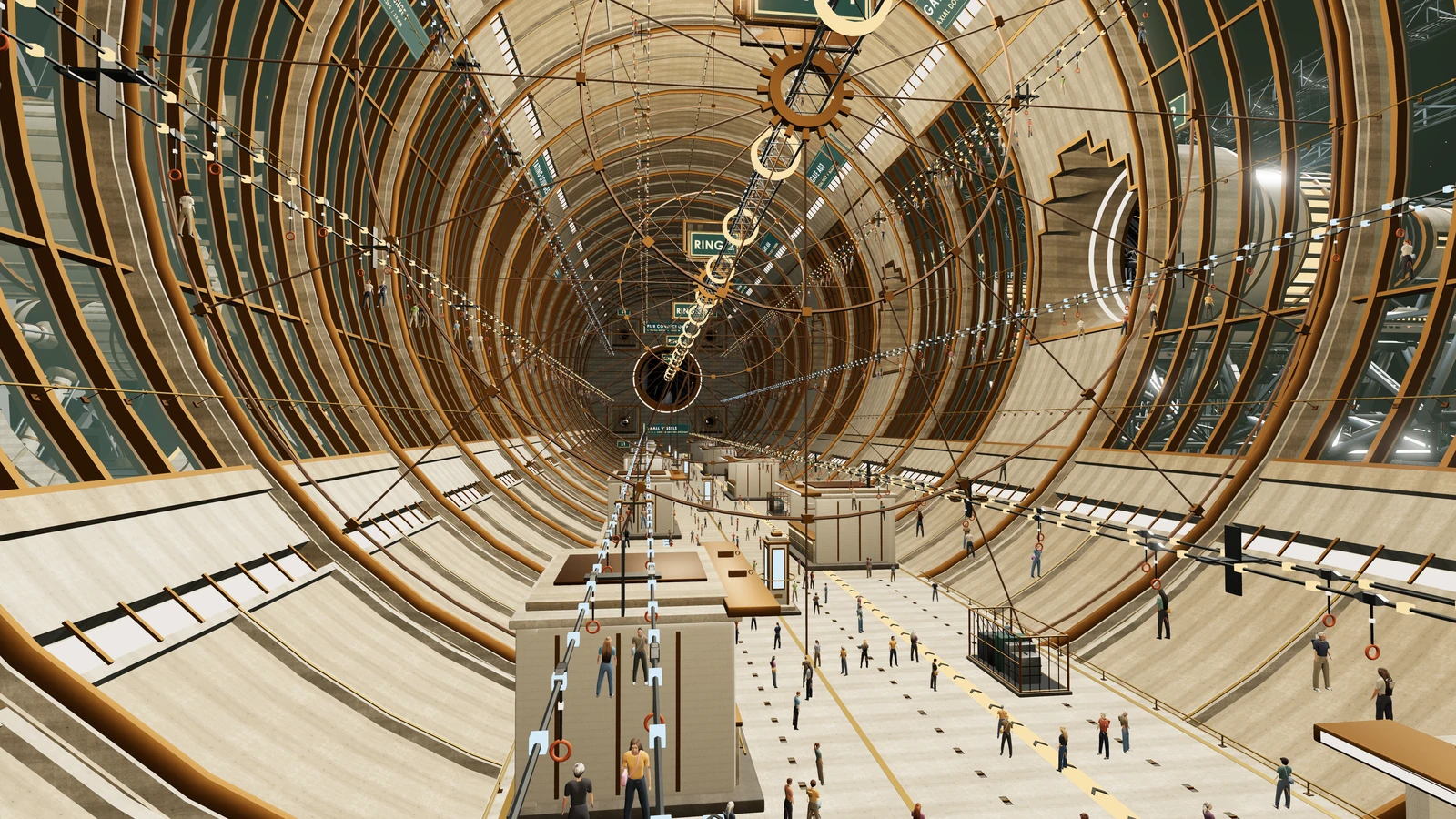
The terminal is one long tube, 440 m by 84 m across, in the same Art Deco language as the city: stone ribs every 20 m, warm light coves and bronze-framed windows. Only the space people use is pressurized, so it holds about 2 million cubic metres of air, not 55 million. One flank looks onto the axial bay, so berths and craft are always in view; the other looks out at the three lounge wheels turning in the open. It is stationary and in zero g. "Up" is where the lamps are, and a stone deck below carries the shops.
Arrival follows one path. The express ends at the spine terminus. A walkway 56 m wide carries you to a monumental arch under a lit panel reading WELCOME TO CONCORDIA. Then three rings across the tube: health screening, customs with eight lanes, and security with eight arches. Then the concourse. Nobody is ever more than 15 m from something to hold: eight conveyor lines of grab handles carry travellers along the tube at walking pace (amber lines to the gates, blue to the lounges), a cable runs down the axis, and a catch net spans the tube every 60 m.
Five gates, A01 to A05, open off the bay flank. Each has an arch in the shell, a gate pod, a telescoping boarding bridge 60 m long and a berth in the axial bay for a docked craft. At the east end a dock hall holds the passenger trunk to pier P1 and four small docks, S1 to S4, for couriers. Crews reach cargo and tug bays by their own route, so freight never shares a bridge with passengers.
Comfort lounges
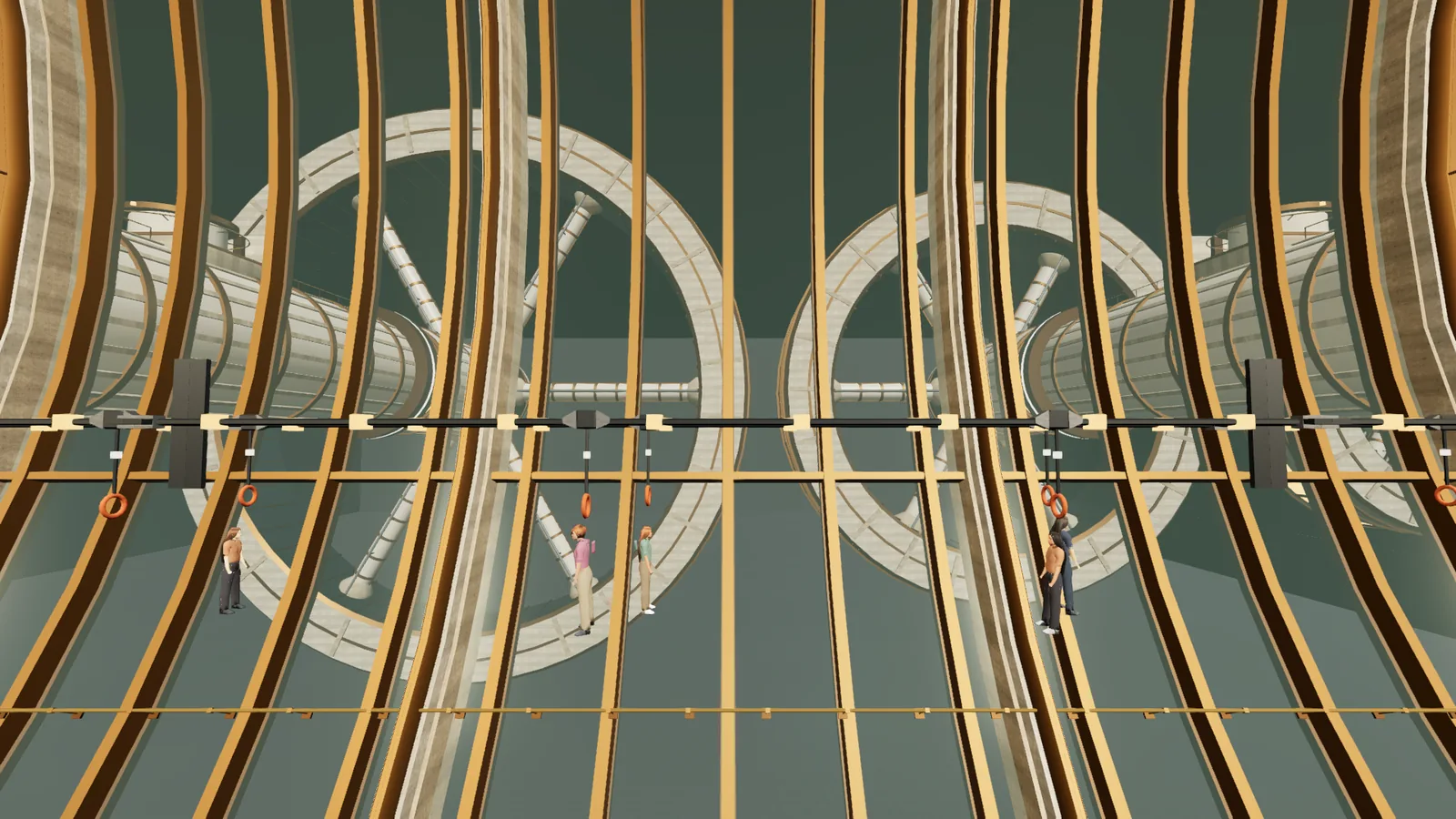
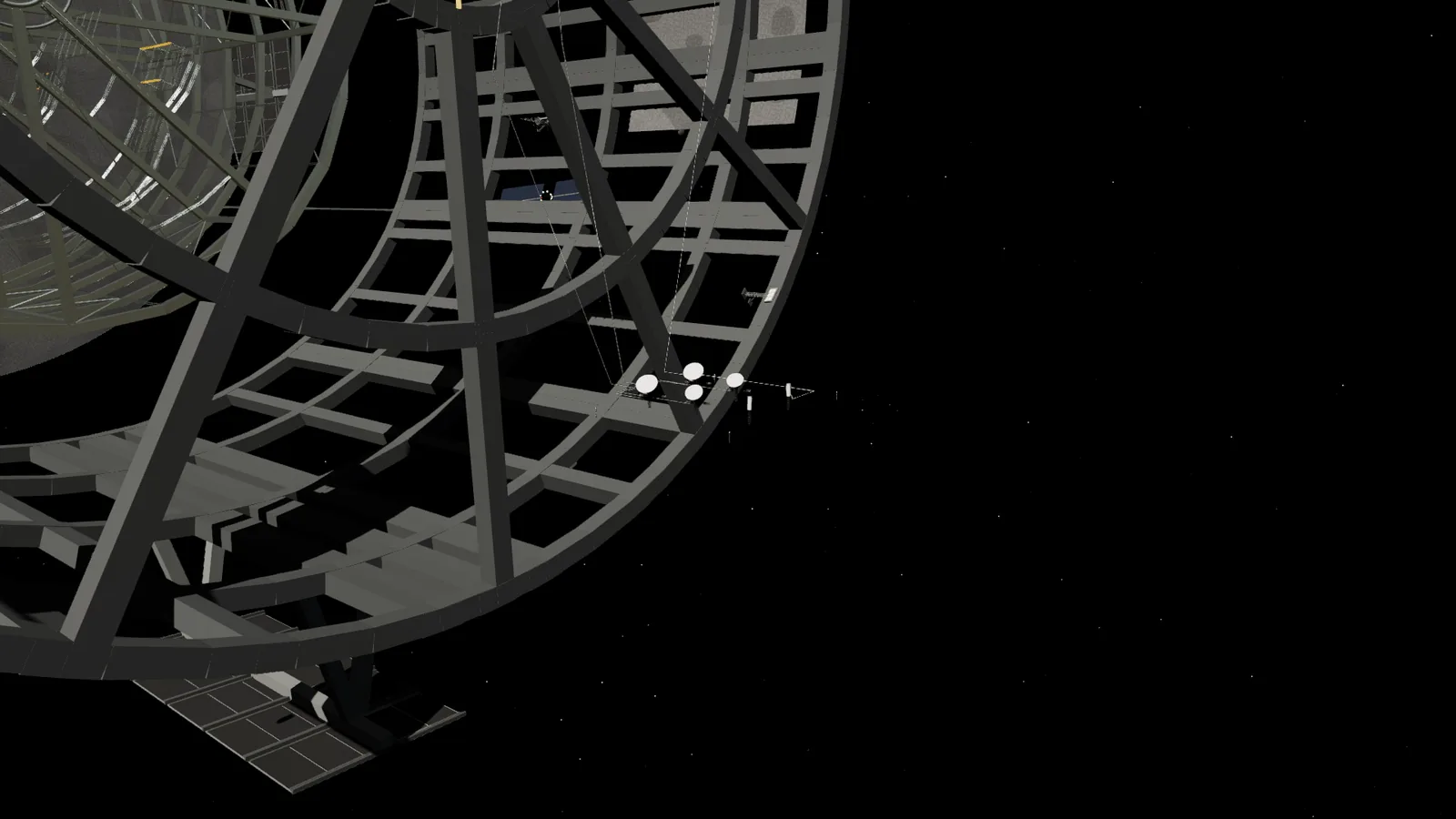
Three wheels beyond the far flank give travellers a rest from weightlessness, at 0.13 g, 0.20 g and 0.28 g. You float to the stationary hub, enter a transfer chamber spun to match, and ride a spoke to the rim to find restaurants, sleeping rooms and a quiet deck.
Piers and the propellant farm
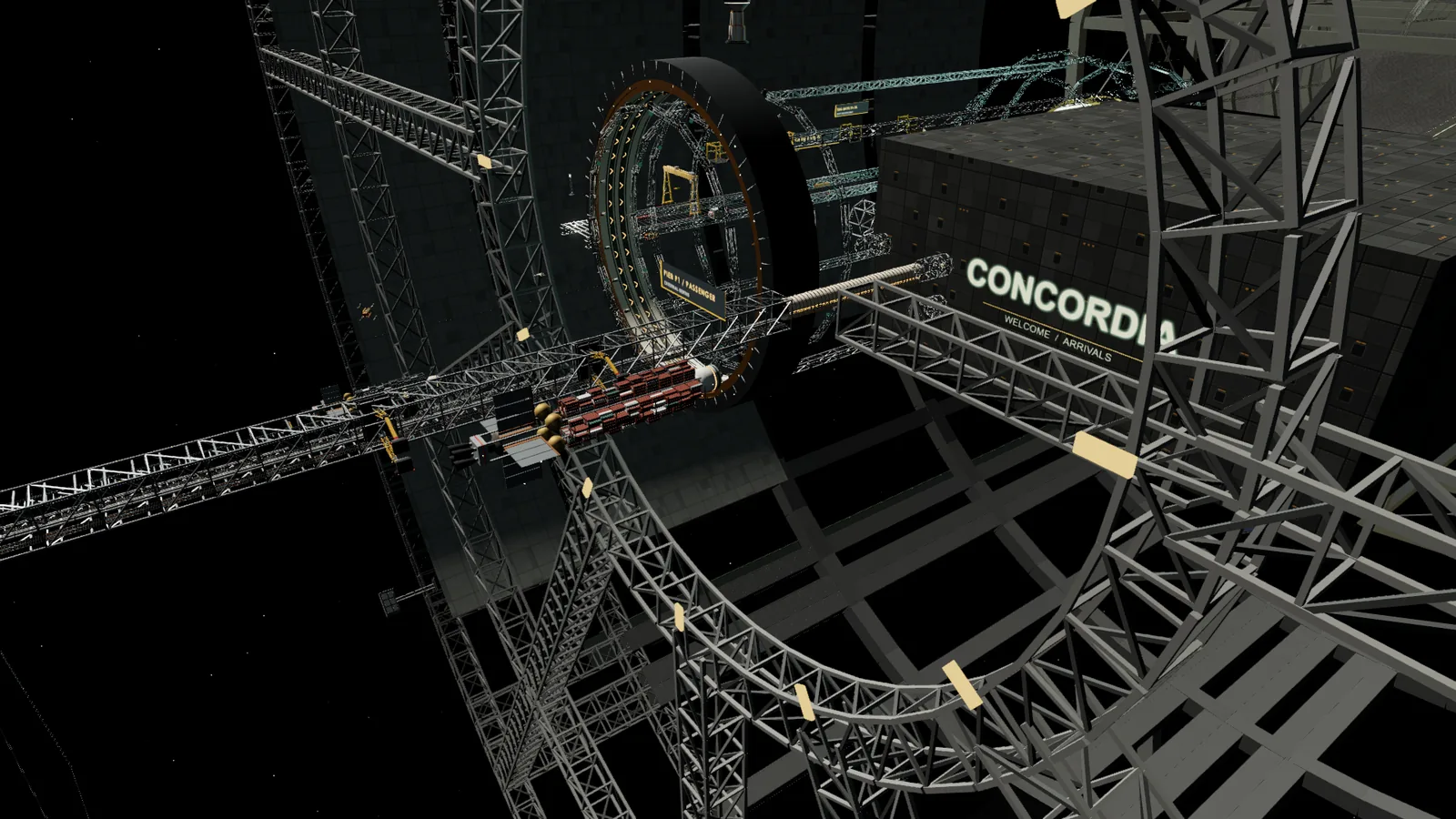
Large ships do not dock inside. They berth at three piers on the outer face of the port, each a deep truss running 900 m. Articulated arms clamp a ship alongside, and freighters are 260 m long. Pier P1 is the passenger pier, with a pressurized trunk that runs straight on from the axis of the terminal.
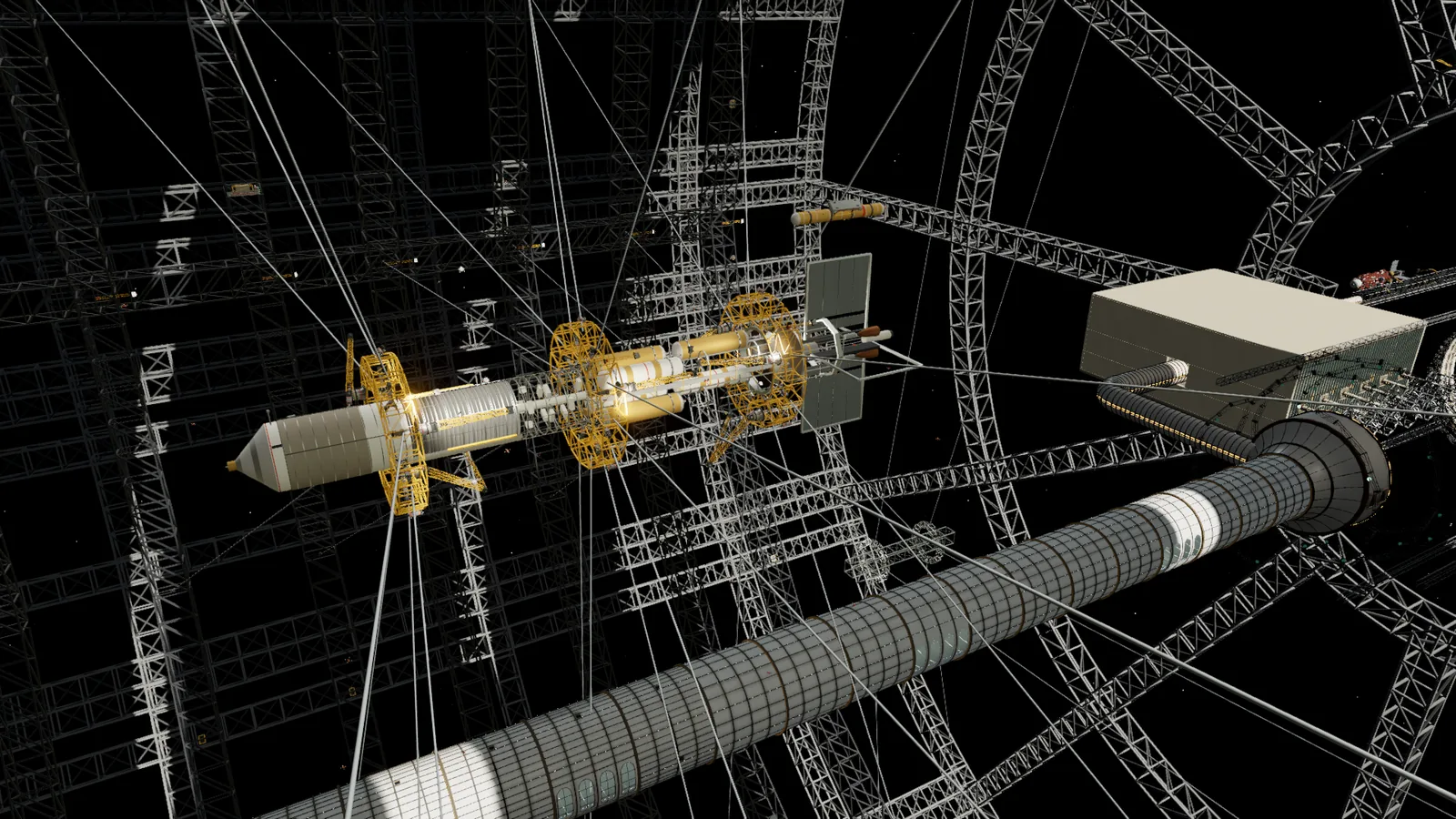
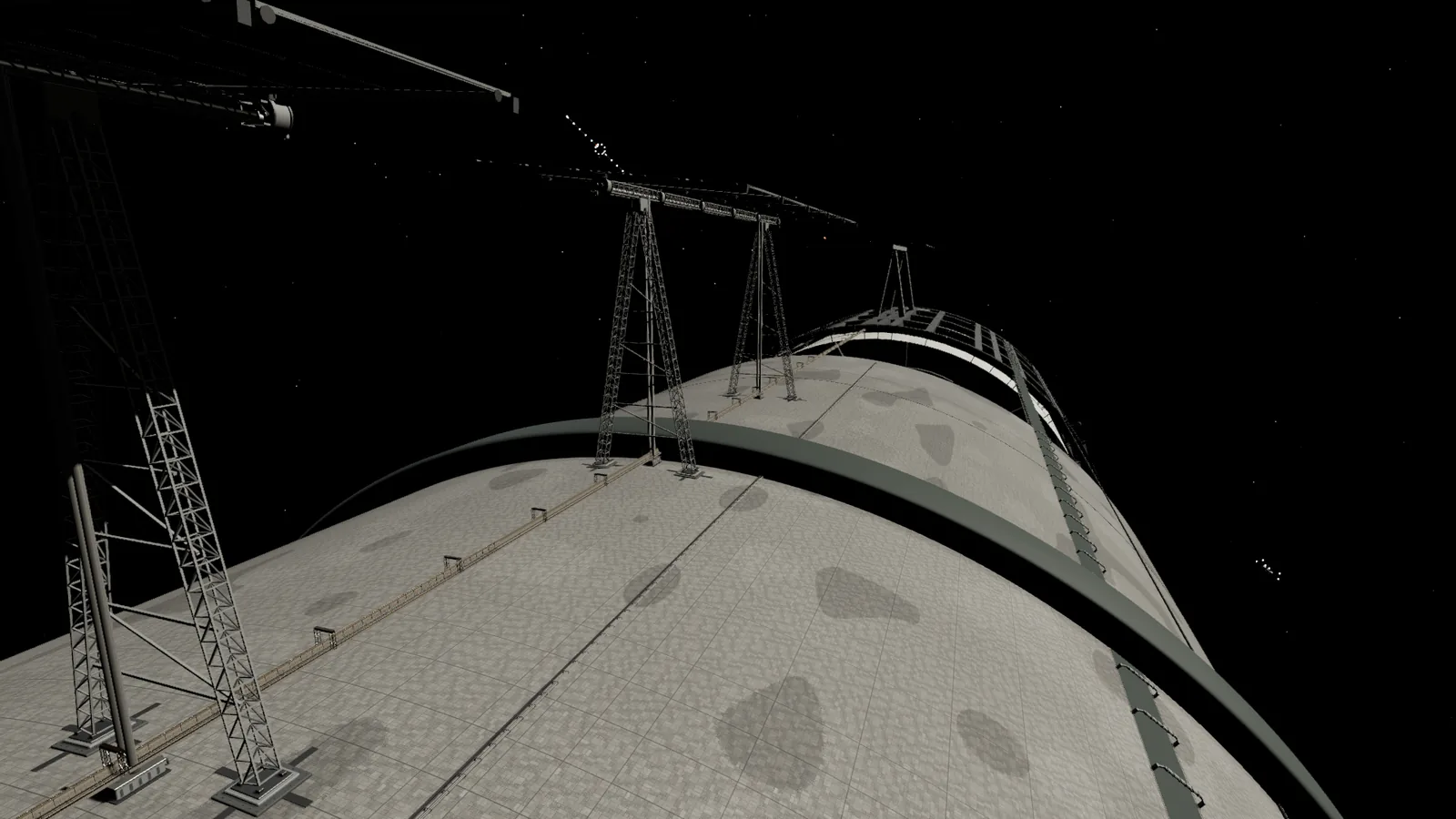
Beyond the piers, outside the station body, is the propellant farm: two liquid hydrogen spheres, two liquid oxygen spheres and two storable-propellant cylinders under sunshades, with cryocoolers that re-liquefy the boil-off. It sits clear of the approach lane and well away from the city's pressure vessels, so a tank failure cannot reach a home.
How it works in brief
Passengers leaving for Earth do not use a gate. They take the express to the launch berth and ride a launcher along a track outside the hull. That story is in Getting there. The express that brings you here is described in The axis and the spine.
Key numbers
Go deeper: Lounges and docking
All three lounges turn at 2.0 rpm, comfortable for a short stay, and differ only in radius.
| Lounge | Radius | Gravity | Rim speed |
|---|---|---|---|
| L1 | 62 m | 0.28 g | 13.0 m/s |
| L2 | 45 m | 0.20 g | 9.4 m/s |
| L3 | 30 m | 0.13 g | 6.3 m/s |
Lounges 1 and 3 turn one way and lounge 2 the other, so most of their angular momentum cancels. A gate berth is an octagonal cradle 85 m deep with four capture arms and a docking collar 5.5 m in radius.
The propellant farm begins about 11,420 m along the station, at least 355 m outside the 1,500 m approach cylinder and about 1.4 km beyond the nearest defence battery. The farm holds spheres of 16 m radius (hydrogen) and 12 m radius (oxygen), and cylinders of 6 m radius.
Visit
Open in the simulation: Passenger Spaceport Terminal Open in the simulation: Spaceport Arrival Face Open in the simulation: Spaceport Concourse A Open in the simulation: Spaceport Gate A03 Open in the simulation: Spaceport Rotating Lounges Open in the simulation: Spaceport External Pier
Nearby
The zero-g shipyard
The shipyard is a stationary vacuum yard about 3.5 km long, with no floor and no up.
The axis and the spine
At the centre of every rotor you weigh almost nothing, and a stationary tube 120 m wide runs the whole length of the station.
The exterior
From outside, Concordia is a grey cylinder 21 km long and 6.2 km wide.