What you see
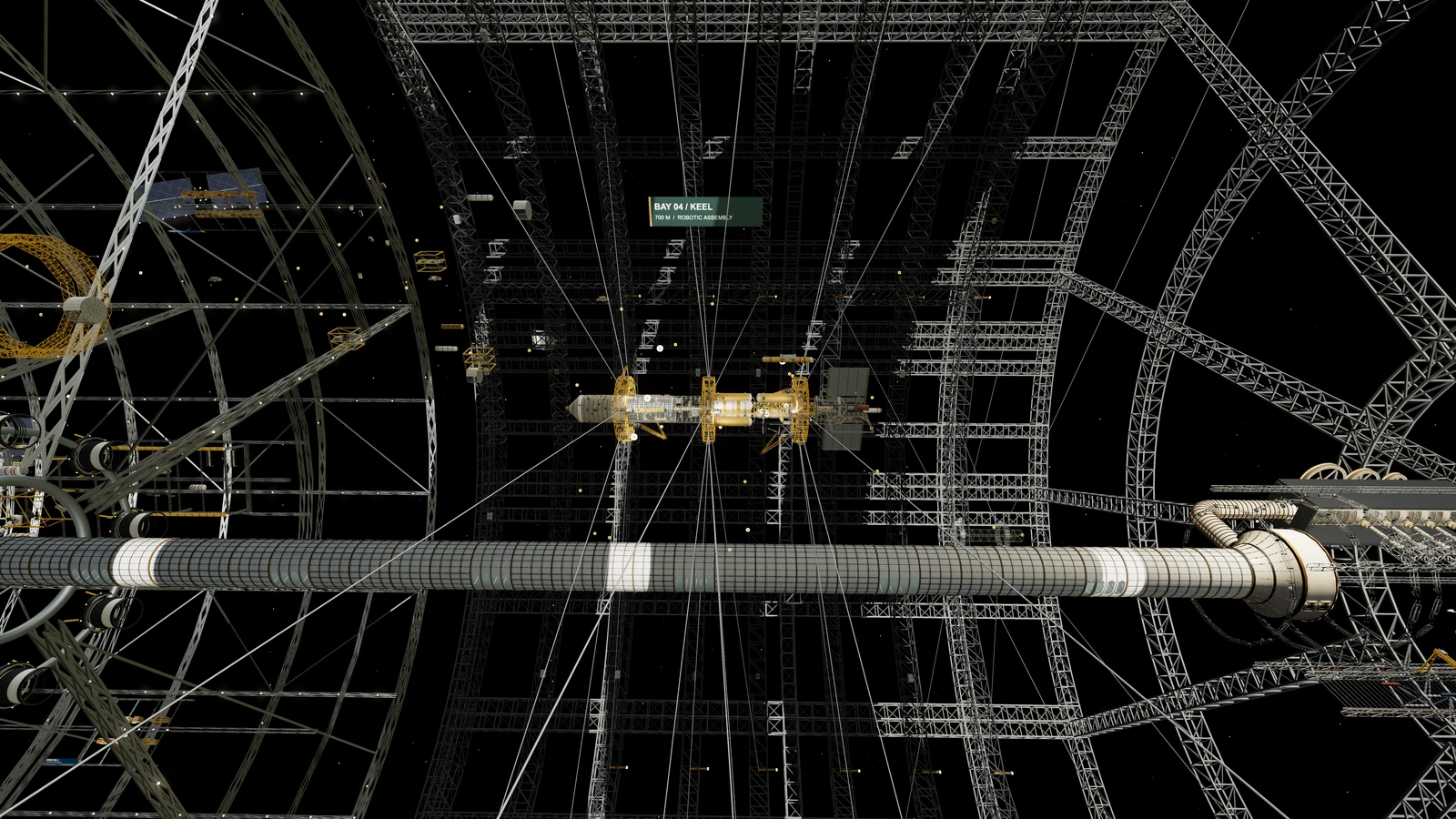
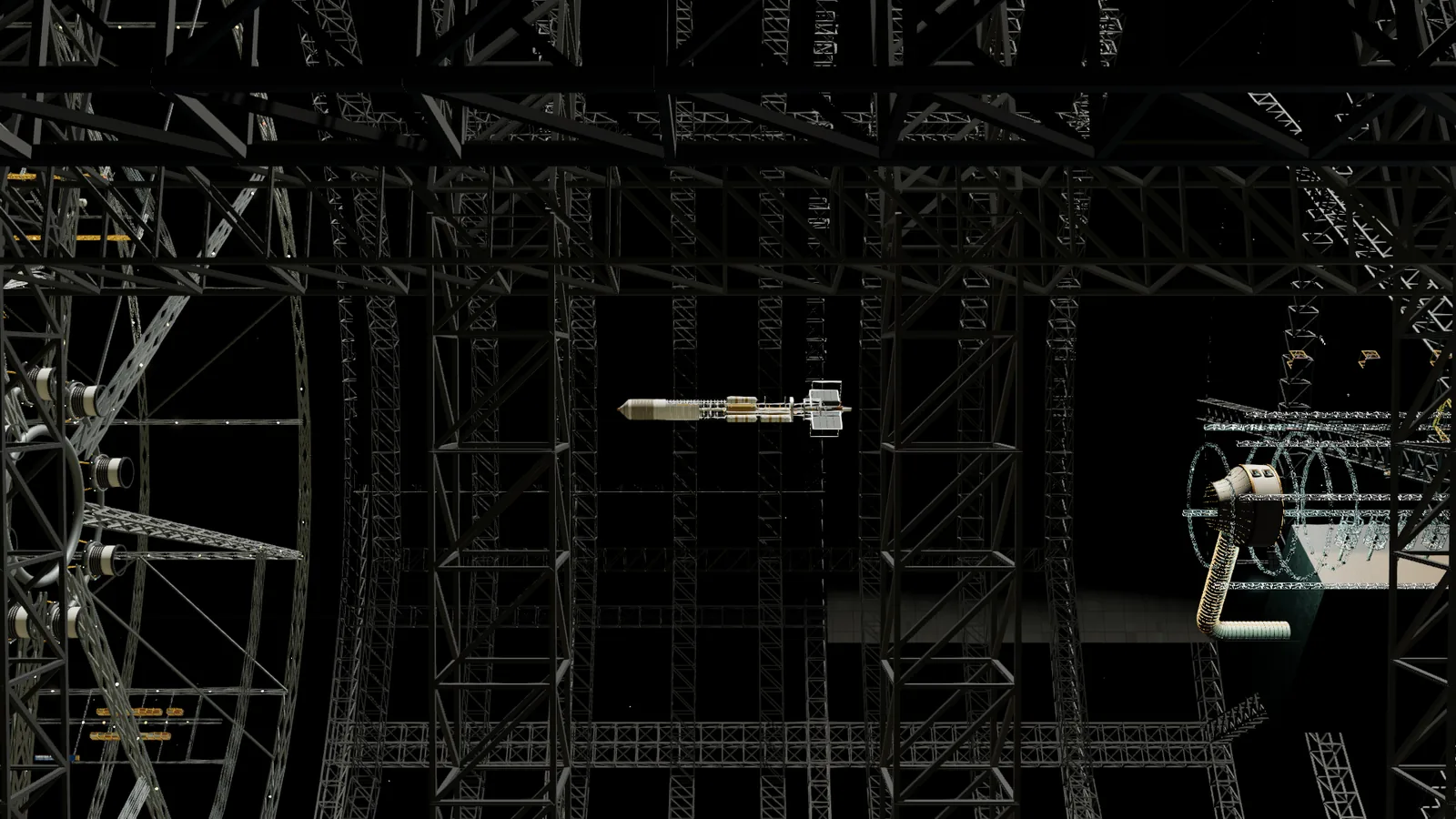
The yard sits at the forward end of the station, between Ehricke (the industrial rotor) and the spaceport. A frame of eight huge rim rings, each a 16-sided lattice 5 km across and 100 m deep, joined by eight longerons, encloses the work. The shell here is an open cage, so the yard is visible from outside and the Sun shines in.
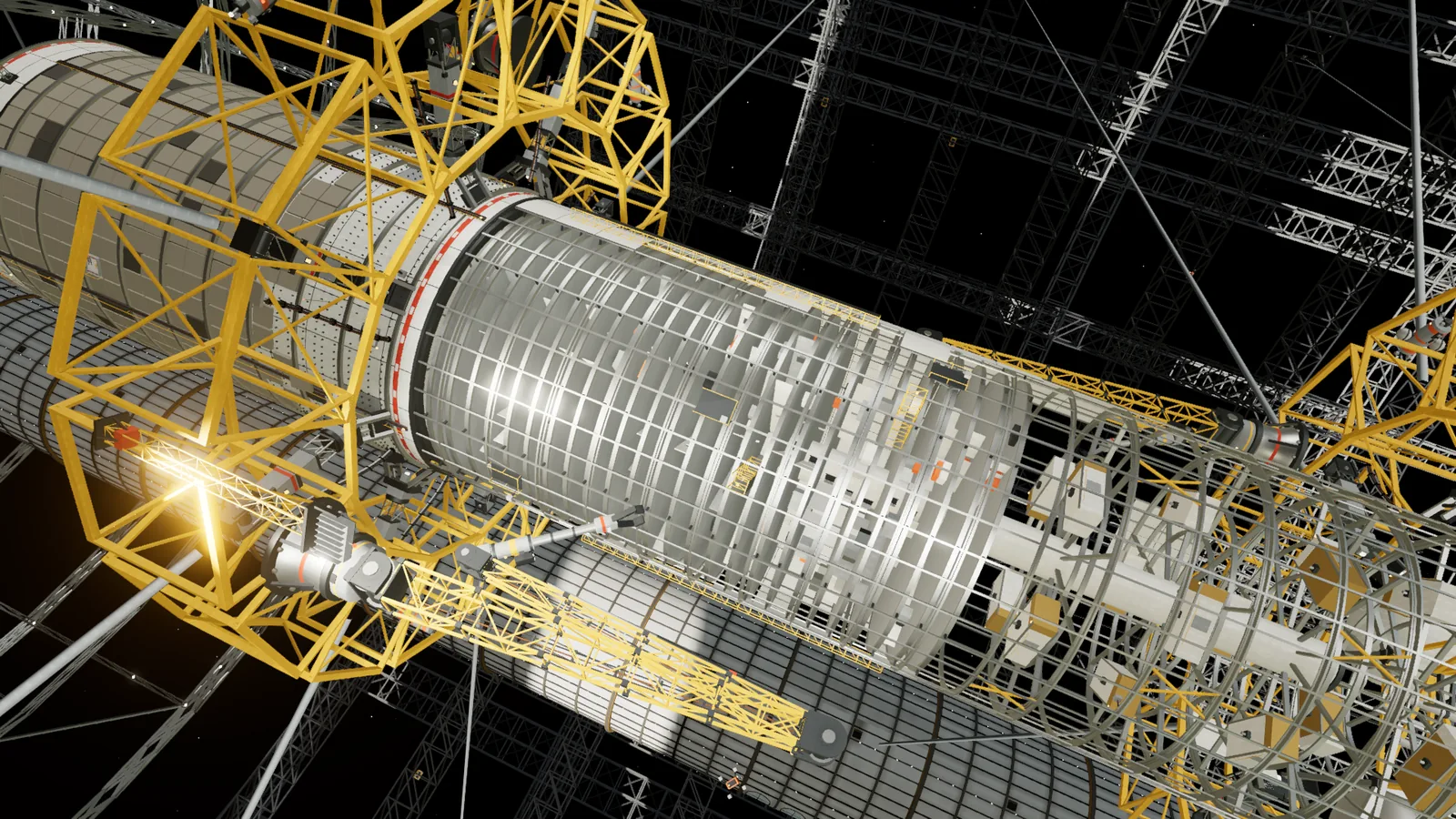
At its centre floats Meridian 04, the fourth hull of a long-haul crew and cargo class. She is 700 m long and 76 m across her tanks, and she is unfinished. From the bow back, her skin is white and gold. Then comes a crew drum with its shielding plates about 60 percent on, then a drum cut open to show 25 stacked decks, then a bare frame with cabin pods waiting beside it. Eight hydrogen tanks sit on a keel truss, some wrapped in foil and some still empty cradles. At the stern are the reactor behind its shadow shield, four radiator wings and four engine mounts, two of them fitted.
How a ship is held
Nothing carries her weight. Three open lattice rings, each with eight padded capture arms, touch the hull only at structural frames. Each ring hangs from the yard ribs on 8 to 12 pre-tensioned lines, 1.8 m thick and 2 to 2.5 km long, spread like a web. Nine small tugs fire short pulses to hold her still when a tank is delivered and shifts the centre of mass.
Tanks, drums, truss lengths and cabin pods arrive from the industrial rotor's logistics end on cargo movers, then cross a straight lane to the ship at 20 to 40 m/s, braking over the last 200 m.
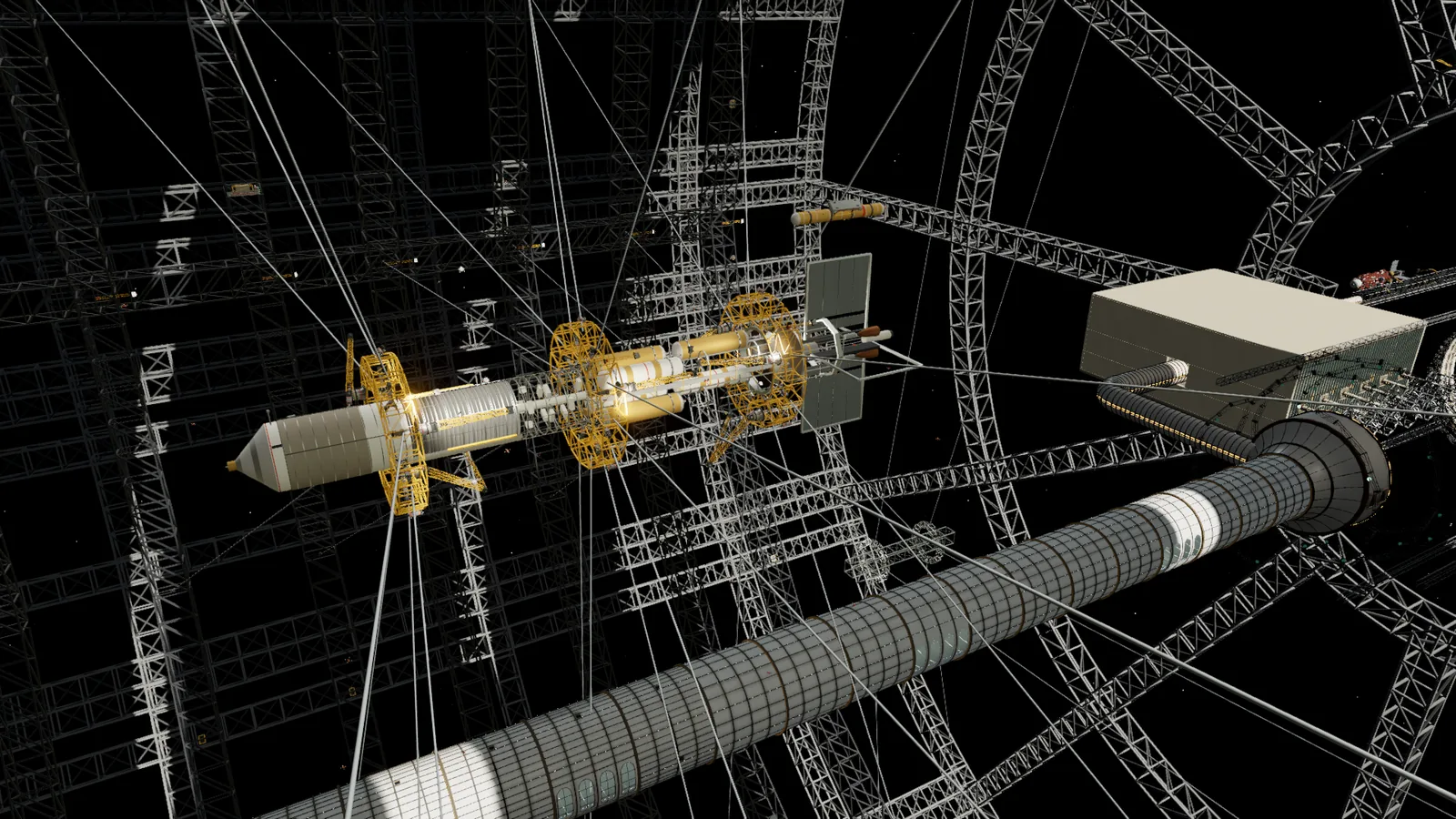
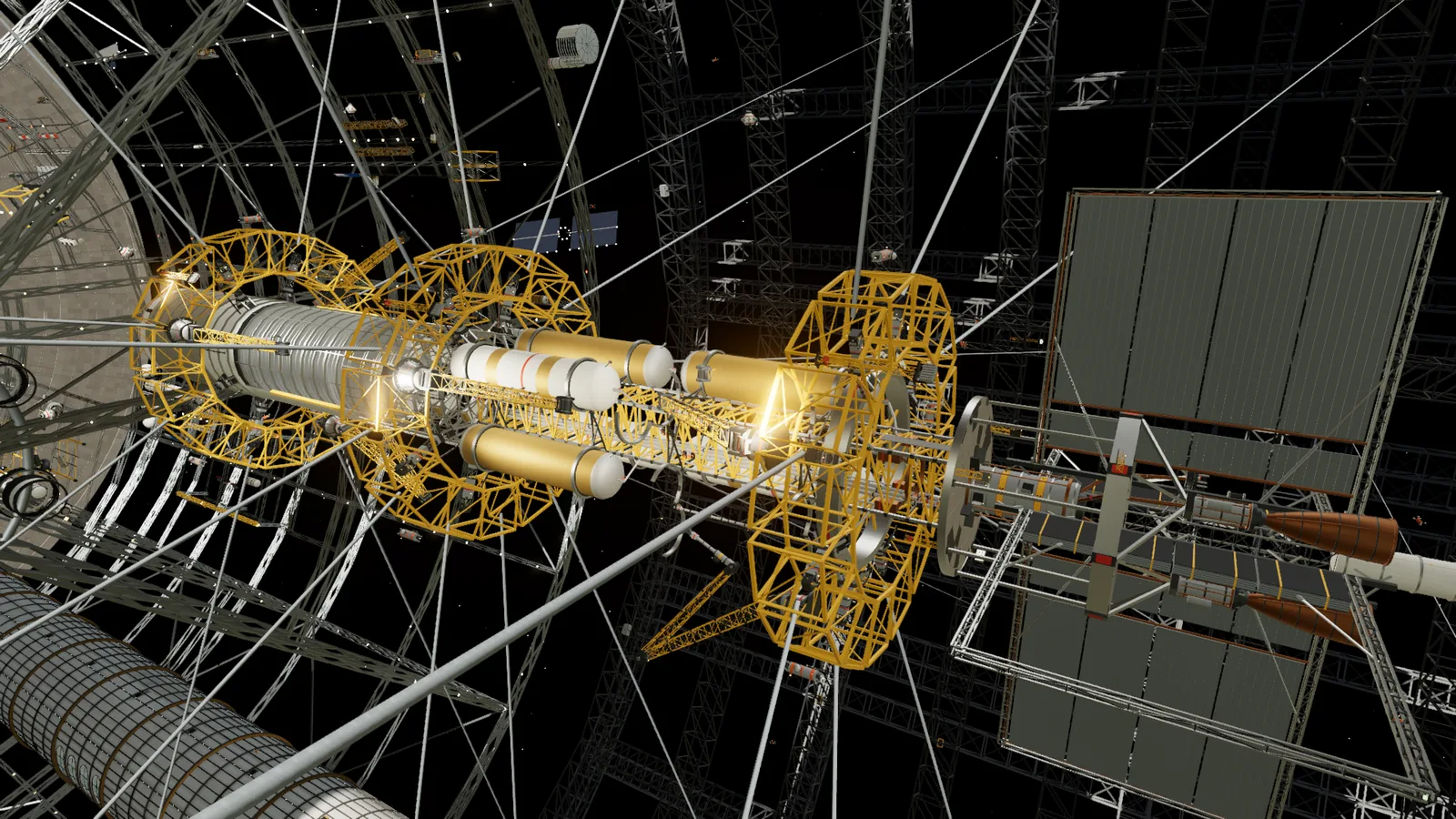
About 40 drones carry fasteners and inspection cameras. Eight heavy manipulators, reaching 80 to 150 m, place the modules. Crawlers weld and sinter seams. Six pressurized capsules hold people near the open section, so a person can look at the work in person without an EVA.
Why zero g
Gravity makes big structures expensive. A very large tank, a truss kilometres long or a telescope mirror needs no extra strength to hold itself up in the yard, only to survive its working loads. The yard is reserved for jobs that gain from weightlessness or hard vacuum: spacecraft assembly, very large tanks, telescope assembly, truss fabrication, vacuum metallurgy and oversized additive manufacturing. Finished ships leave radially through the open cage.
The material comes from the industrial rotor next door. See The industrial rotor for the stores and Materials for the lunar and asteroid sources. For what a ship like this does once she leaves, see Getting there: she is nuclear-thermal, with a specific impulse of about 900 seconds.
Key numbers
Go deeper: Meridian 04 in detail
Meridian 04 holds about 226,000 m³ of liquid hydrogen in eight tanks, each 20 m across and 90 m long, and masses 25 to 30 kt dry. The reactor sits about 300 m behind the crew drums, so distance plus a shadow shield does most of the radiation shielding. That sets the class length of 500 to 800 m: a shorter hull cannot hold this much hydrogen with the reactor that far back.
At 70.8 kg/m³ the hydrogen is about 16,000 t. With an exhaust speed of 900 × 9.81 = 8.8 km/s and a 27,500 t dry ship, the rocket equation gives Δv = 8.8 × ln(43,500 ÷ 27,500) = about 4 km/s on full tanks.
| Zone | Length | Content |
|---|---|---|
| A, Receiving gate | 450 m | module convoys arrive from the industrial rotor |
| B, Stockyard | 700 m | spare tanks and hull drums on racks |
| C, Bay 04 | 1,500 m | the hero ship, with a clear void of 1.2 km around her axis |
| D, Outfitting | 500 m | a keel-only cradle for the next hull, and the engine and radiator test stand |
| E, Sun gate | 350 m | the floodlit last frame before the spaceport |
The ship sits 450 m above the spine, which keeps the spine's transfer line clear. Her stern is at x = 8,470 m and her bow at x = 7,770 m.
Visit
Open in the simulation: Zero-G Shipyard: Hero View Open in the simulation: Shipyard: Close Construction View Open in the simulation: Shipyard: Open Pressure Section Open in the simulation: Shipyard: Tank Bay and Delivery Open in the simulation: Exterior QA: Shipyard Through the Cage
Nearby
The industrial rotor
Ehricke, the industrial rotor, is the factory floor. It is a skeleton of rings and girders 3.5 km long, turning opposite the city rotors, with refineries, tank farms, container...
The spaceport
Everyone who arrives from Earth or the Moon comes through the spaceport at the forward end.
The exterior
From outside, Concordia is a grey cylinder 21 km long and 6.2 km wide.