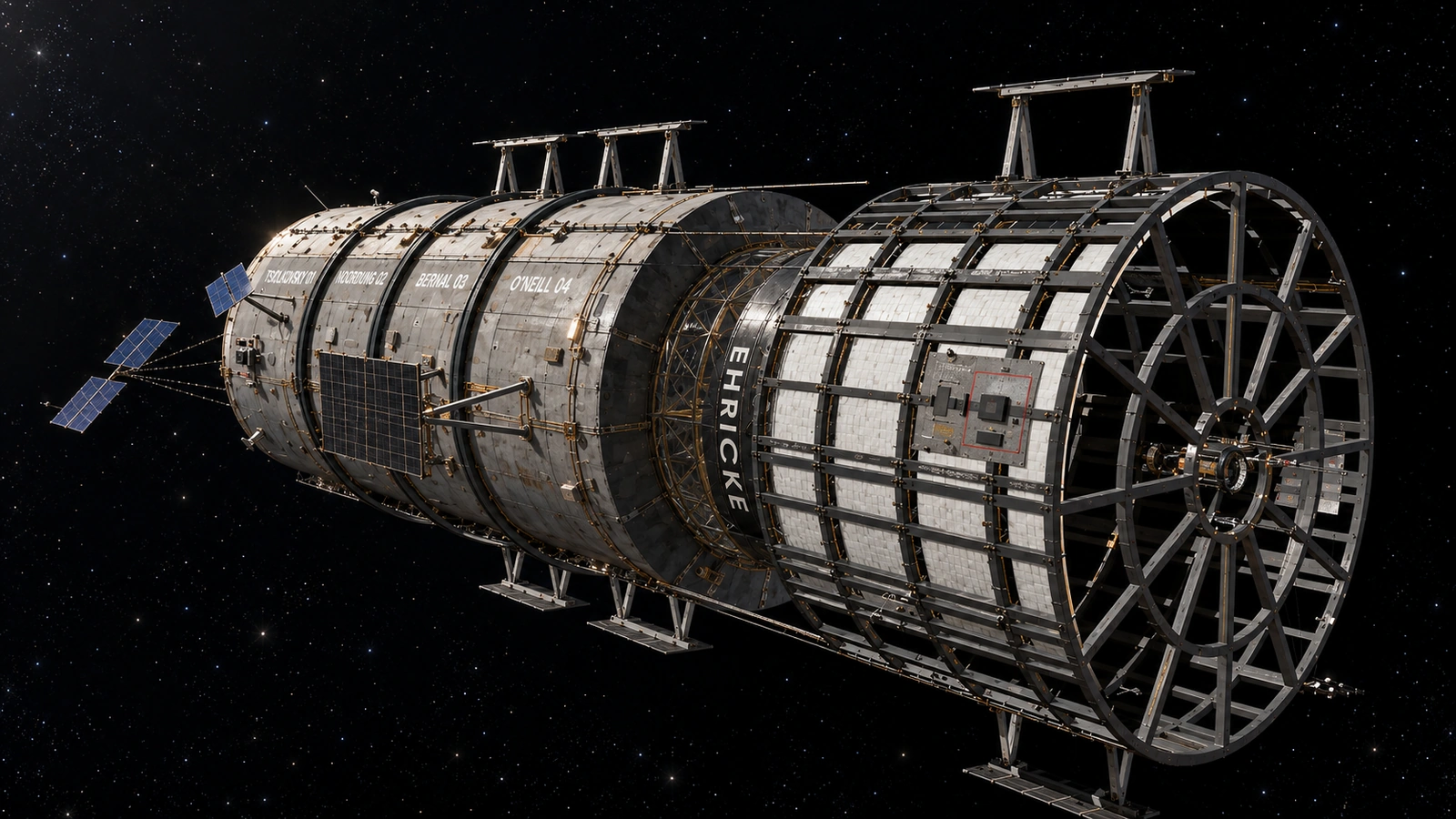
The hull
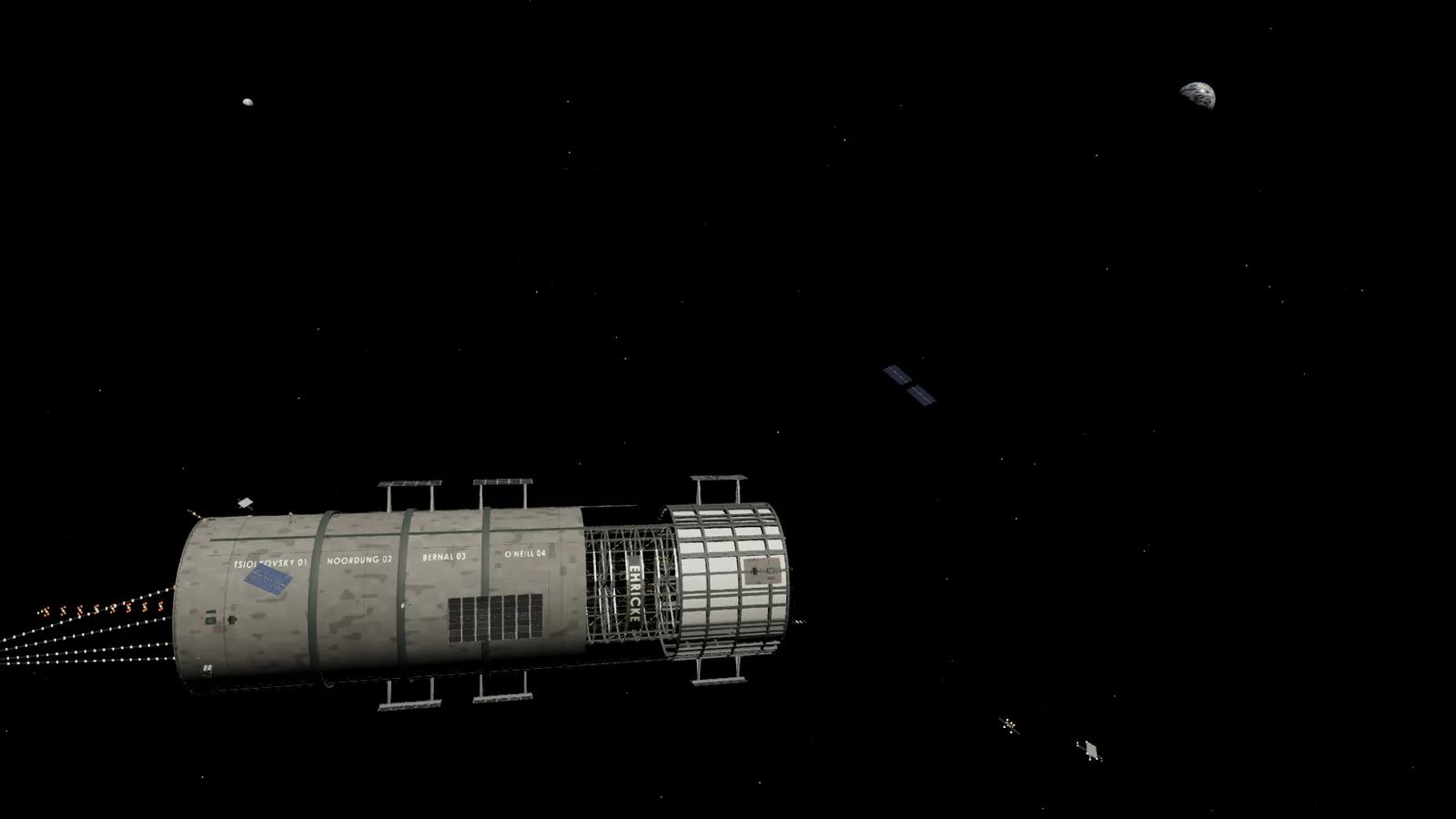
The outer shell is a deep open truss with removable shielding cassettes on its surface. It is not the pressure vessel: the habitat's air is held hundreds of metres inward, so a punctured panel does not open a home to space. The cassettes are compacted regolith and slag in 32 m tiles, 609 around the ring, between ribs every 128 m along the axis and every 96 m around it.
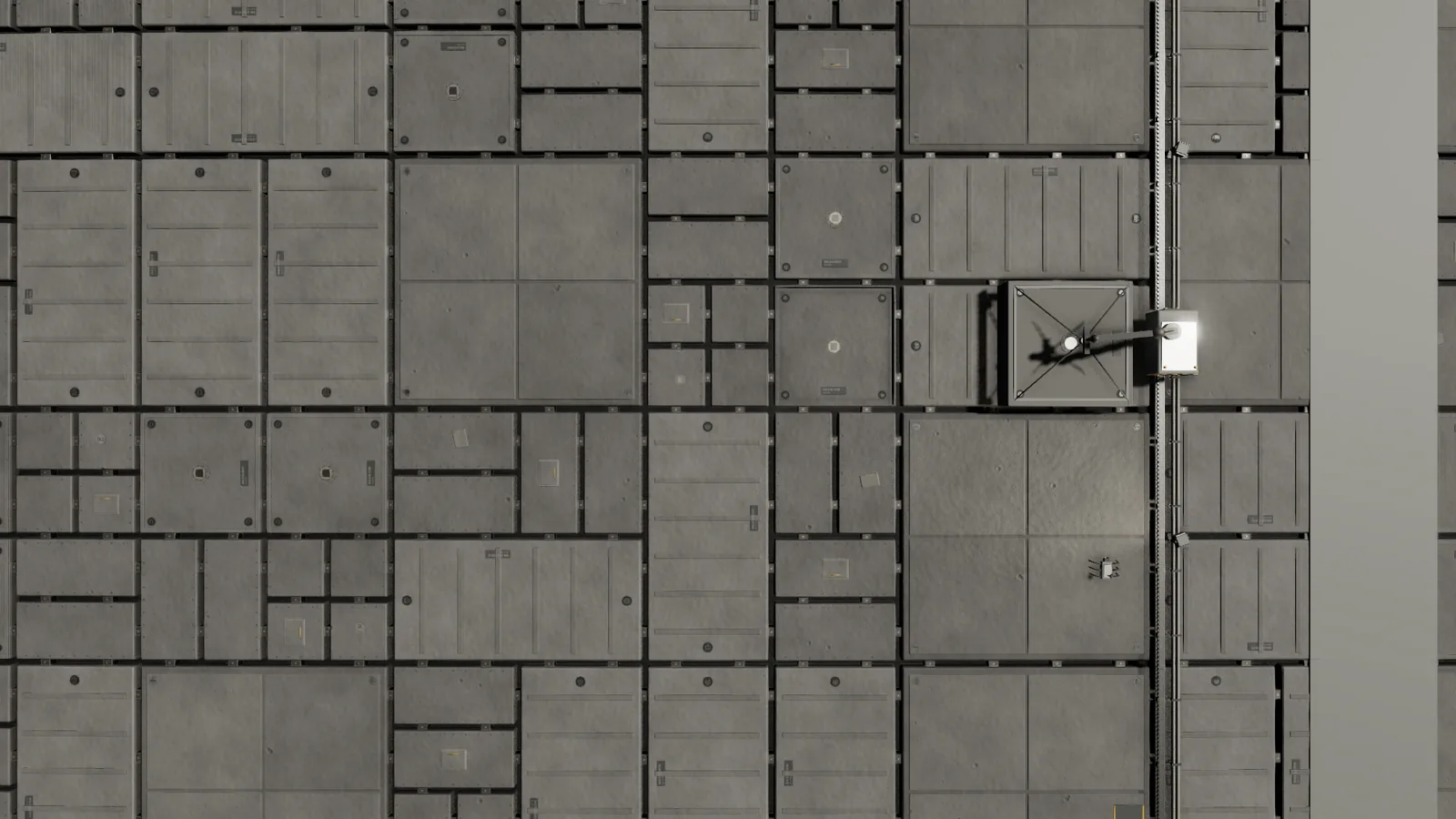
The skin looks patched because it is. Cassettes come in four types, fitted over the years and replaced as they wear, so some panels are years older than others. Rails run along the hull for crawlers that swap them. The shielding is broken in two places: over the open industrial bay, and from the shipyard to the port, where an open cage lets finished ships leave. See Radiation and debris for how the stack works.
Radiators, dishes and arrays
Nearly all of the station's electricity and body heat ends up as heat, and in space it can only leave as light. Eight radiator banks stand off the hull on pylons, 248 panels of 400 by 200 m in all, running at 380 to 500 K. Each bank turns slowly to keep its edge to the Sun. Four dish stations carry 170 m reflectors and optical terminals, and one backup PV collector stands on a 1,100 m mast.
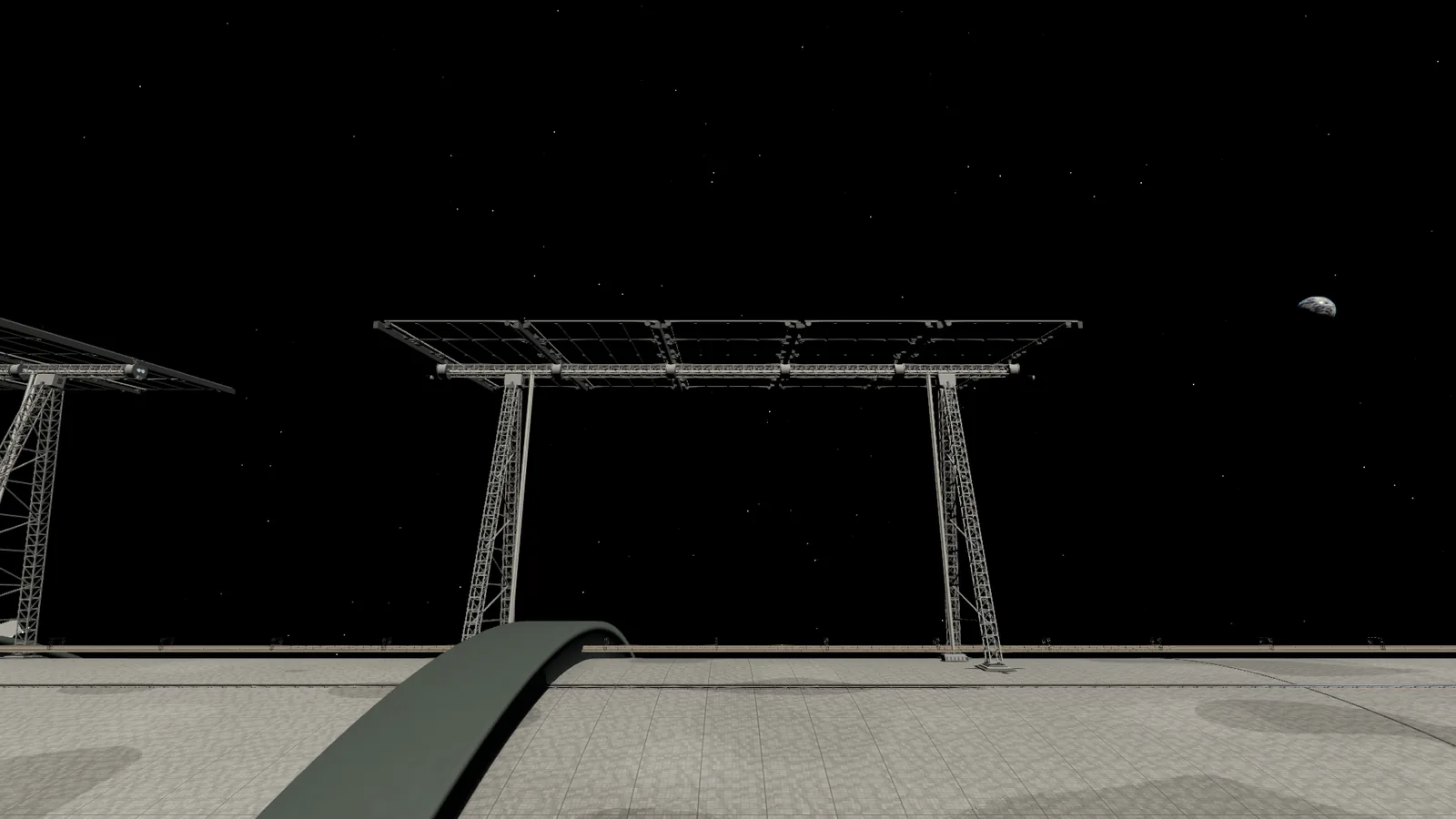
The launch track for passenger craft runs 10 km along the hull, and two cargo mass drivers 15 to 16 km long run on opposite sides. See Power and heat for the radiator physics and Getting there for the track.
Defence and satellites
Defence
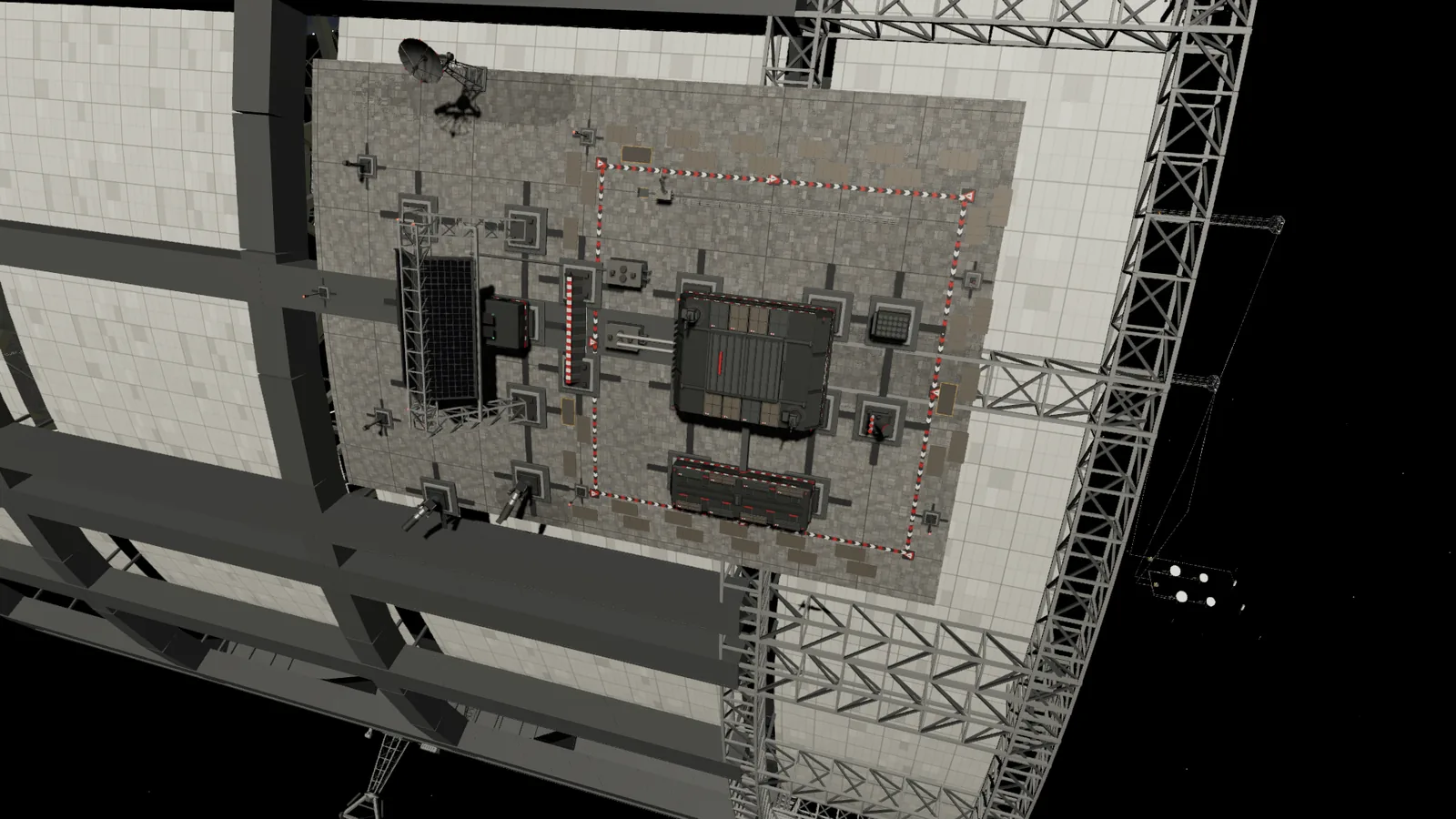
Four sites guard the station: two forward and two aft. Radar fences, an 85 m tracking dish, survey telescopes and lidar masts watch for debris, and heavy and rapid interceptors, point-defence guns and capture-net launchers answer it. Layered detection and interception cover each end, and radiation and debris explains where shielding stops and interception starts. Directed energy is left out. Cargo from the Moon and the asteroids is caught tens or hundreds of kilometres away and towed in, never aimed at the habitat.
Satellites
Seven craft fly free of the hull. P1 is a tethered solar farm 7 km aft. P2 and P3 are formation-flying power platforms that send power by a microwave link. V1 and V2 are volatiles depots. R1 is the Earth relay and S1 is the forward sentinel. The overlay shows them: Open in the simulation: Satellites overlay
Key numbers
Go deeper: Hull stack and fleet
The layers from outside in: sacrificial impact layer, standoff vacuum, regolith or slag cassette layer, structural shell, service vacuum, hydrogen-rich local shielding, then the rotating pressure vessel. Thickness varies with what lies behind it. For scale, 1 m of regolith at 1.6 t/m³ over the whole 470 km² is about 750 million tonnes.
Radiator banks: the top and bottom banks are fields of 2,200 × 1,000 m on 1,100 m stand-offs, and the side banks are 3,100 × 1,500 m on 1,600 m. At 450 K a single-sided radiator rejects about 2.1 kW/m².
P1 is a tethered farm at x = −17,500 m. Power reaches the station through four aft masts; see Aft works. Full buildout at about 40 GW needs roughly 28 platforms of 4.2 km².
The defence sites are DEF-F1 and F2 at x = 9,728 m and DEF-A1 and A2 at about x = −9,472 m. Heavy interceptors are 36 m long and about 120 t.
Visit
Open in the simulation: Exterior Hero: Complete Habitat Open in the simulation: Exterior QA: 25 km Silhouette Open in the simulation: Exterior QA: 25 m Materials Open in the simulation: Radiator Field Open in the simulation: Forward Defence Battery Open in the simulation: Satellite Fleet: Opening Shot
Nearby
Aft works
The back of the station is where the electricity comes in. Eight tethers run 7 km aft to the solar farm, four masts land the power, two reactors can restart everything after a...
The spaceport
Everyone who arrives from Earth or the Moon comes through the spaceport at the forward end.
The zero-g shipyard
The shipyard is a stationary vacuum yard about 3.5 km long, with no floor and no up.