What you see
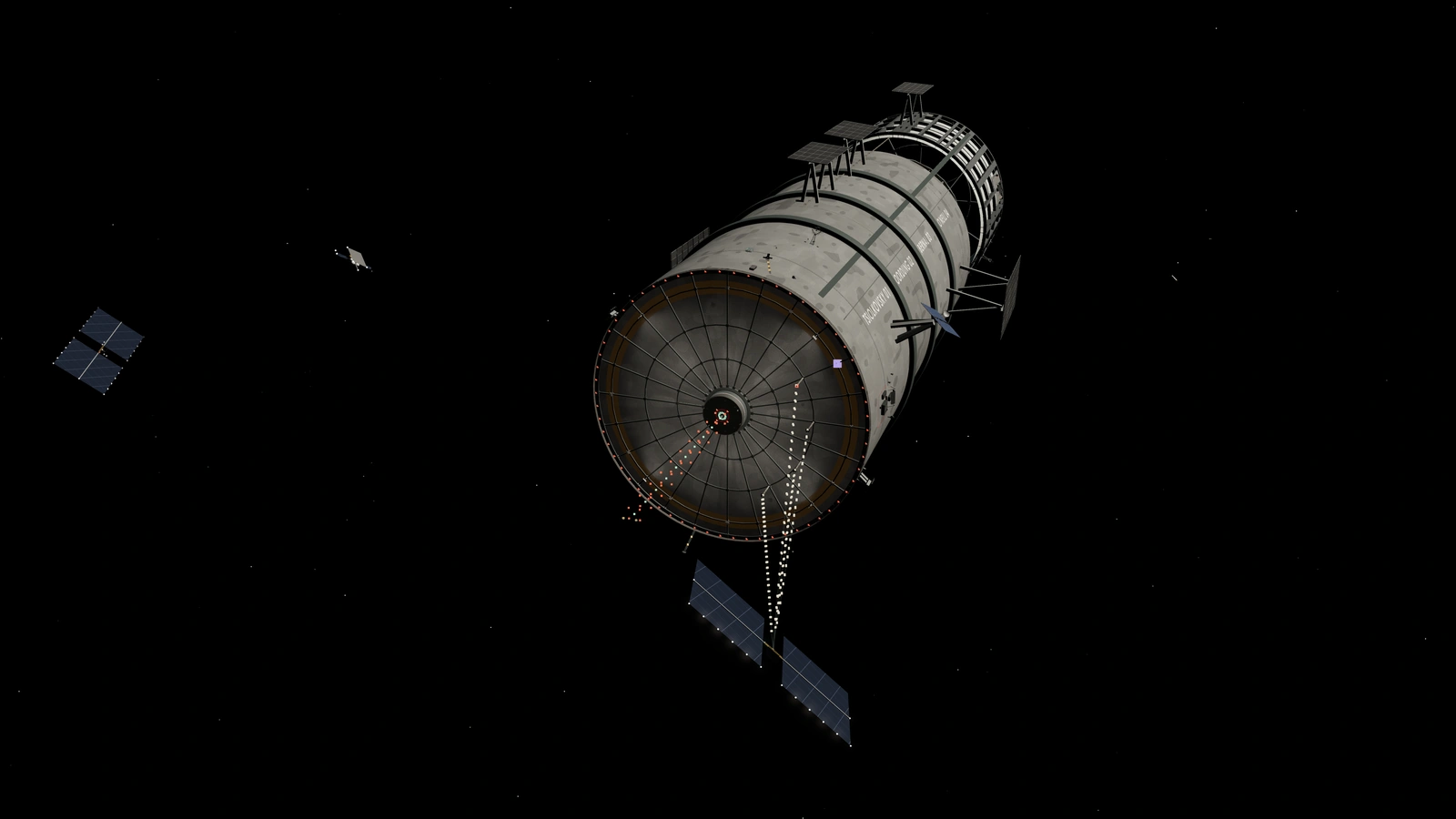
From 25 km the aft face reads as a shielded disc. Twenty-four buttress ribs, every 15 degrees, cross three ring frames at radii of 1,150 m, 1,900 m and 2,700 m. At the rim a girder and a louvred Whipple skirt carry 62 red marker lights, and in the centre a tower 350 m tall holds the blast iris over the service port. A white beacon on the tower pulses every 12 seconds.
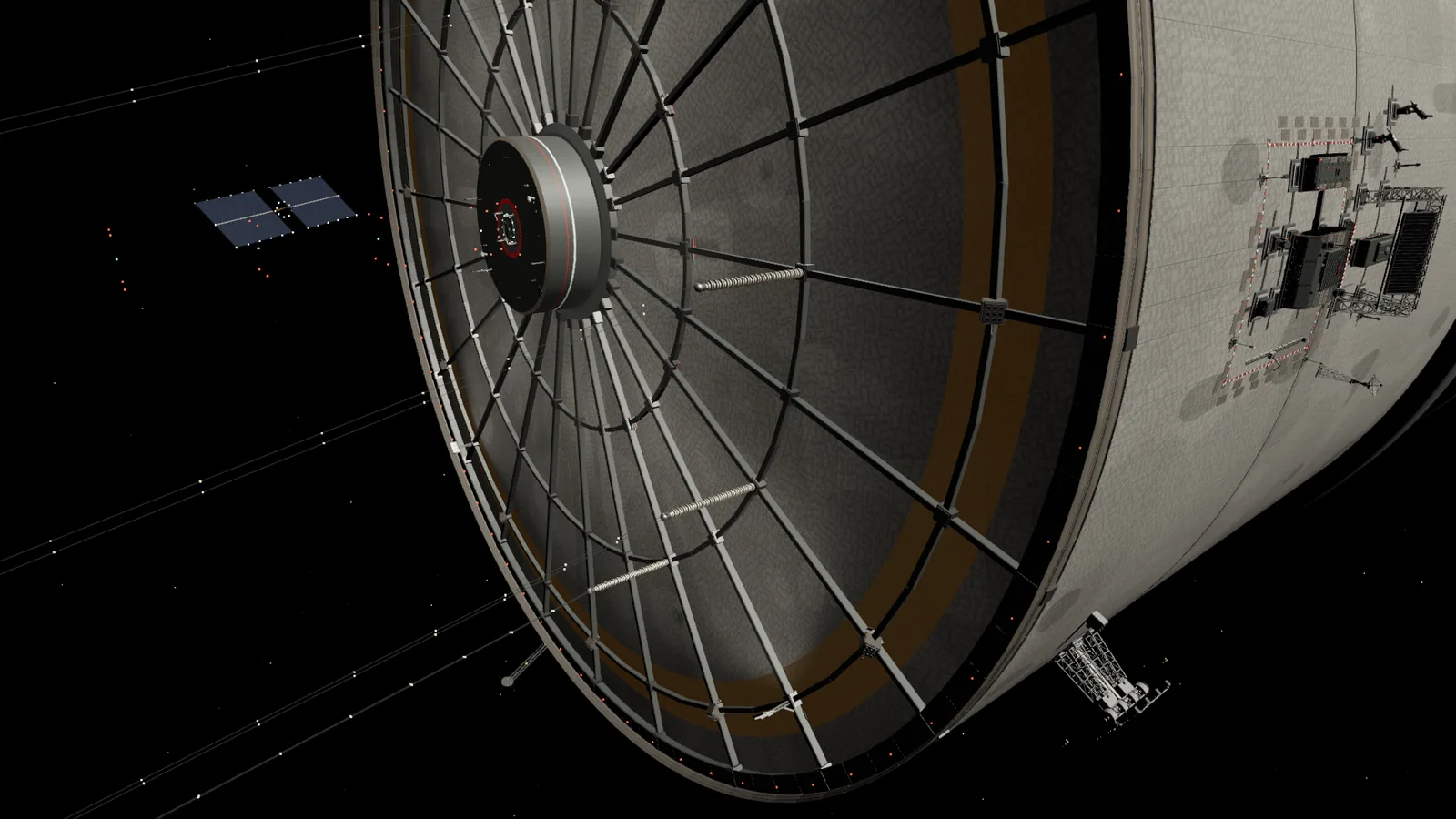
Four landing masts, each 500 m tall, stand at a radius of 1,900 m. Eight tethers run from the masts straight aft, about 7 km, to the hub of the solar farm, marked by a light every 250 m. The farm is a tethered power platform, held against the pull of the tethers by its own thrusters.
On two masts at the rim stand the black-start reactors, 800 m tall and behind shadow shields, with radiator petals turned edge-on to the Sun.
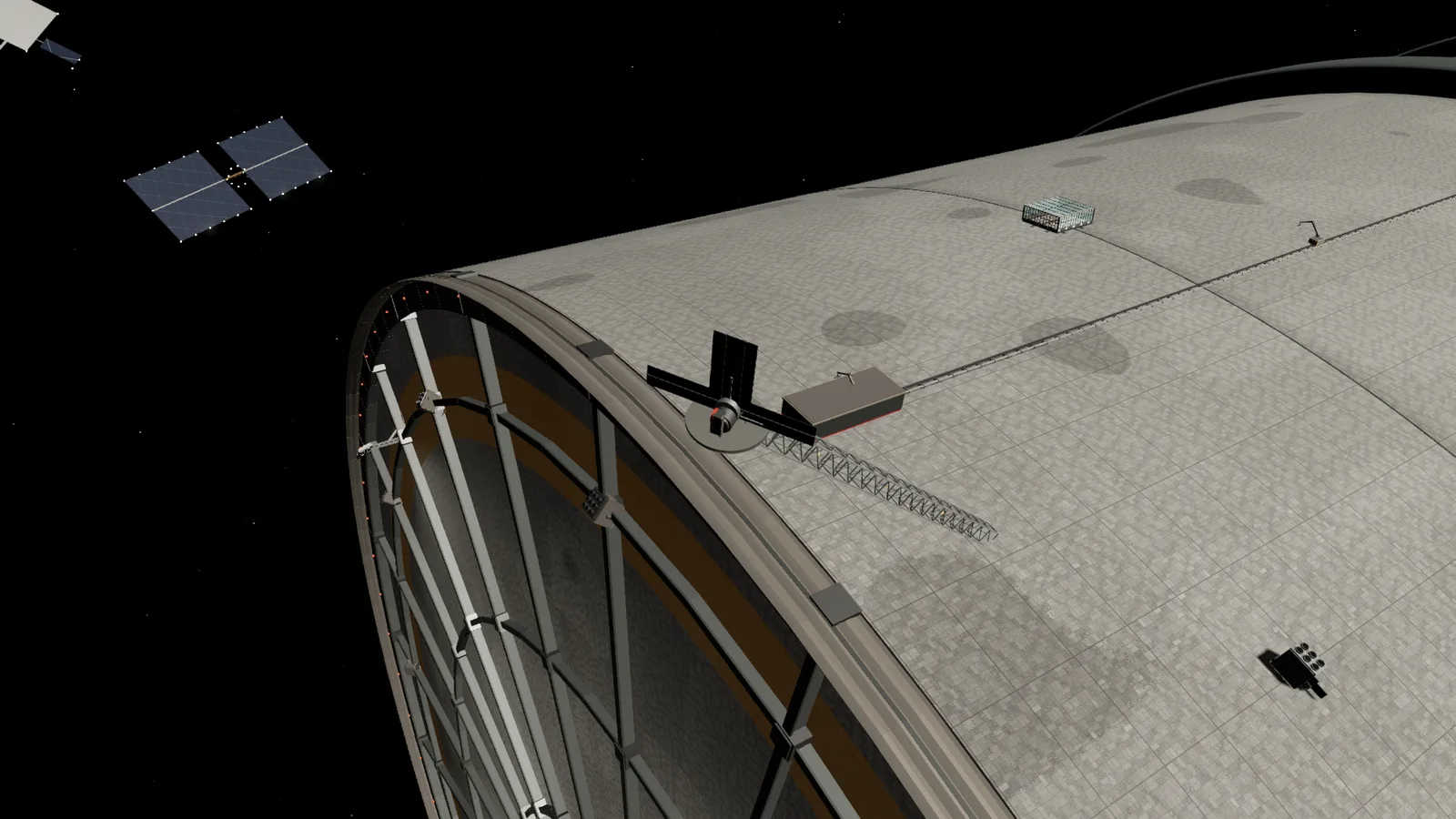
Around the face sits a ring of twelve thruster pods, canted outward and wrapped in Whipple shields.
Inside the aft end
The spine ends here, 120 m wide, at a flat glazed wall with a boarding platform marked AFT TERMINUS. Beyond it the station is an engine room.
The converter hall is a row of twelve 50 m bays: HVDC valve halls in four towers, breaker bays, capacitor banks and cooling headers. Behind it are the control blister, a glazed dome on the tube, and two black-start switchgear halls. Last comes the vacuum service bay, with berths for tugs, a servicing craft and a tender, and a 350 m lined bore to the blast iris. Just ahead of the converter hall is the aft bearing gallery of Tsiolkovsky (Rotor 1).
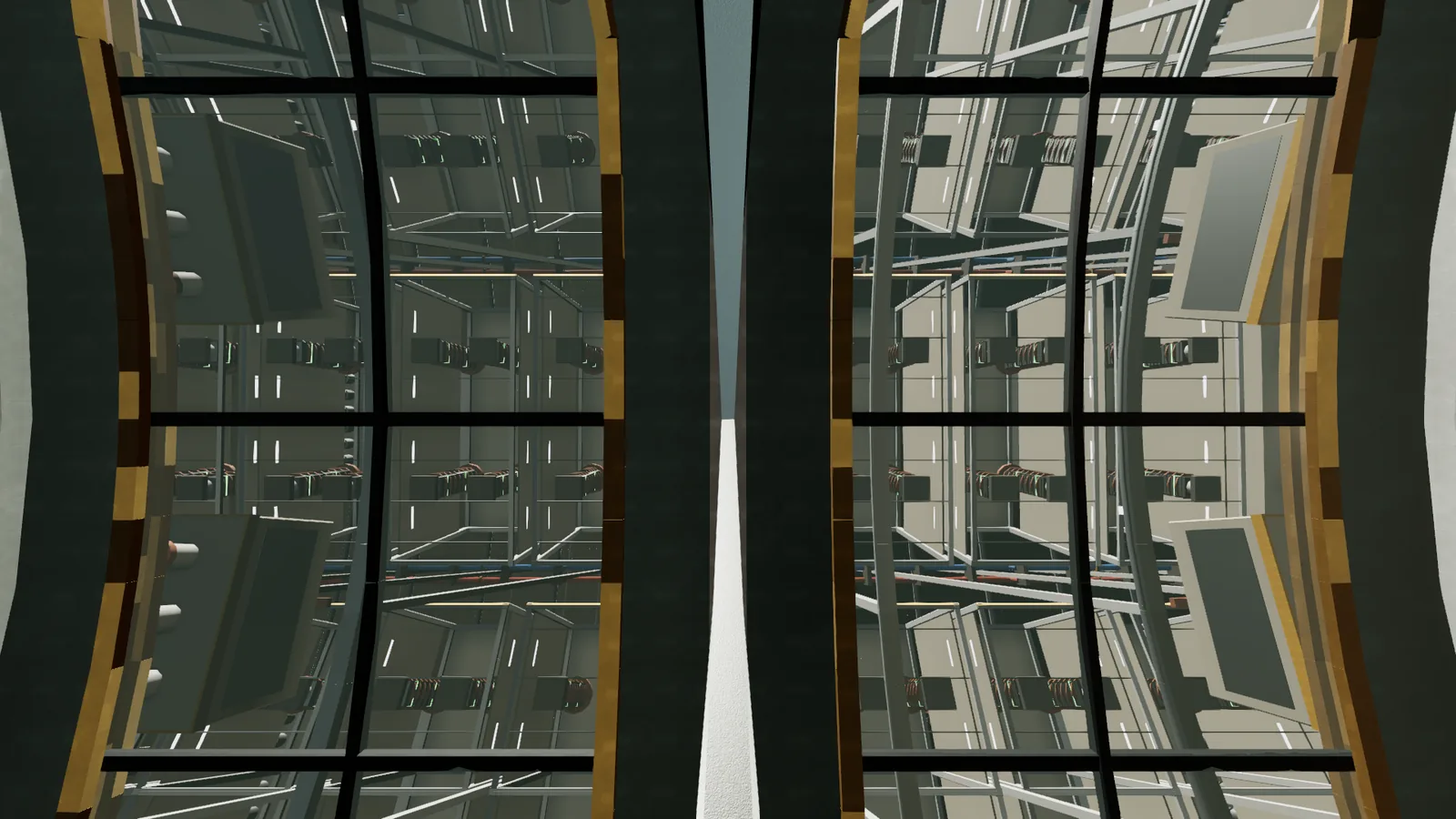
Open in the simulation: Aft Works · Aft Terminus Platform Open in the simulation: Aft Works · Service Bay
A rail garage near the aft end shelters a crawler and cradle for the hull's shielding service rail. Lane markers run out 5 km behind the station, green down the centre and red at the edges, to guide tugs and tenders to the service port.
How it works in brief
Solar platforms send direct current down the tethers. The converter hall turns it into the supply that feeds the station. HVDC is the efficient way to move up to 40 GW over 7 km, and the loss is a few hundredths of one percent. If the grid ever goes dark, the reactors restart the station from cold, running the bearings, pumps and communications and the first converter blocks. This is called a black start.
The thrusters trim the station's attitude and cancel the push of sunlight. They do not hold the orbit alone: keeping station at L5 takes the full thruster farm over weeks. Power, heat and thrusters are in Power and heat, and the tethers and solar farm in The exterior.
Key numbers
Go deeper: Sizes and electrical values
The power landing carries four bipoles at ±1.2 MV, 4.2 kA per conductor. A 7 km conductor of 4,200 mm² aluminium weighs about 80 t, and the ohmic loss is about 0.02 percent.
Each reactor delivers 250 MWe from about 700 MWt, and rejects about 470 MW through about 19,000 m² of radiator at 700 K. That is enough to restore the bearings, pumps, communications and the first converter blocks, not the full station demand.
The twelve thruster pods each carry nine 1 MW units, 108 MW class in all. With a specific impulse of 3,000 s, the ring makes about 4.4 kN. That cancels solar and thermal pressure of about 1 kN and trims attitude. Propellant is lunar metal vapour of the magnesium class, brought by tender.
Converter losses are about 1 percent of 40 GW, or 400 MW, rejected by two banks of radiator 250 × 250 m.
Visit
Open in the simulation: Aft Works: Far Read Open in the simulation: Aft Works: Power Landing Open in the simulation: Aft Works: Reactor Mast Open in the simulation: Aft Works: Thruster Ring Open in the simulation: Aft Works · Converter Hall Open in the simulation: Aft Works · Tsiolkovsky Aft Bearing Gallery
Nearby
The axis and the spine
At the centre of every rotor you weigh almost nothing, and a stationary tube 120 m wide runs the whole length of the station.
The exterior
From outside, Concordia is a grey cylinder 21 km long and 6.2 km wide.
The industrial rotor
Ehricke, the industrial rotor, is the factory floor. It is a skeleton of rings and girders 3.5 km long, turning opposite the city rotors, with refineries, tank farms, container...