What you see
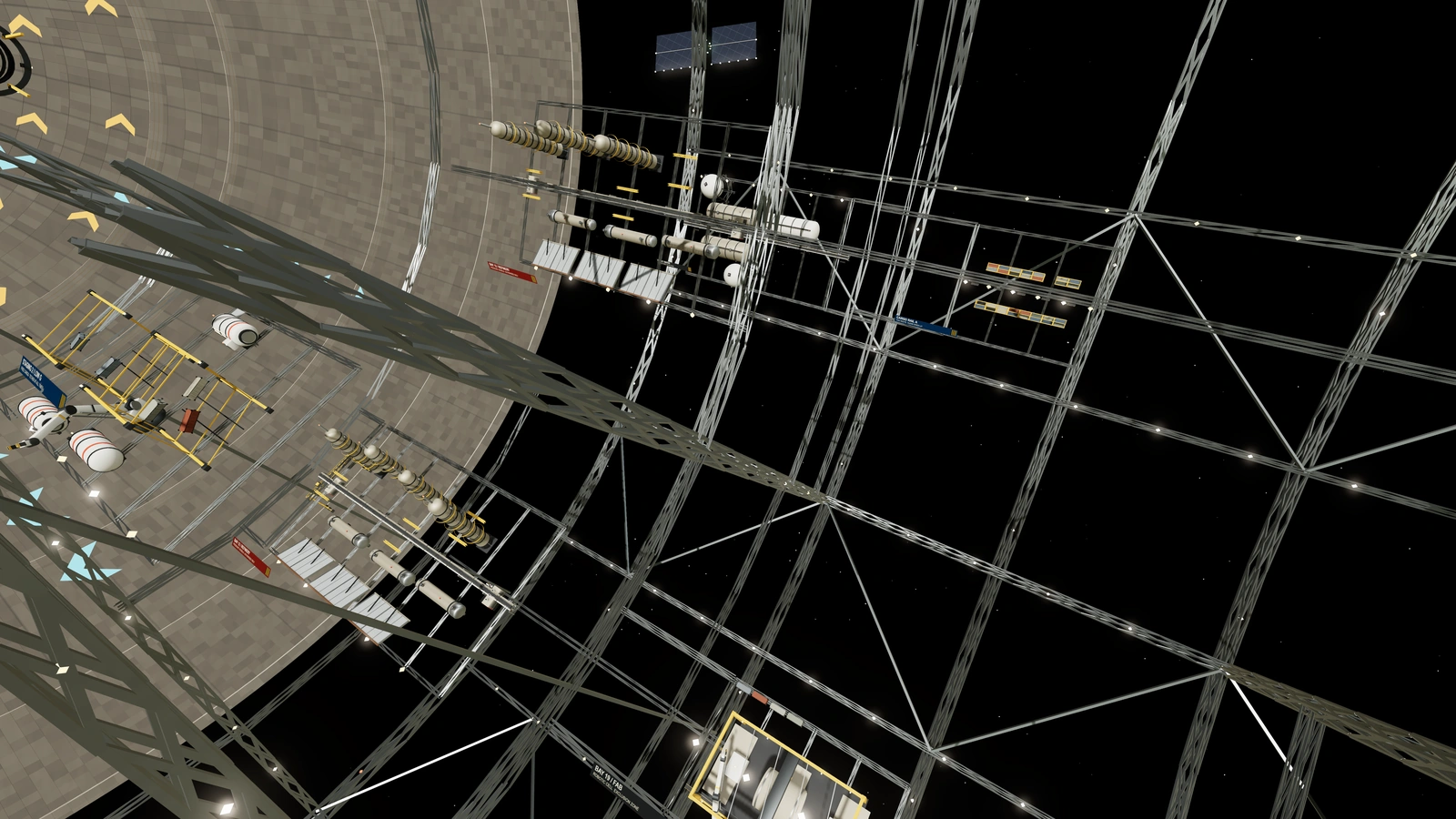
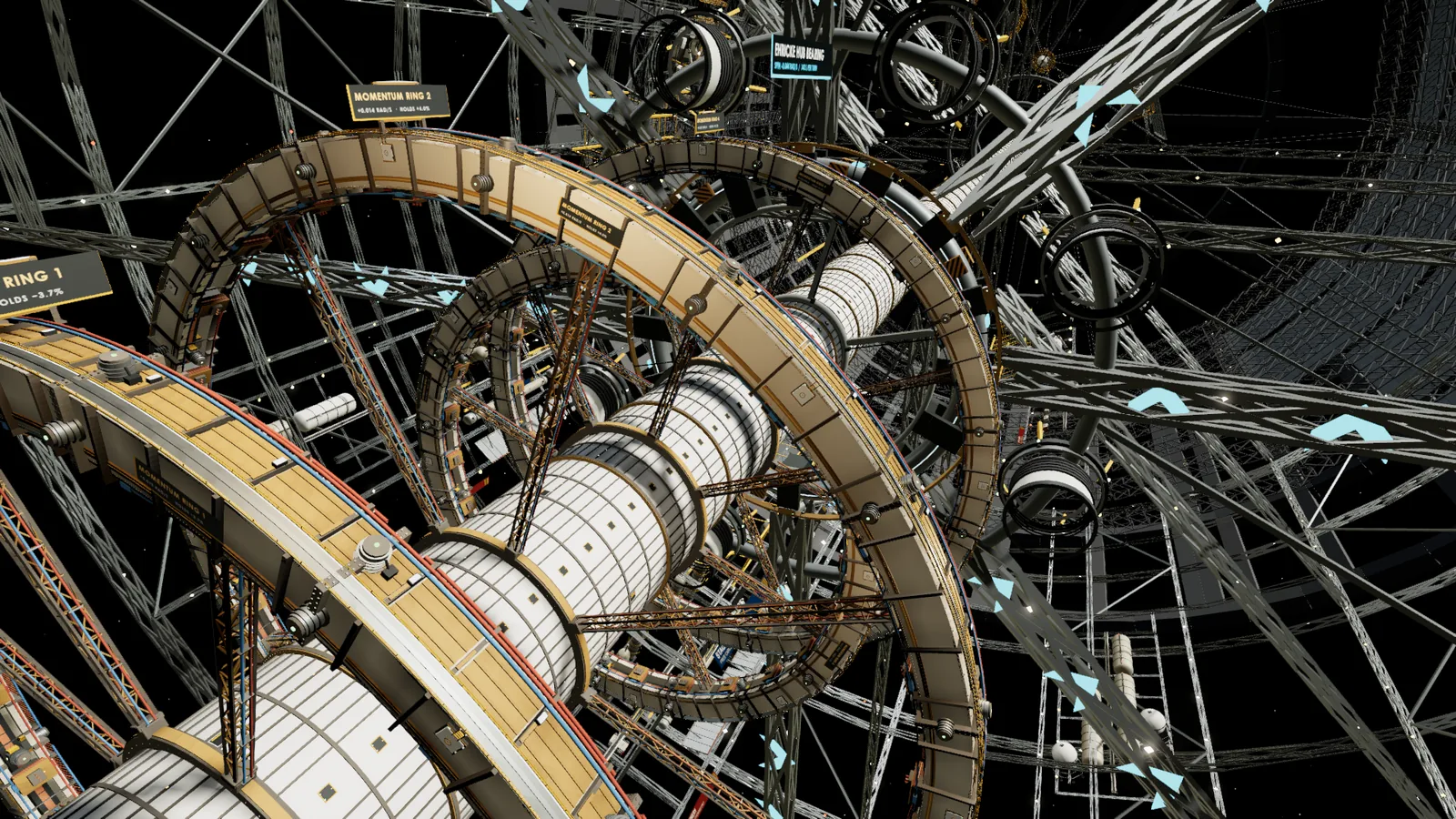
There is no shell and no roof. Seven rim rings carry the hoop load, 24 axial girders tie them together, and radial spokes at four stations reach down to hub collars at the axis. About three quarters of the volume is empty vacuum, which is how you read the scale. Equipment hangs on lattice cradles between the rings, with its floor toward the rim, because outward is down.
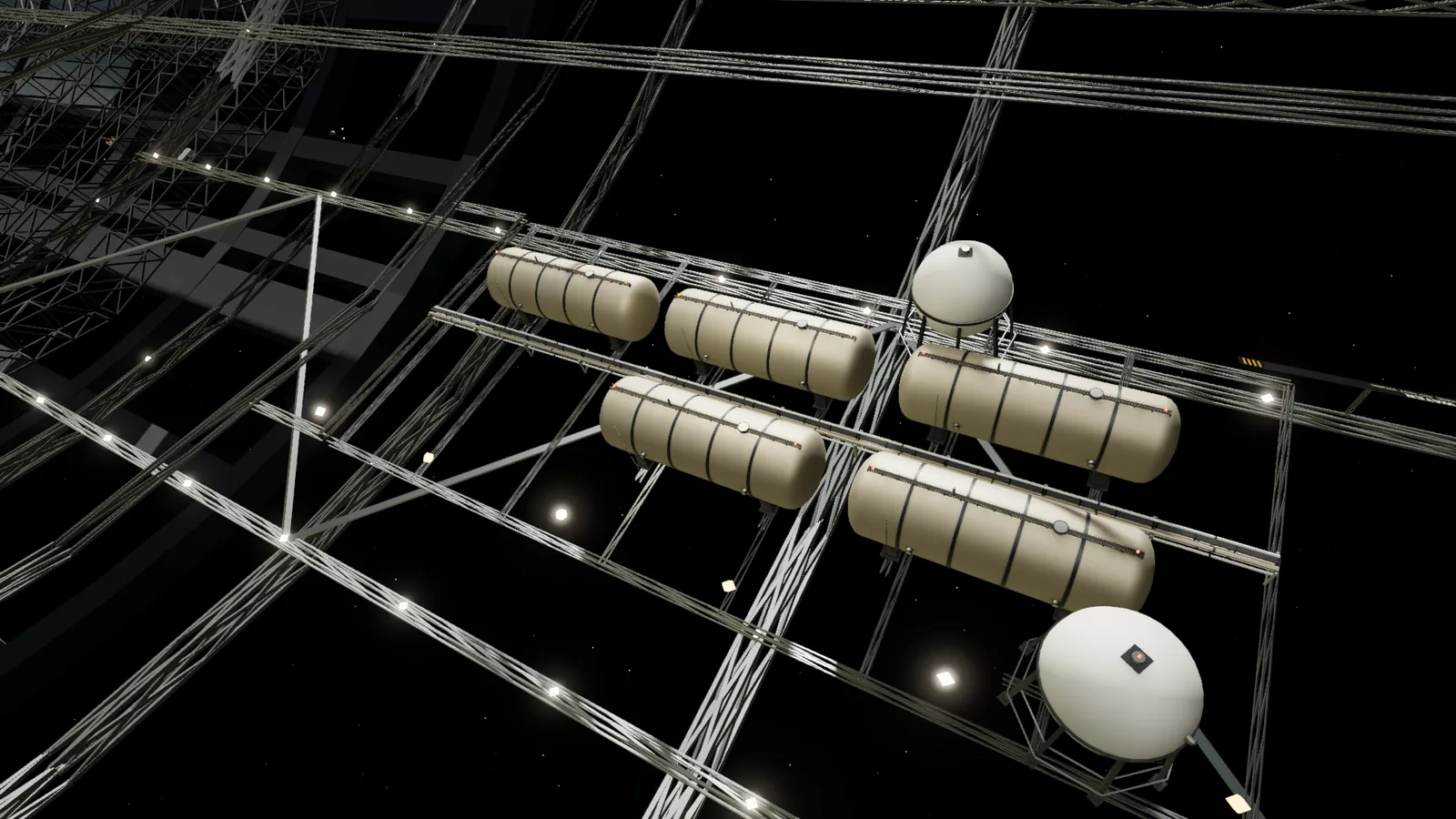
The bay has three zones from the hub end to the shipyard end. The first is processing: spherical tanks of the water and volatile farm, with refining and chemical units behind. The second is utility and fabrication, with recycling lines, fabrication cells and the power plant. The third is logistics: container racks, a cargo rail yard and gantries, assembly trusses and tug berths. Machinery thins toward the shipyard end, and tugs and containers get bigger.
The light is hard. A single sun casts black shadows with no haze to soften them, so work-light strings along the rim chords and gantries do the rest: white on the rings, amber on maintenance routes, cool white on process units and red hazard beacons on the rim and exclusion edges. A green glow marks the control module. Walkways, railings, ladders and stencilled bay numbers give the eye something human-sized, so containers, tugs and process vessels read at their true size.
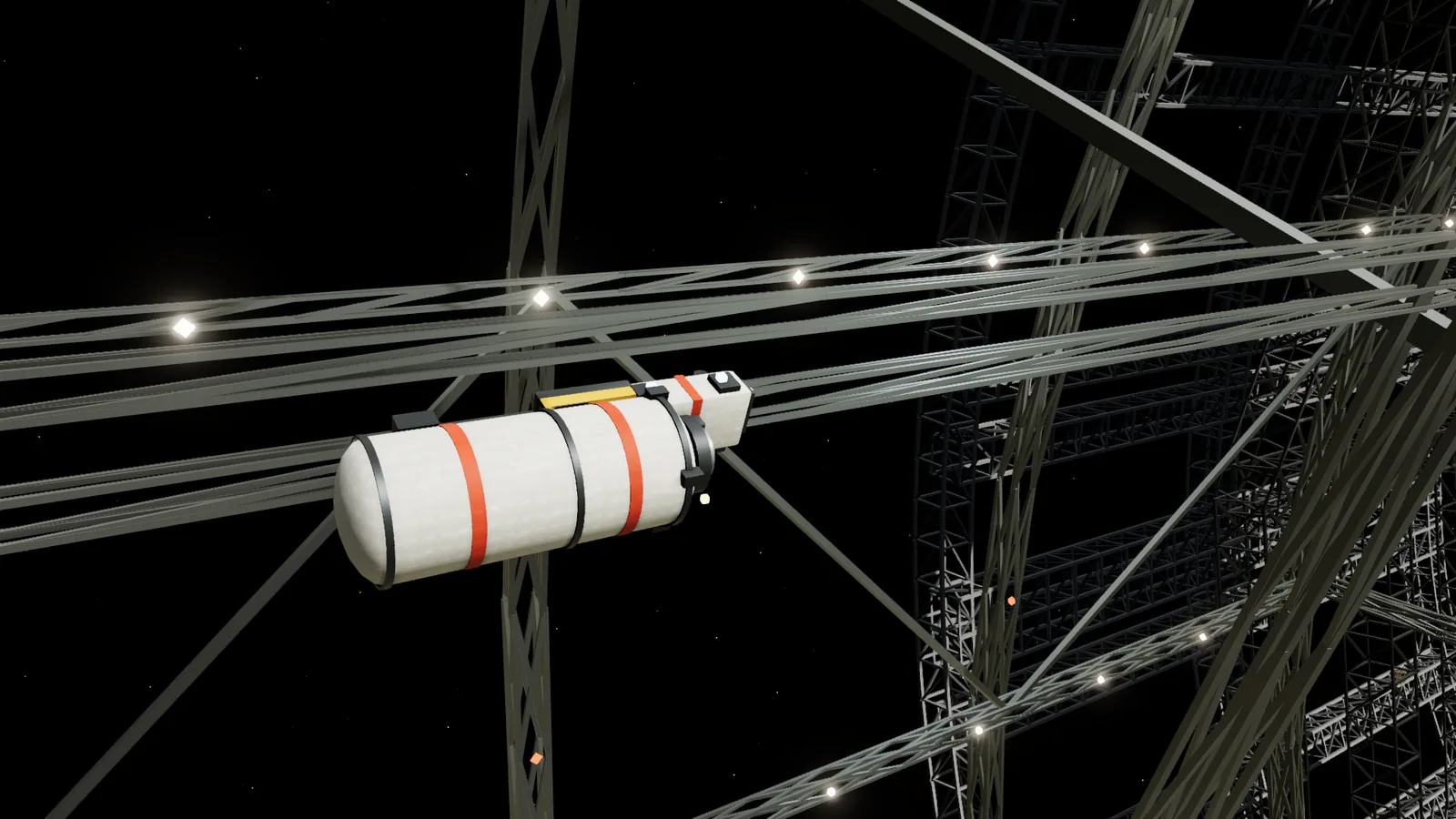
Everything is robotic. Tugs about 25 m long run on cargo rails at about 8 m/s. Arms, crawlers and drones do the maintenance. When a person does go in, it is in a pressurized capsule.
Two streams of material
The rotor holds stores of semi-processed material from two sources.
Lunar feedstock arrives from the Moon by mass driver: sintered regolith billets, aluminium and iron ingots, glass and basalt fibre, and oxygen. It is the bulk of what the city is made from.
Asteroid stock comes from small asteroids bagged and hauled into the L5 region: metal-rich bodies first, for iron-nickel, then carbonaceous ones for water ice, carbon feedstock, nitrogen compounds and metal concentrates. The Moon has little carbon, hydrogen or nitrogen, so these stores are what the farms, the air and the chemical plants draw on.
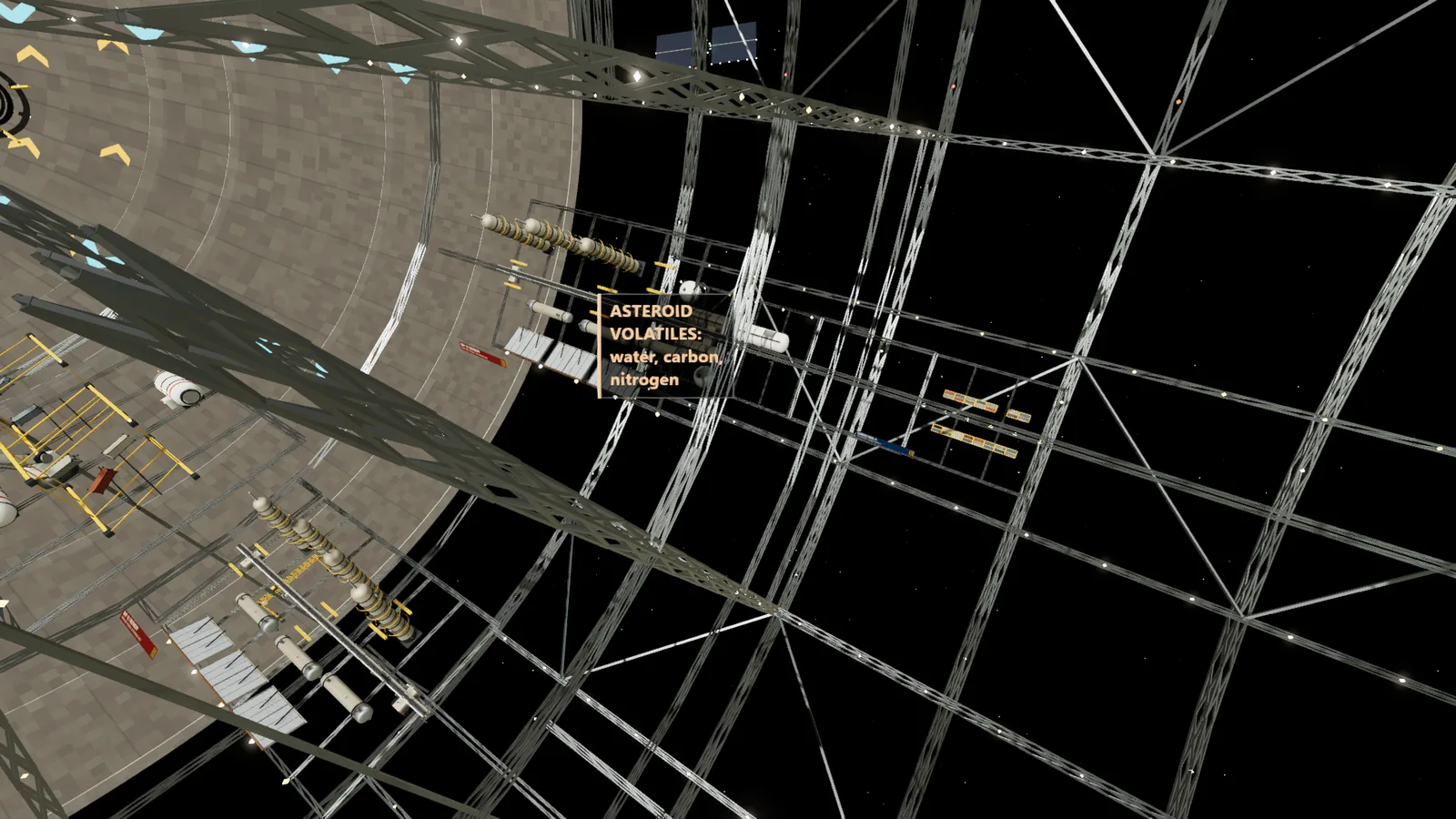
Open the overlay on the view above: Open in the simulation: Material flow overlay. The full story of how the material gets here, and what the Moon and the asteroids each supply, is in Mining, Materials and Building Concordia.
How it works in brief
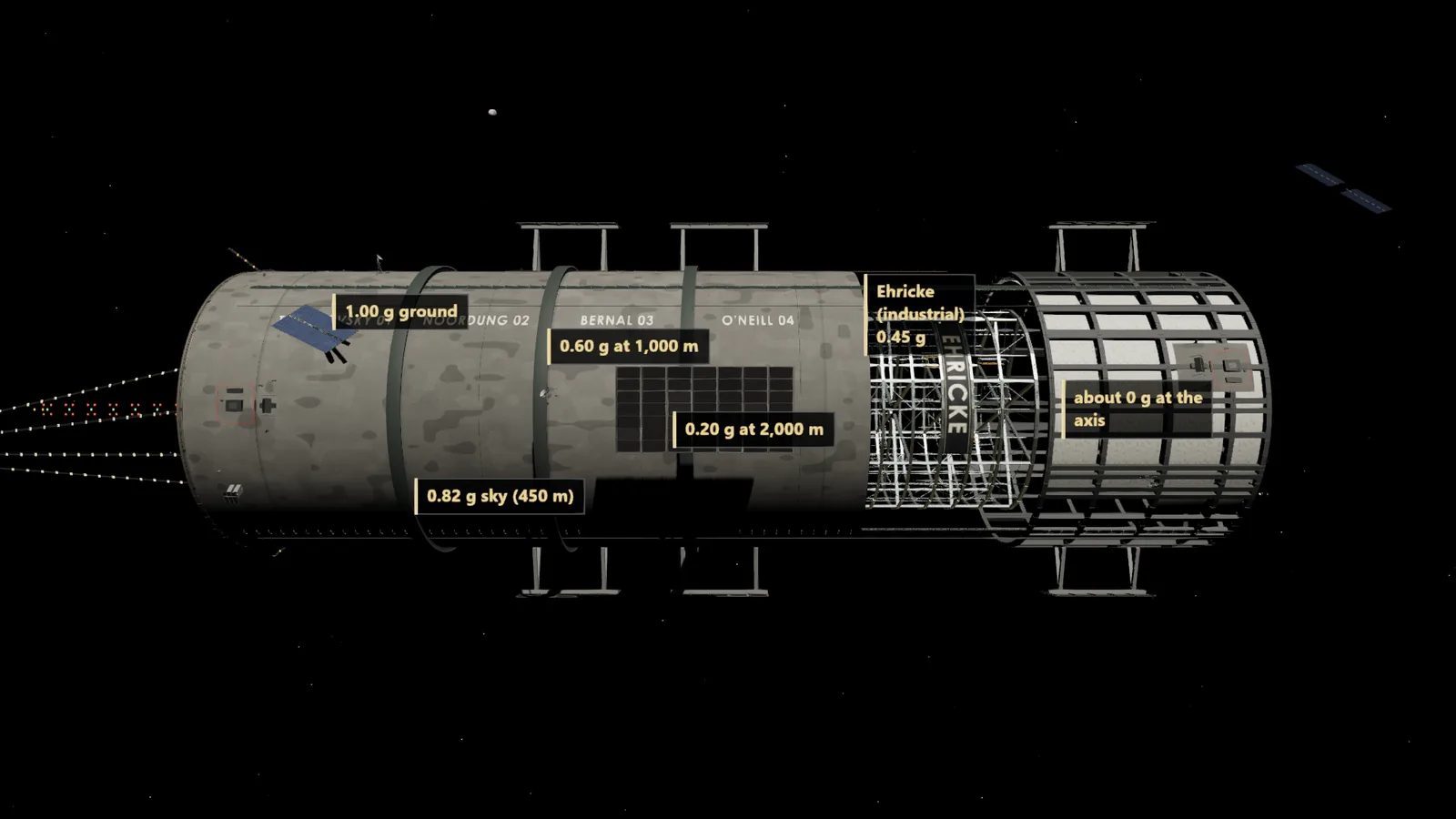
The rotor turns at 0.044 rad/s, a turn every 143 seconds, in the direction opposite O'Neill (Rotor 4). At the outer rim it gives about 0.45 g, falling to under 0.15 g near the hub, so heavy stores sit outside and delicate work goes inside. It is also a flywheel in the station's momentum ledger. Together with the momentum rings in the bay beside rotor 4, it balances the spin of the city rotors, so the station as a whole has no net angular momentum. See Counter-rotation.
Key numbers
Go deeper: Gravity zones and momentum
Gravity falls in a straight line toward the axis, so the bay has three bands. The outer band, 0.35 to 0.45 g, holds the water and volatile tank farm, the recycling line, bulk tanks and the container racks. The middle band, 0.2 to 0.3 g, holds refining units, fabrication cells, the power plant and assembly trusses. The inner band, under 0.15 g, holds the transfer hub, light storage, cargo staging and tug berths.
Rim speed is about 101 m/s. The rotor carries about 1.9 × 10¹⁶ N m s, roughly 4 percent of the four city rotors' total. Opposing the city rotors with an industrial rotor alone would need one heavier than the whole station, about 2.5 billion tonnes against the station's two, which is why the city rotors are paired against each other instead.
The vacuum bay runs from x = 2,750 m to 6,250 m along the station and is open to space with no shielding shell.
Visit
Open in the simulation: Ehricke Industrial Rotor, Wide Open in the simulation: Exterior QA: Industrial Open Bay Open in the simulation: Bearing Gallery · Counter-Rotation Open in the simulation: Momentum Control Bay Open in the simulation: Momentum Ring 2 · Close
Nearby
The zero-g shipyard
The shipyard is a stationary vacuum yard about 3.5 km long, with no floor and no up.
The axis and the spine
At the centre of every rotor you weigh almost nothing, and a stationary tube 120 m wide runs the whole length of the station.
The exterior
From outside, Concordia is a grey cylinder 21 km long and 6.2 km wide.