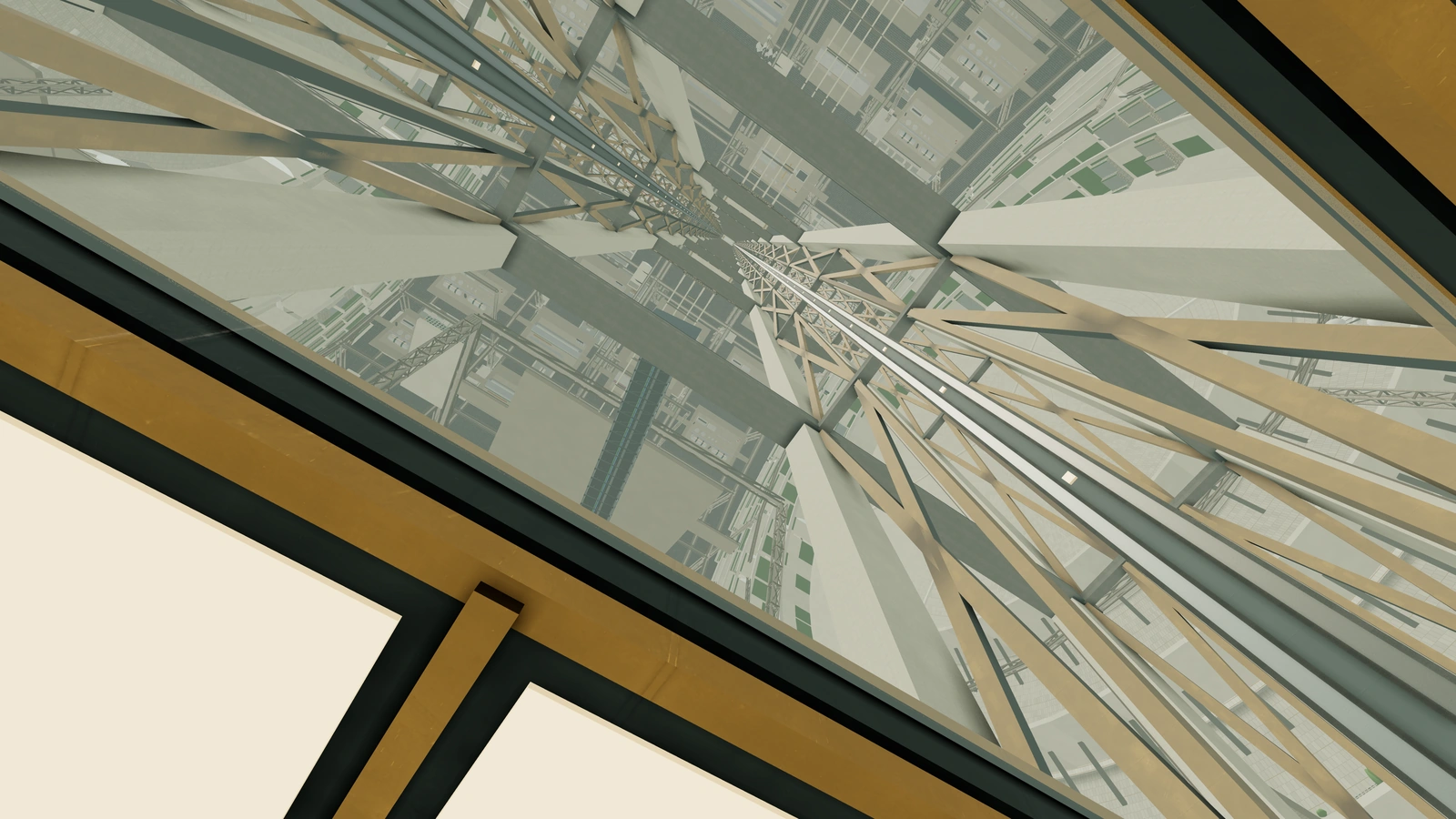
What you see
Each rotor has four axis stations, spaced 90 degrees apart around the ring. Each station is a tower of four bronze-latticed blade trusses with three tracks, where cabins pass each other going up and down. The tower is built of 23 segments of 100 m.
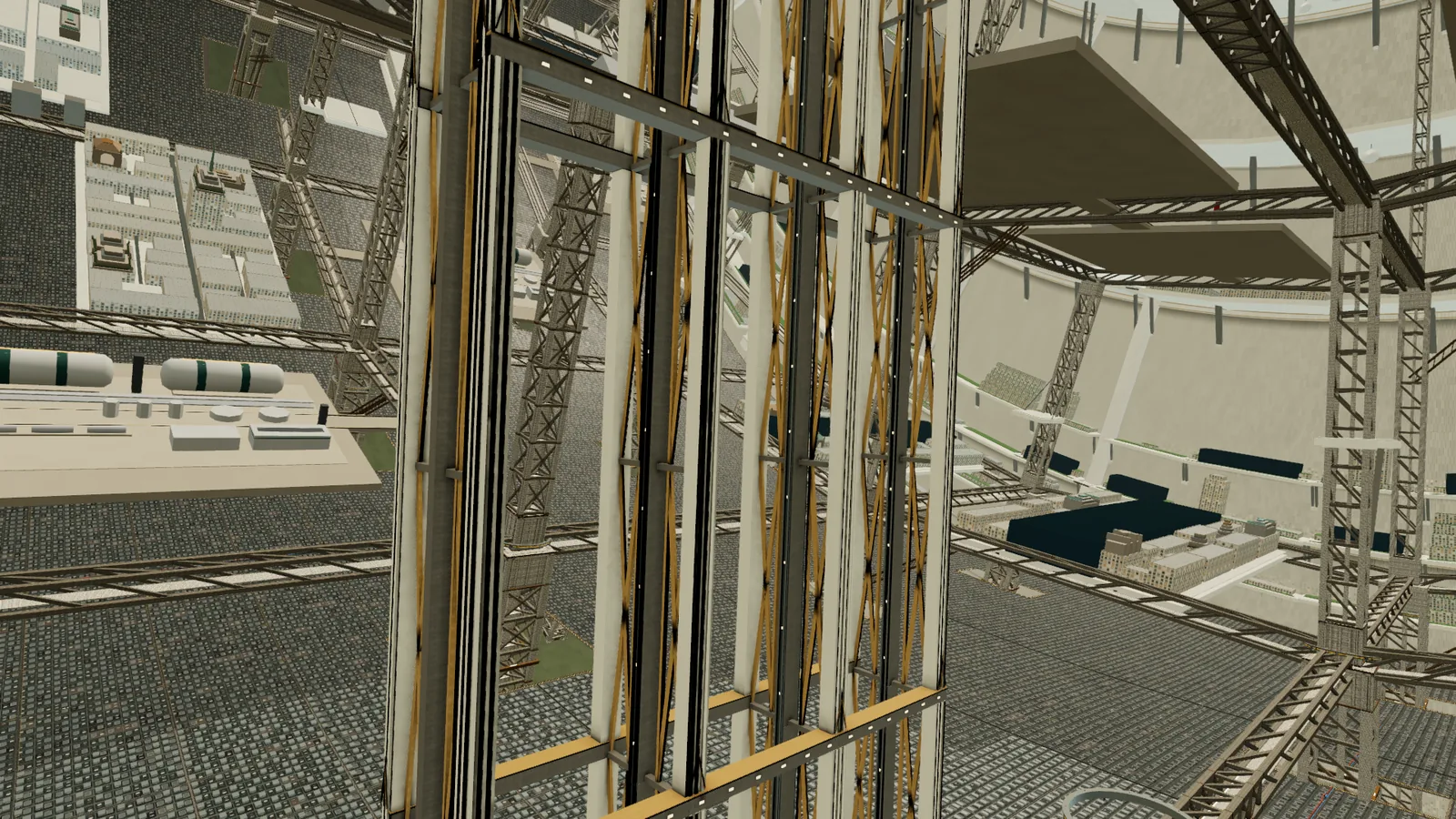
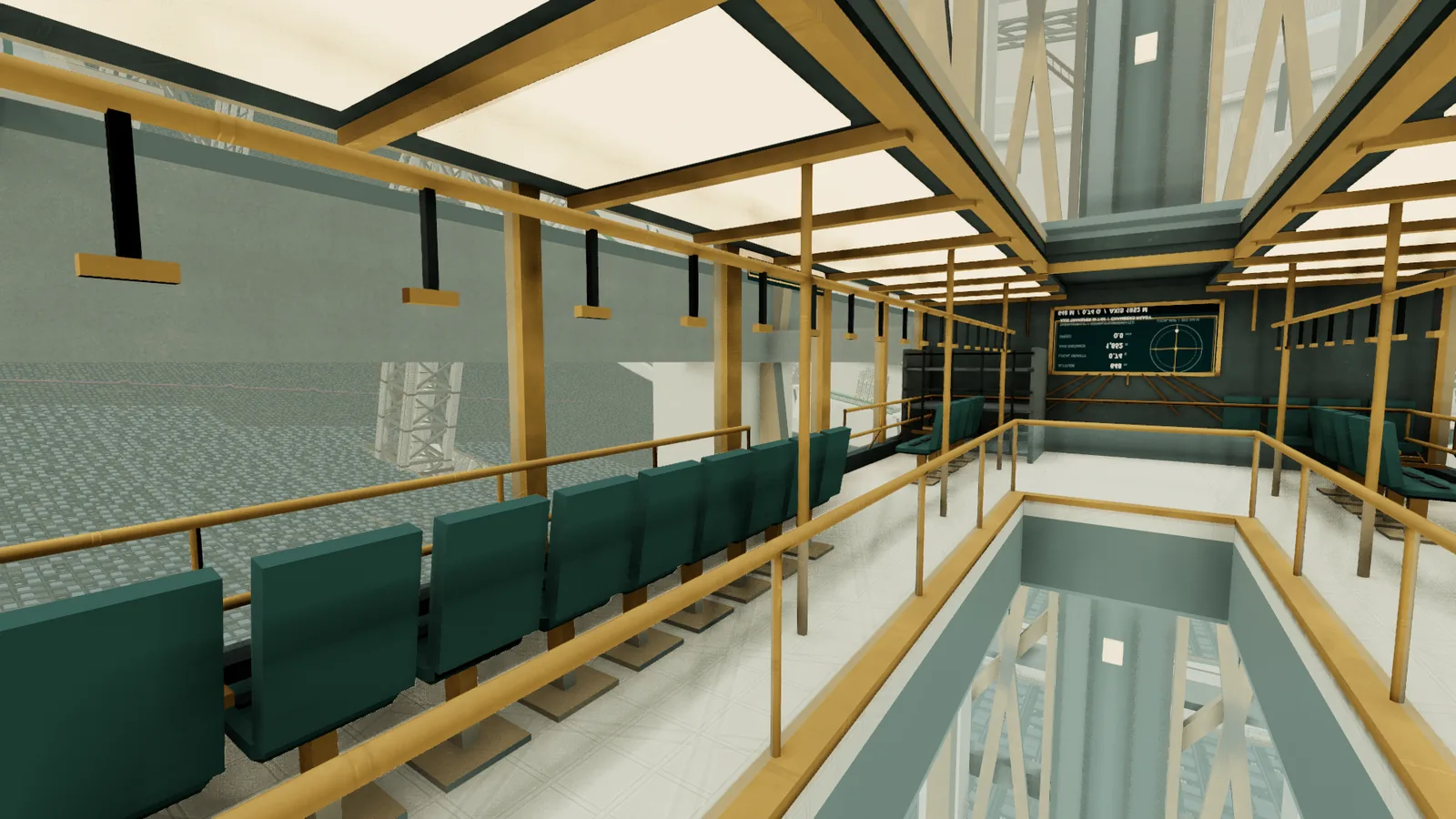
The cabin is 26 m long and 7.6 m wide, with window seats, rails and a glass floor gallery. A live display shows altitude, gravity and the transfer ahead. For the first stretch the neighbourhood stays familiar below you while the horizon curves up.
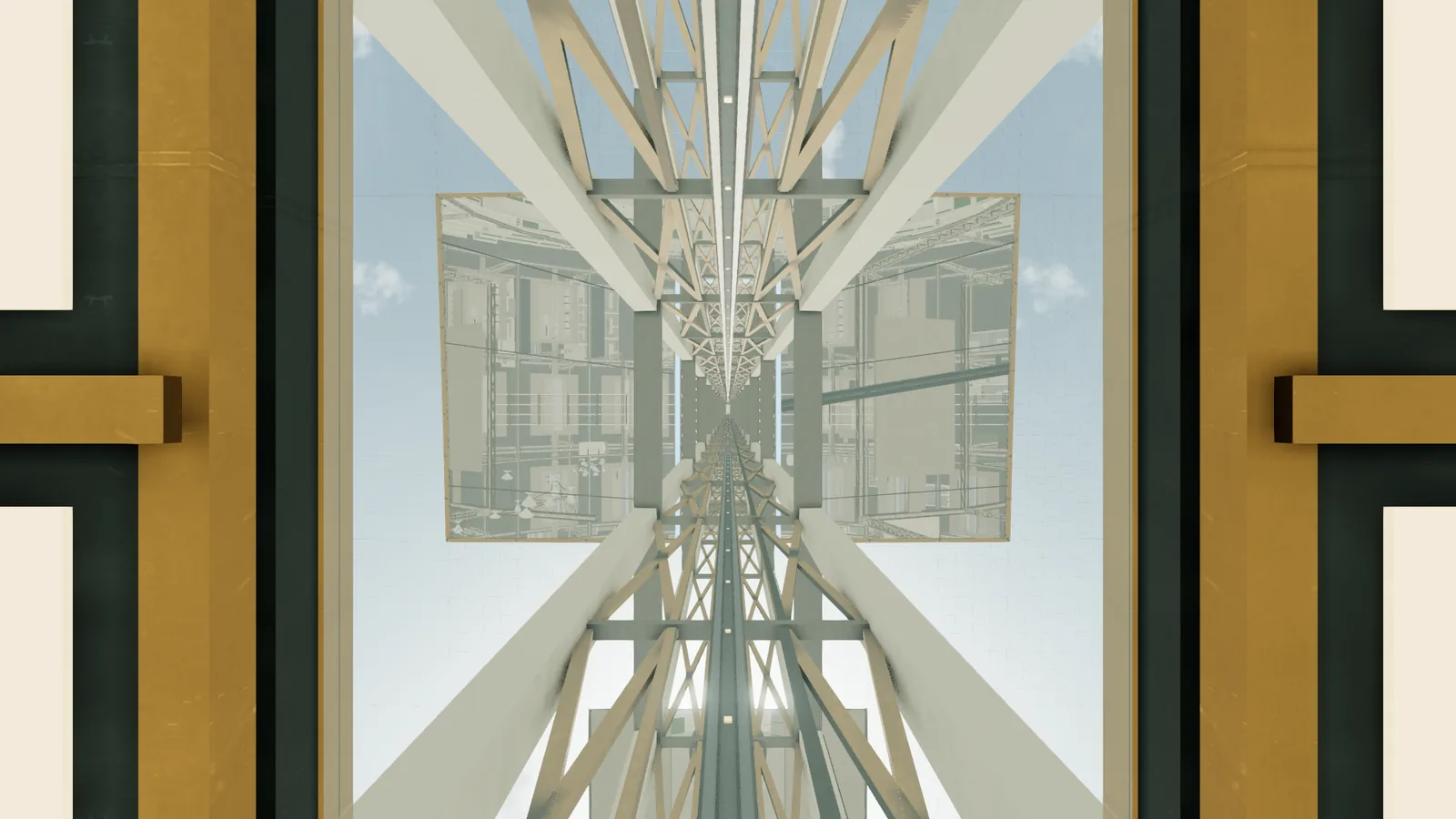
At about 450 m the cabin reaches the sky. The artificial sky is a ceiling of luminous panels hung on hoops and stay cables, and from below it looks like a clear day. Each ascender tower passes through a permanent opening, roughly 154 m by 210 m. The cabin slides through it and the other half of the world appears: panel frames, maintenance paths, and the city on the far side of the rotor, hanging upside down in the distance.
Above the sky you cross the megaframe at 0.75 g, 0.60 g and 0.40 g, then reach the hub terminal, where the lift meets the axis and the spine.
The ride has three acts. Up to the sky you are in your own neighbourhood and the street is still the street. Through the sky you enter the engine room of the world: bronze trusses, stay cables and the frame of the megaframe. Above 1,000 m the city thins out, gravity drops below 0.6 g and the cabin feels lighter with every hundred metres.
How it works in brief
A rotor is a spinning wheel, and you spin with it. At the street the cabin moves sideways with the rotor at 153 m/s. At the hub it moves at 4.4 m/s. Guide rails supply the push that slows it as it rises. A climb stores 630 MJ per loaded cabin, and the descending cabin on the next track returns it through regenerative motors.
The cabin also leans. Moving toward the axis creates a small sideways push (the Coriolis effect), and the cabin tilts to keep the floor under your feet. The lean is 4 degrees 150 m above the deck, 6.7 degrees at 1,000 m and 15 degrees inside a radius of 656 m, with a limit of 18 degrees. The tilt flips direction between Tsiolkovsky and Noordung (Rotors 1 and 2) and Bernal and O'Neill (Rotors 3 and 4).
See Artificial gravity for why weight fades with height, Light and the sky for how the ceiling makes daylight, and Moving around for the ride in depth.
Open in the simulation: The sky is machinery. Open in the simulation: Gravity overlay
Key numbers
Go deeper: The ride in numbers
The boarding deck is 50 m up, at a radius of 2,450 m. The hub terminal is at a radius of 70 m. The cabin accelerates at 0.4 m/s² for 14 s, cruises at 5.5 m/s, and averages 4.0 m/s over the whole trip.
| Stage | Gravity |
|---|---|
| Boarding deck, 50 m | 0.98 g |
| Sky, about 450 to 550 m | about 0.8 g |
| 625 m | 0.75 g |
| 1,000 m | 0.60 g |
| 1,500 m | 0.40 g |
| Hub skin | 0.056 g |
| Hub terminal | 0.028 g |
Each cabin holds 64 seated and 86 standing passengers and weighs 54 t loaded, 40 t empty. Each ascent hands the rotor 2.1 × 10¹⁰ N m s of angular momentum, about 0.2 parts per million of the rotor's total, and the counter-phased cabin on the next track gives it back.
Visit
Open in the simulation: Ascender: 250 m Open in the simulation: Ascender: Artificial Sky Breakthrough Open in the simulation: Ascender: Cabin Interior Open in the simulation: Ascender: Tower From Outside Open in the simulation: Ascender: Near Axis Open in the simulation: Ascender: Rotating Transfer Hub
Nearby
The axis and the spine
At the centre of every rotor you weigh almost nothing, and a stationary tube 120 m wide runs the whole length of the station.
The megaframe city
Above the streets, a lattice of piers and ring beams holds a second city on plates, bridges and terraces. The lattice is the megaframe.
Upper city farms
Food is grown high in each rotor, where gravity is 0.6 g and the air is the same air the city breathes.