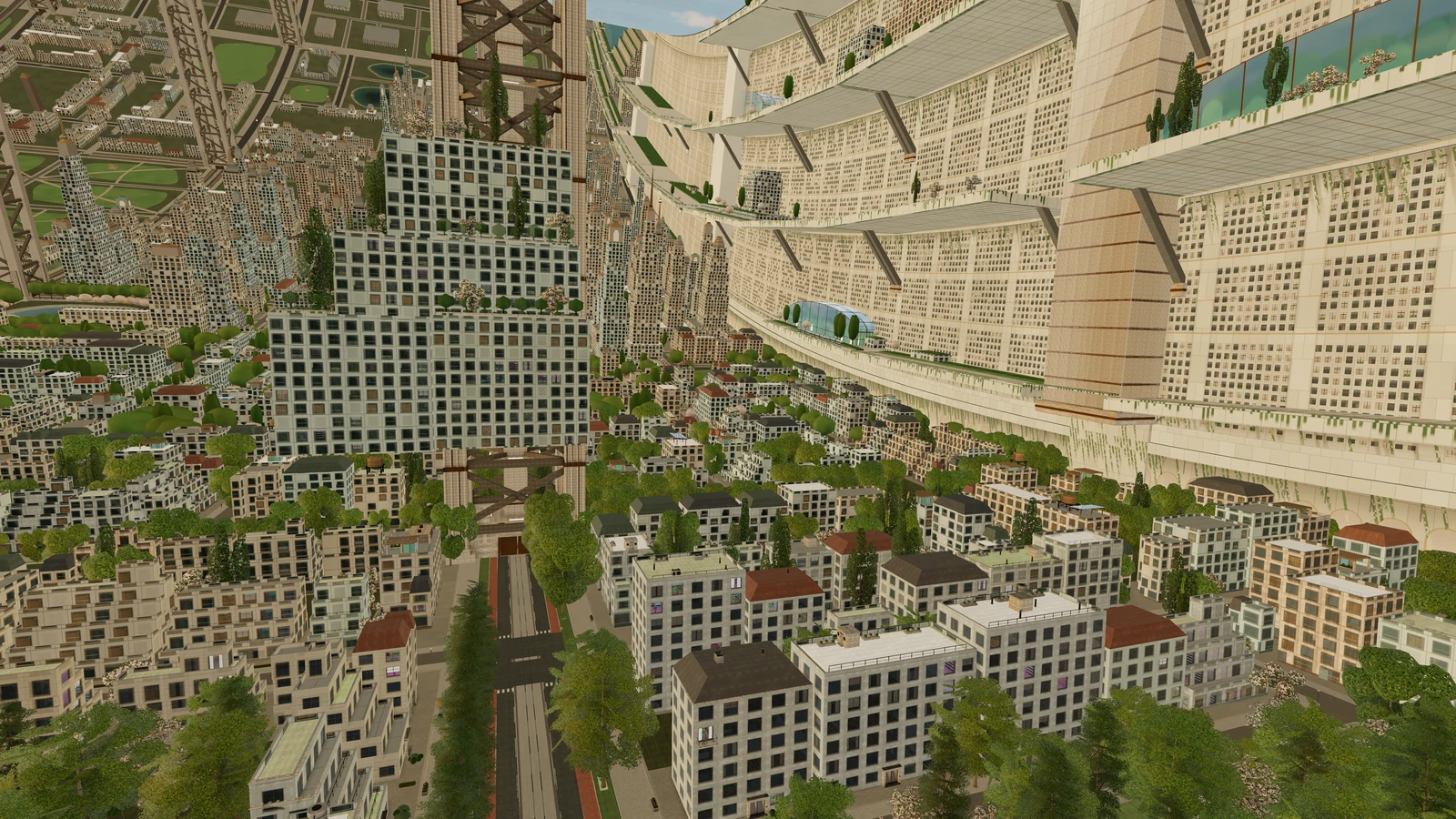
These are the station's design values, plus quantities worked out from them. Rows marked "derived" are computed from other rows with the formula shown. The Basis column says what kind of number each row is: established physics, a design value, an engineering challenge or story. What the tags mean.
Size and position
| Quantity | Value | Basis | Why | Formula |
|---|---|---|---|---|
| Orbit | Earth-Moon L5 region, 384,400 km from Earth | Design value | Low-energy access to lunar material, room to build, a market within reach | |
| Orbital speed | 1.018 km/s | Established physics | Same as the Moon's | |
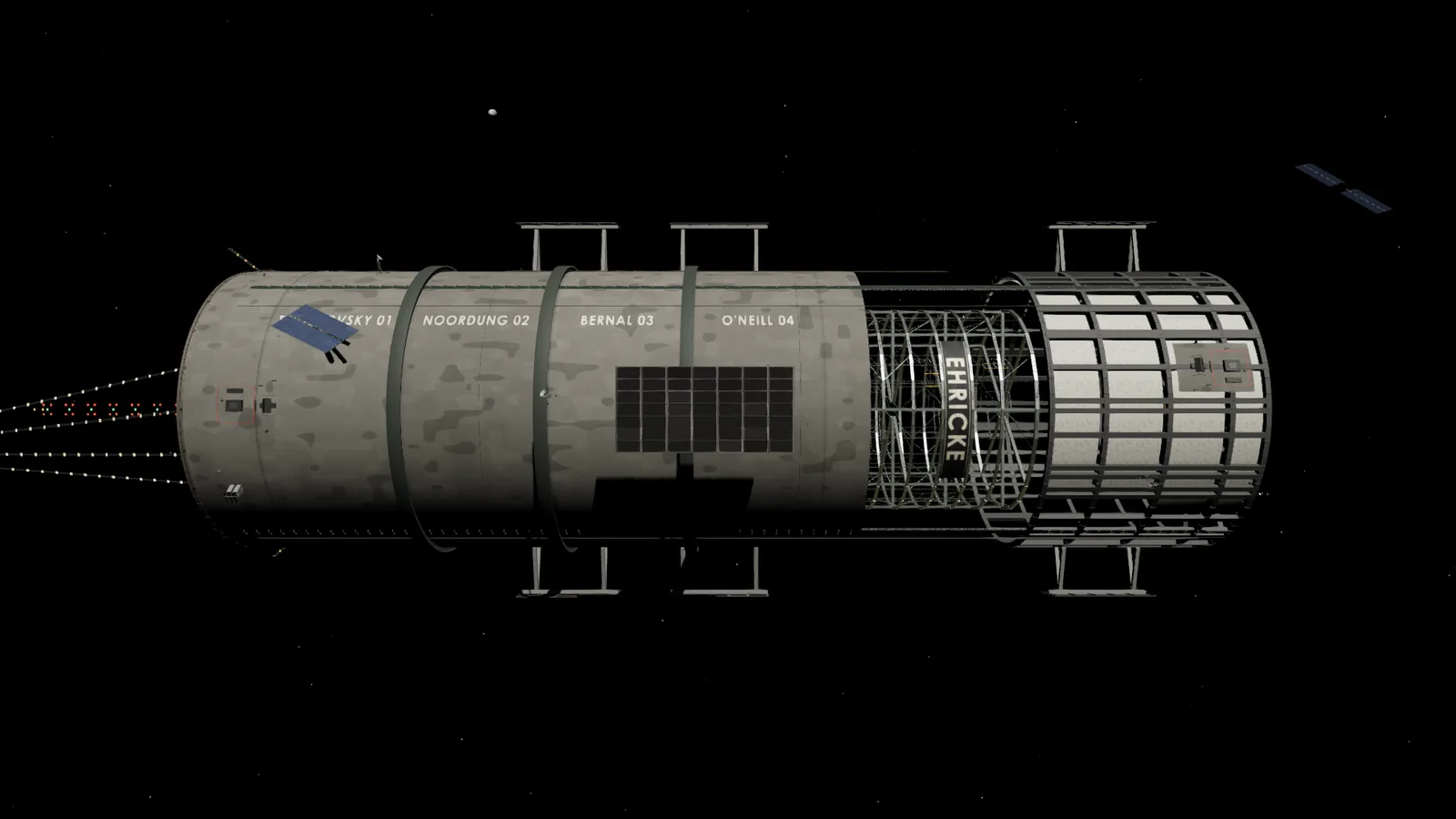
| Length | 21 km | Design value | Four rotors, industry, yard and port on one axis | |
| Maximum diameter | 6.2 km (radius 3,100 m) | Design value | Shell sits outside 2,500 m rotors with room for shielding | |
| Hull surface | about 470 km2 | Design value | Sets the shielding and radiator areas | 2 pi r L + 2 pi r^2 = 469 km2 (derived) |
| Population now | about 400,000 | Story | Rotors fill one at a time | |
| Design population | 1.0 to 1.2 million | Design value | Four rotors with elevated building | |
| Finished mass | about 2 x 10^12 kg, two billion tonnes | Design value | Why Earth launch cannot supply it | sum of the mass budget below (derived) |
Spin and gravity
| Quantity | Value | Basis | Why | Formula |
|---|---|---|---|---|
| Rotor radius | 2,500 m | Design value | A big radius gives 1 g at a slow spin | |
| Rotor length | 2,500 m | Design value | Room for a city in each rotor | |
| Spin rate | 0.0626 rad/s (0.598 rpm) | Design value | Sets 1 g at the ground | w = 2 pi / T |
| Period | about 100.4 s | Established physics | One turn | T = 2 pi / w = 100.37 s (derived) |
| Rim speed | about 157 m/s | Established physics | How fast the ground moves | v = w r = 156.5 m/s (derived) |
| Ground gravity | 1.00 g | Established physics | Weight equals Earth's | g = w^2 r / 9.80665 = 0.999 (derived) |
| Gravity at height h | 1 - h / 2,500 m | Established physics | Weight falls in a straight line to the axis | g(h) = 1 - h / r |
| Sky level (450 m) | 0.82 g | Established physics | Where the artificial sky hangs | g = 1 - 450 / 2,500 = 0.82 |
| Farm level (1,000 m) | 0.60 g | Established physics | Partial-gravity growing | 1 - 1,000 / 2,500 |
| Hub terminal (r = 70 m) | 0.028 g | Established physics | Almost weightless at the axis | w^2 r / 9.80665 |
| Head-to-foot gradient (1.8 m) | 0.07 percent of 1 g | Established physics | Too small to feel | w^2 x 1.8 / 9.80665 = 0.0007 g (derived) |
| Rotor gap | 300 m | Design value | Space between neighbouring rotors |
Structure, shielding and air
| Quantity | Value | Basis | Why | Formula |
|---|---|---|---|---|
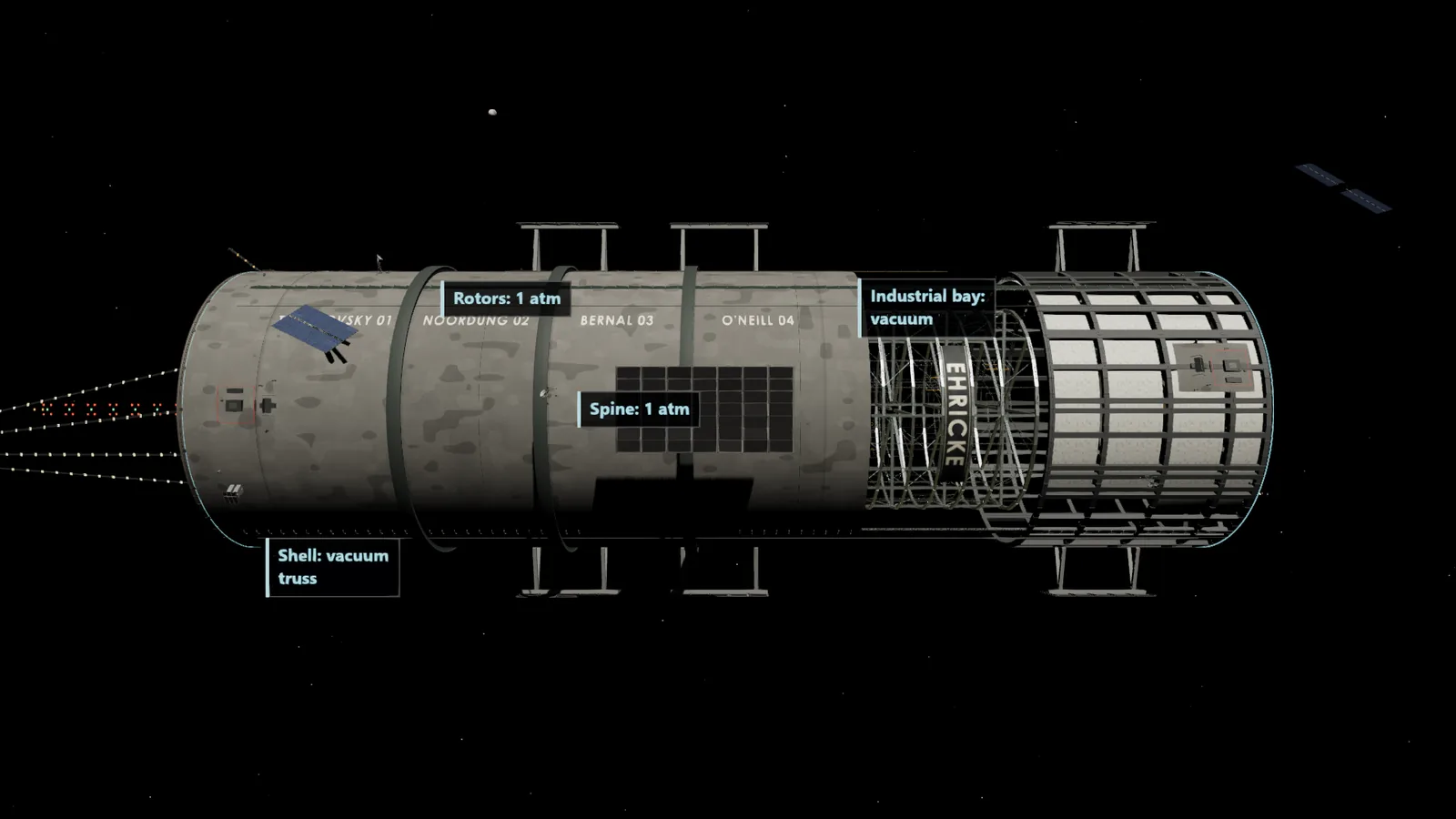
| Atmosphere | about 1 atm (101 kPa) | Design value | Earth-like air in the rotors, spine and above the sky | |
| Air volume | almost 200 km3 | Design value | Four rotors | pi r^2 L x 4 = 196 km3 (derived) |
| Air mass | 150 to 200 Mt; about 45 Mt per rotor | Established physics | Why volatiles are an industry | |
| Rotor wall load from the air | about 250 MN per metre of length | Established physics | Tension bands carry the pressure, not a thin can | P x r = 101,325 x 2,500 = 253 MN/m (derived) |
| Megaframe | extends to 1,500 m, plates to 800 m | Design value | The prebuilt lattice that holds the elevated city | |
| Megaframe mass | about 6 Mt per rotor (estimate) | Engineering challenge | About 150 kg per m2 of floor, about fifty times lighter than the same volume built solid | 300 Mt / 6 Mt = 50 (derived) |
| Shield example | 1 m at 1.6 t/m3 = about 750 Mt | Design value | Order of magnitude for regolith cover | 1 m x 1.6 t/m3 x 470 km2 |
| End wall | 2,436 m tall, 24 cells | Design value | An inhabited cliff at each rotor end | 2,500 m - 64 m bore |
| Spine | 120 m diameter, never rotates | Design value | Zero-g transport and utility core | |
| Bridge | 300 m between end walls, 45 m above ground | Design value | Links same-spin neighbours |
Mass budget
The finished station is about 2.05 x 10^12 kg, about two billion tonnes. The table lists what is included: the four habitation rotors with their air, Ehricke (the industrial rotor), and the shielding example. The spine, ports, radiators and yards are small next to these rows and are not itemised.
| Part | Mass | Basis | Why | Formula |
|---|---|---|---|---|
| Four habitation rotors, air included | 1.2 x 10^12 kg | Design value | Each rotor is planned at 3 x 10^11 kg, about 45 Mt of it air | 4 x 3 x 10^11 kg |
| Ehricke (the industrial rotor) | 1 x 10^11 kg | Design value | The rotating mass of the industrial rotor | |
| Stationary shielding | about 7.5 x 10^11 kg | Design value | One metre of regolith at 1.6 t/m3 over the hull | 1 m x 1,600 kg/m3 x 470 km2 (derived) |
| Total | about 2.05 x 10^12 kg | Design value | Still of the order of 10^12 kg | 1.2 + 0.1 + 0.75 = 2.05 x 10^12 kg (derived) |
| In International Space Stations | about 4.9 million | Design value | One ISS is 419,725 kg | 2.05 x 10^12 / 419,725 (derived) |
| Momentum rings, share of the total | about 0.35 percent | Design value | About 7 Mt of rim | 7 x 10^9 / 2.05 x 10^12 = 0.34 percent (derived) |
Momentum and industry
| Quantity | Value | Basis | Why | Formula |
|---|---|---|---|---|
| Net angular momentum | zero by construction | Established physics | A steerable station | Tsiolkovsky and Noordung (Rotors 1+2) = -50 percent, Bernal and O'Neill (Rotors 3+4) = +50 percent |
| Rotor angular momentum | 1.2 x 10^17 N m s each | Established physics | Cancelled in pairs | L = m r^2 w, with m = 3 x 10^11 kg |
| Ehricke (the industrial rotor) | radius 2,300 m, 3,500 m long | Design value | Heavy industry at partial gravity | |
| Industrial spin | 0.044 rad/s, period 142.8 s | Design value | Opposes O'Neill (Rotor 4) | T = 2 pi / w (derived) |
| Industrial gravity | about 0.45 g | Established physics | Lower than the cities | w^2 r / 9.80665 = 0.454 g (derived) |
| Industrial momentum | 1.9 x 10^16 N m s, about 4 percent | Established physics | Cancelled by the momentum rings | |
| Momentum rings | about 7 Mt total | Design value | Store what the pairs cannot cancel | m = L / (v r) at 1 km/s, 3,000 m |
| Net hold | within 0.1 percent | Design value | Cargo and launches move it | |
| Shipyard | about 3,500 m long, zero g | Design value | Build without a floor | |
| Example ship | 700 m long | Design value | Scale of the hero vessel |
Open in the simulation: Ehricke Industrial Rotor, Wide Open in the simulation: Momentum Control Bay
Power, heat and light
| Quantity | Value | Basis | Why | Formula |
|---|---|---|---|---|
| Average power draw | 20 to 25 GW | Design value | Four cities, industry, the skies and the launcher | |
| Power system sized for | about 40 GW continuous | Engineering challenge | Room for industry to grow | |
| Solar area | about 118 km2, about 28 platforms | Design value | Platforms sit away from the hull | 40 GW / 340 W/m2 (derived) |
| Main power line | 4 bipoles at +/-1.2 MV, 4.2 kA per conductor | Design value | Low loss over 7 km | loss about 0.02 percent |
| Black start | 2 reactors, 250 MWe each | Engineering challenge | Restarts the grid from nothing | |
| Heat to reject | up to 40 GW at 380 to 500 K | Established physics | All power ends up as heat | P = emissivity x sigma x A x T^4 |
| Radiator flux at 450 K | about 2.1 kW/m2 | Established physics | One-sided panel | q = emissivity x sigma x T^4, emissivity about 0.9 (derived) |
| Radiator area | about 19 km2 at 450 K | Established physics | What the heat needs | 40 GW / 2.1 kW/m2 (derived) |
| Sky brightness | 900 cd/m2 mean | Design value | Daylight feel | |
| Sky power | 2.2 GW average | Design value | Four rotors, day phases 6 h apart | up to 2.6 GW |
| Day length | 10 to 14 h by rotor | Design value | Each rotor keeps its own clock |
Moving around and leaving
| Quantity | Value | Basis | Why | Formula |
|---|---|---|---|---|
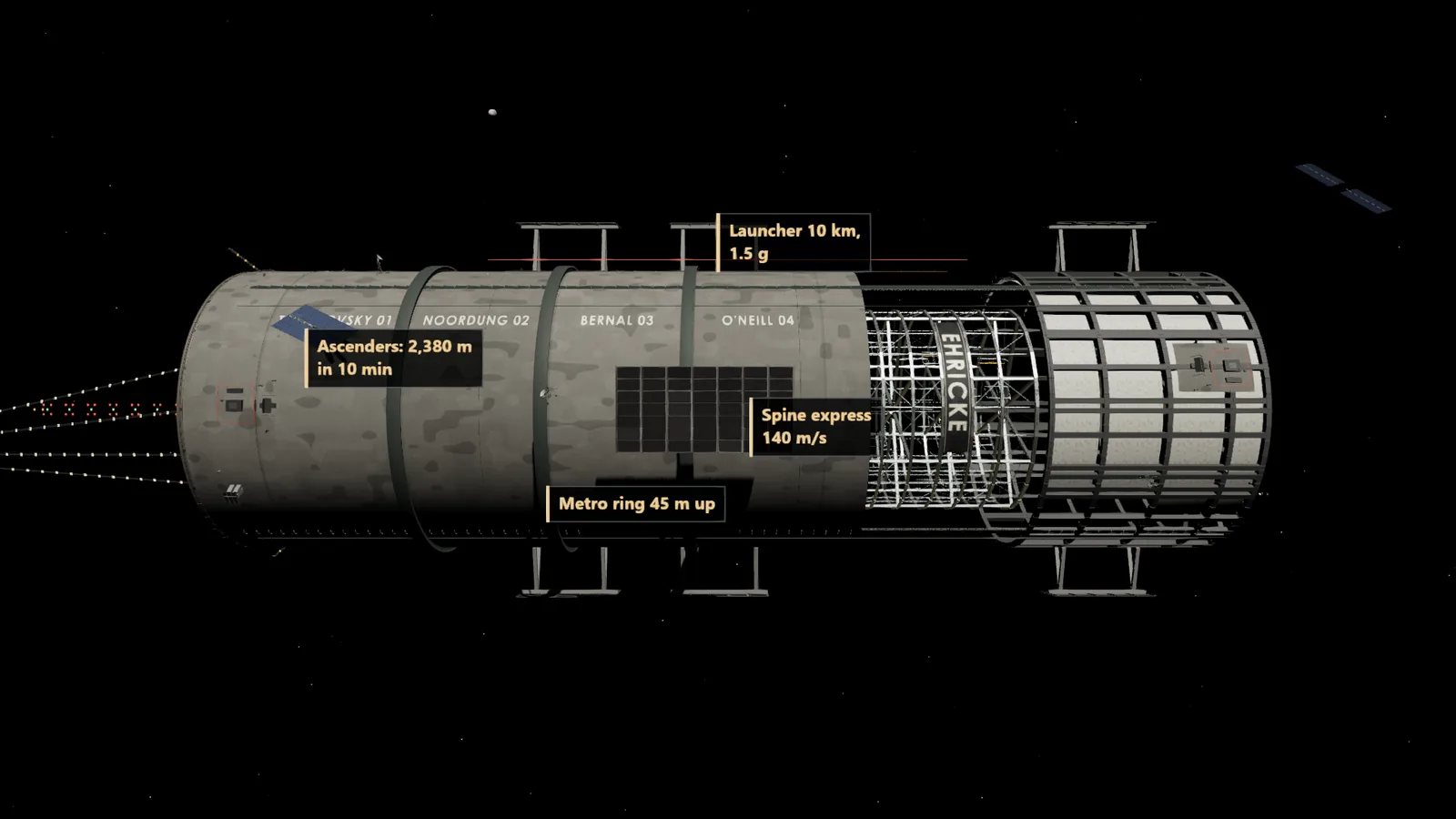
| Metro height | 45 m above the street | Design value | Viaducts, not tunnels | |
| Metro Coriolis | 0.66 g antispinward at 100 km/h, 1.33 g spinward at 90 km/h | Established physics | Weight changes with direction | 2 w v = 3.5 m/s2 at 100 km/h |
| Axial metro | 0.98 g | Established physics | No Coriolis along the axis | |
| Ascender | 2,380 m in about 595 s; 150 passengers | Design value | Ground to hub | avg 4.0 m/s |
| Hub spin transfer | about 602 s per cycle | Engineering challenge | De-spin, couple, spin up | |
| Spine express | 140 m/s | Design value | Hub to spaceport in minutes | |
| Launch track | about 10 km at 1.5 g for about 37 s | Engineering challenge | Cuts the propellant for departure | v = a t = 544 m/s (derived) |
| Exit speed | about 540 m/s | Design value | First leg of the trip | |
| Launch energy | about 146 MJ per tonne | Established physics | Kinetic energy at exit | 0.5 m v^2 (derived) |
| Earth transfer | about 15 days | Established physics | Lunar swing-by on day 6 | |
| Capture burn | 395 m/s at 400 km perigee | Established physics | Into a 21 h orbit |
Open in the simulation: Ride the ascender Open in the simulation: Passenger Launcher Interior
Go deeper: Check any row yourself
Almost every gravity and speed value follows from two numbers: the spin rate and the radius.
g = w^2 x r / 9.80665
v = w x r
T = 2 pi / w
With w = 0.0626 rad/s and r = 2,500 m: g = 0.0039188 x 2,500 / 9.80665 = 0.999, v = 156.5 m/s, T = 100.37 s. The Coriolis acceleration on something moving at speed v along the ground is 2 x w x v. At 100 km/h (27.8 m/s) that is 2 x 0.0626 x 27.8 = 3.5 m/s2, or 0.36 g. The exact weight on the ring viaduct (r = 2,455 m, floor speed 153.7 m/s) is (w r +/- v)^2 / r: 0.98 g standing, (153.7 - 27.8)^2 / 2,455 = 6.46 m/s2 = 0.66 g against the spin at 100 km/h, and (153.7 + 25.0)^2 / 2,455 = 13.0 m/s2 = 1.33 g with the spin at 90 km/h.