The ladder
Each generation stands on the one before it. None replaced the last overnight, and several still operate.
| Gen | Name | Era | What it proved |
|---|---|---|---|
| 1 | Government outposts | 1971 to about 2030 | People can live and work in orbit for months |
| 2 | Commercial orbital stations | Late 2020s to 2030s | Private ownership and a market for orbital work |
| 3 | Lunar surface and propellant | 2030s | Resources off Earth: asteroid metal, ice, oxygen, regolith, mass drivers |
| 4 | First rotating stations | Late 2030s | Spin gravity at small scale |
| 5 | Concordia | 2041 on | A city built from space materials, not launched from Earth |
Generation 1: government outposts
The first space station, Salyut 1, launched on 19 April 1971. Skylab followed in 1973 and was crewed for 171 days across three visits. Mir flew from 1986 to 2001 and weighed about 130 tonnes. The International Space Station, at 419,725 kg and 1,005 m3 of pressurized volume, has been continuously occupied since November 2000. China's Tiangong was complete in November 2022.
All of them were assembled from parts launched from Earth. All of them are in microgravity, and a crew stays for months, not years. They proved that people can live and work in orbit. They also set the scale problem: even the largest is the size of a large house.
Generation 2: commercial orbital stations
In the late 2020s, orbital stations started to be built, owned and run by private operators. Generation 2 proved that a market for orbital work exists. Its stations were still small, still in microgravity and still supplied from Earth. They were supplied by a new kind of launcher: fully reusable, refuelled in orbit, carrying over 100 tonnes a flight for about $2 million. That price, about $20 a kilogram to low orbit, is what made the later generations affordable to start (the numbers).
Generation 3: lunar surface and propellant
In the 2030s the supply line moved. The first metal came from small near-Earth asteroids, bagged whole and hauled to L5 (how). On the Moon, prospectors found water ice in the permanently shadowed regolith near the lunar poles (what they found). Ice becomes drinking water, oxygen and propellant. An electromagnetic mass driver on the Moon throws refined feedstock toward L5 at a fraction of what it costs to lift the same mass from Earth.
Generation 3 proved that the Moon is a place you can work, and that its materials can be delivered. What set the pace was industry that copies itself (who paid for it).
Generation 4: the first rotating stations
By the late 2030s the first stations spun. They are small rings a few hundred metres across, built to house the workers of the construction yard at L5. Generation 4 proved that spin gravity works at small scale, and it gave builders years of data on how people live in artificial gravity.
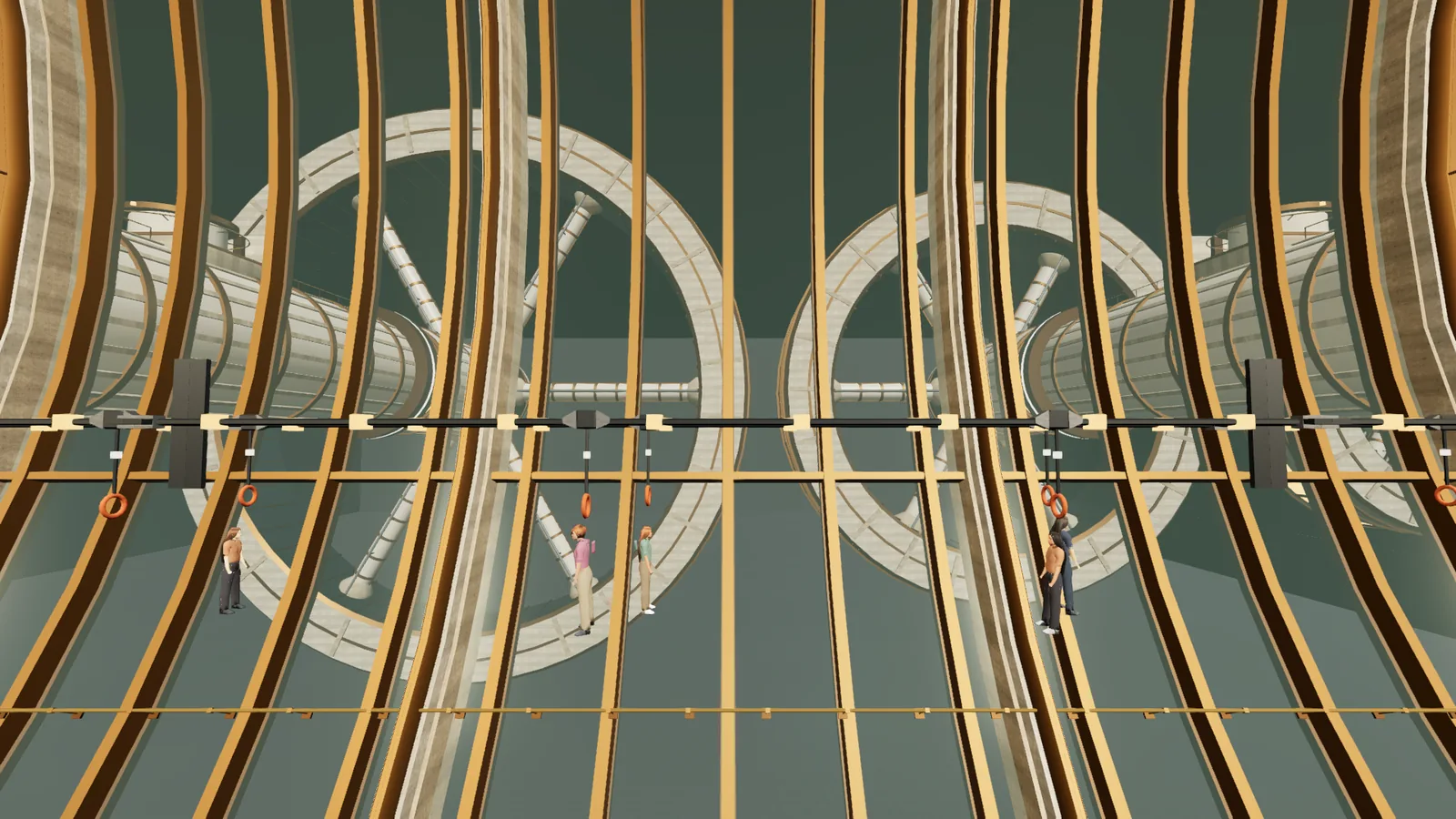
Open in the simulation: Spaceport Rotating Lounges
Their descendants still turn at the spaceport, where three small comfort lounges spin at 2 rpm to give arriving visitors 0.13 to 0.28 g while they adjust. The construction rings themselves were towed 200 km out after the fourth rotor reached full spin in 2044, and they now turn at the next build site, where the yards have started the next station.
Generation 5: Concordia
Three things make the fifth generation different.
Its materials come from space. The stone-like walls are sintered regolith. The air, water and metals come from the Moon and from small captured asteroids. Earth launch is kept for high-value, low-mass items. See how Concordia was built.
It is a city. Each rotor is 5 km across and 2.5 km long. Four of them give about 157 km2 of ground at 1 g before any elevated building, and a million people is the design population. Earlier habitats held crews. This one holds schools, parks, lakes, farms and neighbourhoods.
It cancels its own spin. Two rotors turn one way and two the other, so the station carries no net angular momentum. That is what lets a structure this large steer, dock and launch without fighting a giant gyroscope. See counter-rotation.
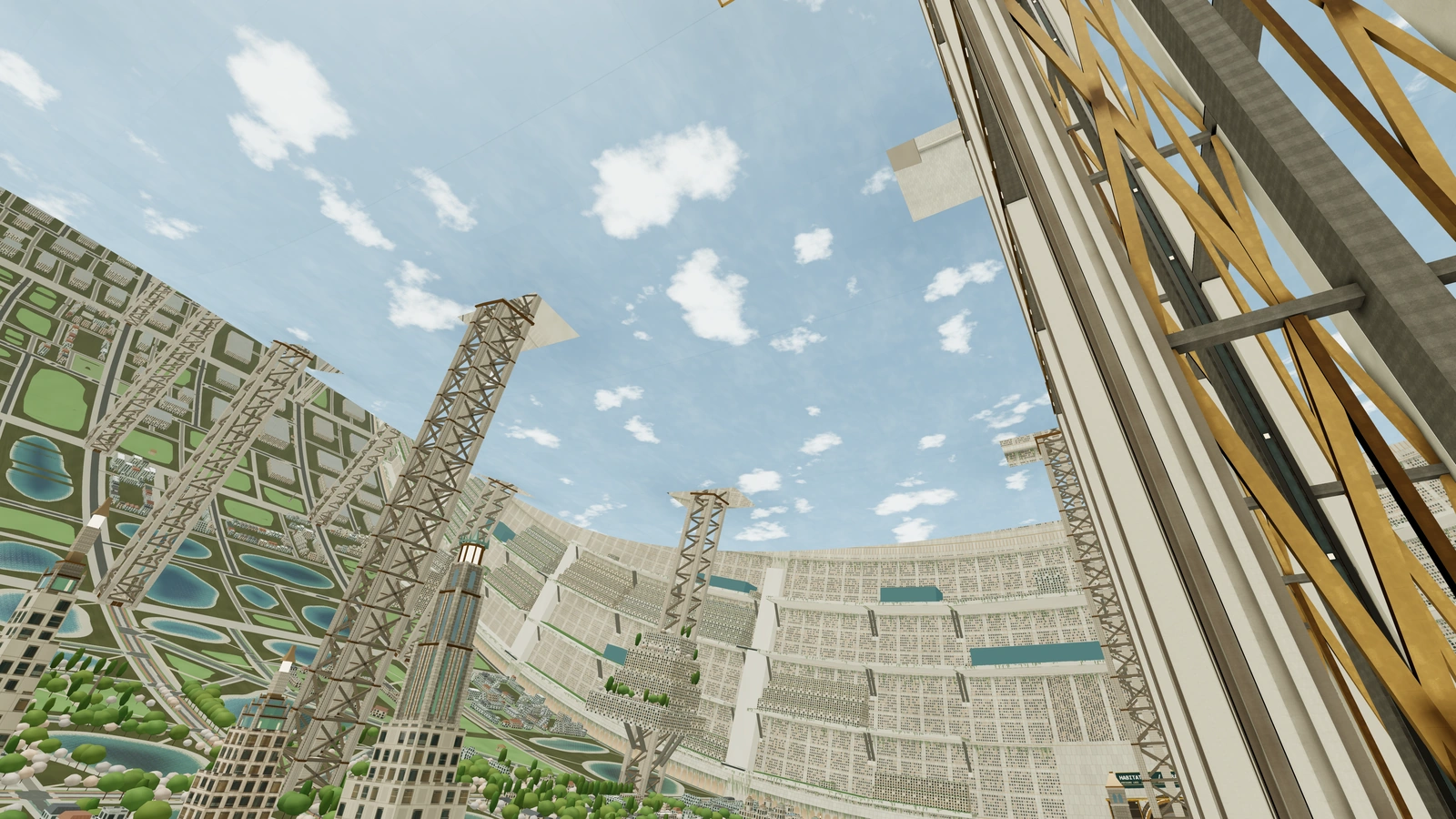
Go deeper: Where the shape comes from
Concordia descends from the O'Neill cylinder, the rotating-cylinder settlement that Gerard O'Neill proposed in the 1970s and that NASA's 1975 summer study worked up as a design in 1977. The cylinder fixes a simple rule: a big radius gives gravity at a slow, comfortable spin. A radius of 2,500 m needs only 0.6 rpm for 1 g.
Concordia keeps the cylinder and changes the rest. It has four rotors instead of one, a stationary shell instead of a rotating one, and an industrial rotor, Ehricke, that spins against the cities. Most of those changes answer one question: what happens when part of it breaks? Safety goes through them.
Sources and further reading
- NASA, "International Space Station facts and figures" (mass 419,725 kg, pressurized volume 1,005 m3, continuously occupied since November 2000): nasa.gov.
- Wikipedia, "Salyut 1" (launched 19 April 1971): en.wikipedia.org/wiki/Salyut_1.
- Wikipedia, "Skylab" (launched 14 May 1973, three crews, 171 days): en.wikipedia.org/wiki/Skylab.
- Wikipedia, "Mir" (1986 to 2001, 129,700 kg): en.wikipedia.org/wiki/Mir.
- Wikipedia, "Tiangong space station" (construction complete November 2022): en.wikipedia.org/wiki/Tiangong_space_station.
- Colaprete et al., "Detection of Water in the LCROSS Ejecta Plume", Science 330, 2010: doi.org/10.1126/science.1186986.
- Johnson and Holbrow (eds.), "Space Settlements: A Design Study", NASA SP-413, 1977: nss.org.