Predict
You ride the ascender up through the artificial sky. What fills the view once you are above it?
- Stars
- The far side of the city, upside down
- Empty vacuum
Show the answer
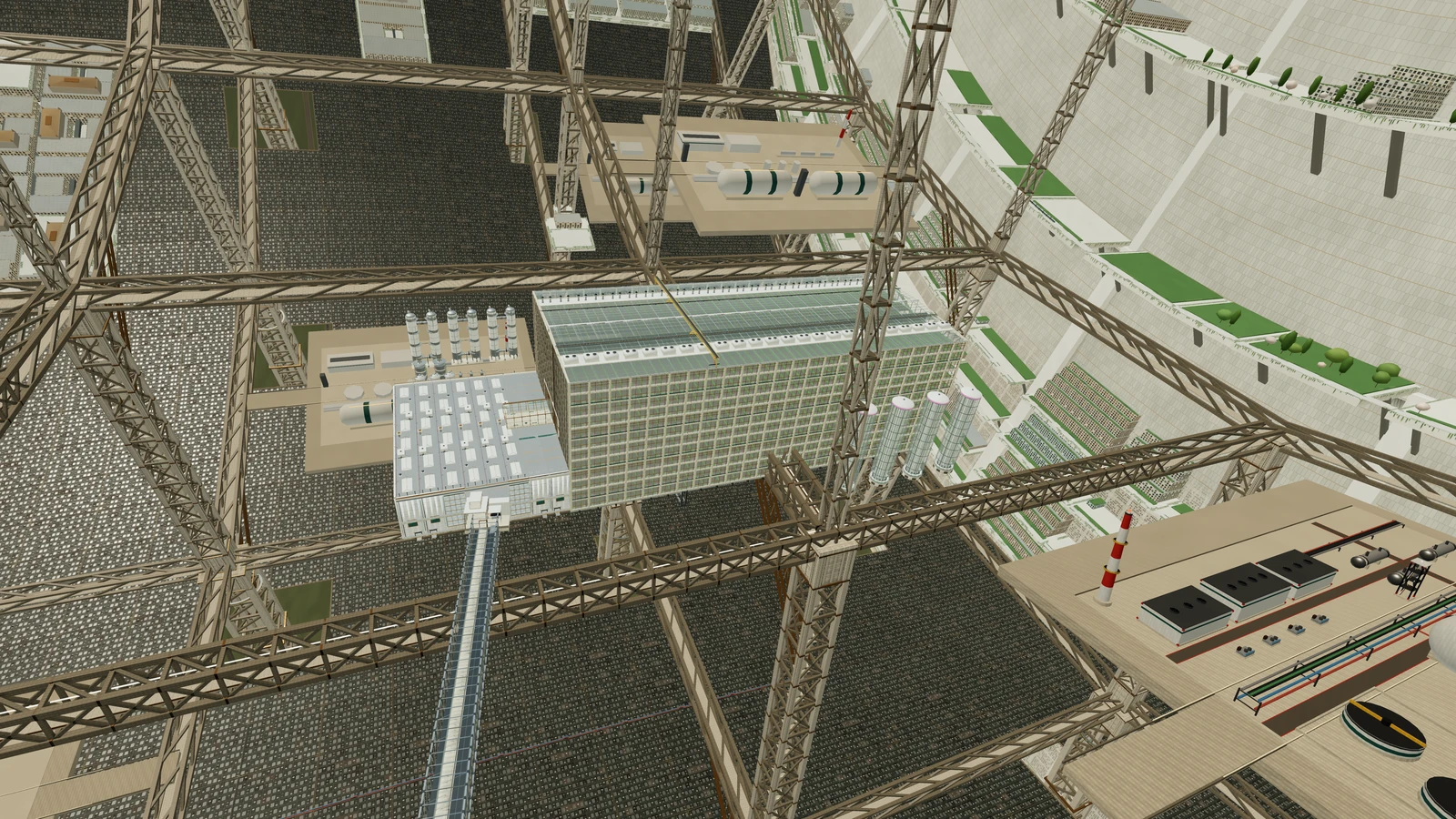
The far side of the city, upside down. Above the sky the rotor opens out to its full 5 km width, and the opposite floor faces you across the air with its streets and towers pointing at the axis.
Observe
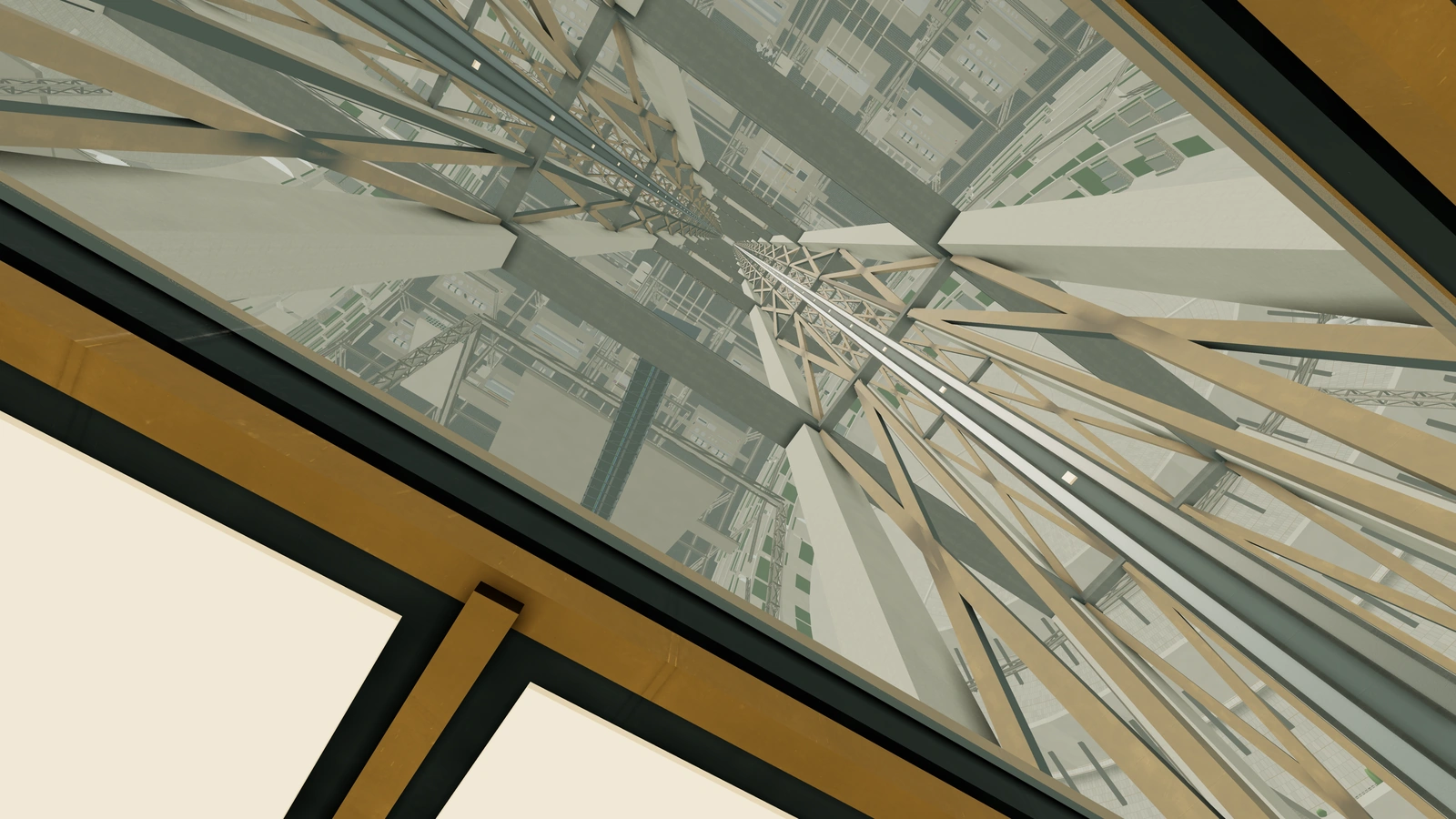
Open the breakthrough view. The cabin has just passed through a permanent opening in the sky, and the backs of the sky panels fill the window.
Open in the simulation: Ascender: Artificial Sky Breakthrough
Explain
The sky is a ceiling of lit panels at 450 m, built to look like open air from the street. From below it is opaque, so from the street you cannot see past it. Each ascender tower passes through a permanent opening, about 154 m by 210 m, and the cabin slides through. Design value
Above the panels the picture changes. You see frames, maintenance paths and stay cables, then the rest of the cylinder. The air above the sky is the same air as the air below it, because the sky is a ceiling and not a seal. The far side of the rotor is 4,550 m from the sky and 2,500 m from the axis, a second city whose floor faces yours. It reads as upside down because its down points away from you, toward the outer wall behind it. Established physics
Weight is already falling as you rise. At the sky you weigh 0.82 g, and it keeps draining until the axis, where you float. This is why the reveal comes from the ascender and not from the street: the sky hides the far side until you are above it. Design value
Go deeper: How far is the far side?
Distances along a diameter of the rotor, which is 5,000 m across at the ground.
sky (r = 2,050 m) to the far ground = 2,050 + 2,500 = 4,550 m
axis to the far ground = 2,500 m
gravity at the sky = 0.0626² × 2,050 / 9.81 = 0.82 g
The ascenders and sky page has the tower numbers, and light and sky explains how the panels make a day.
Change a parameter
Slide the height to 450 m and note 0.82 g, the sky. Then slide on to 2,500 m. The ascender covers this climb in about ten minutes.