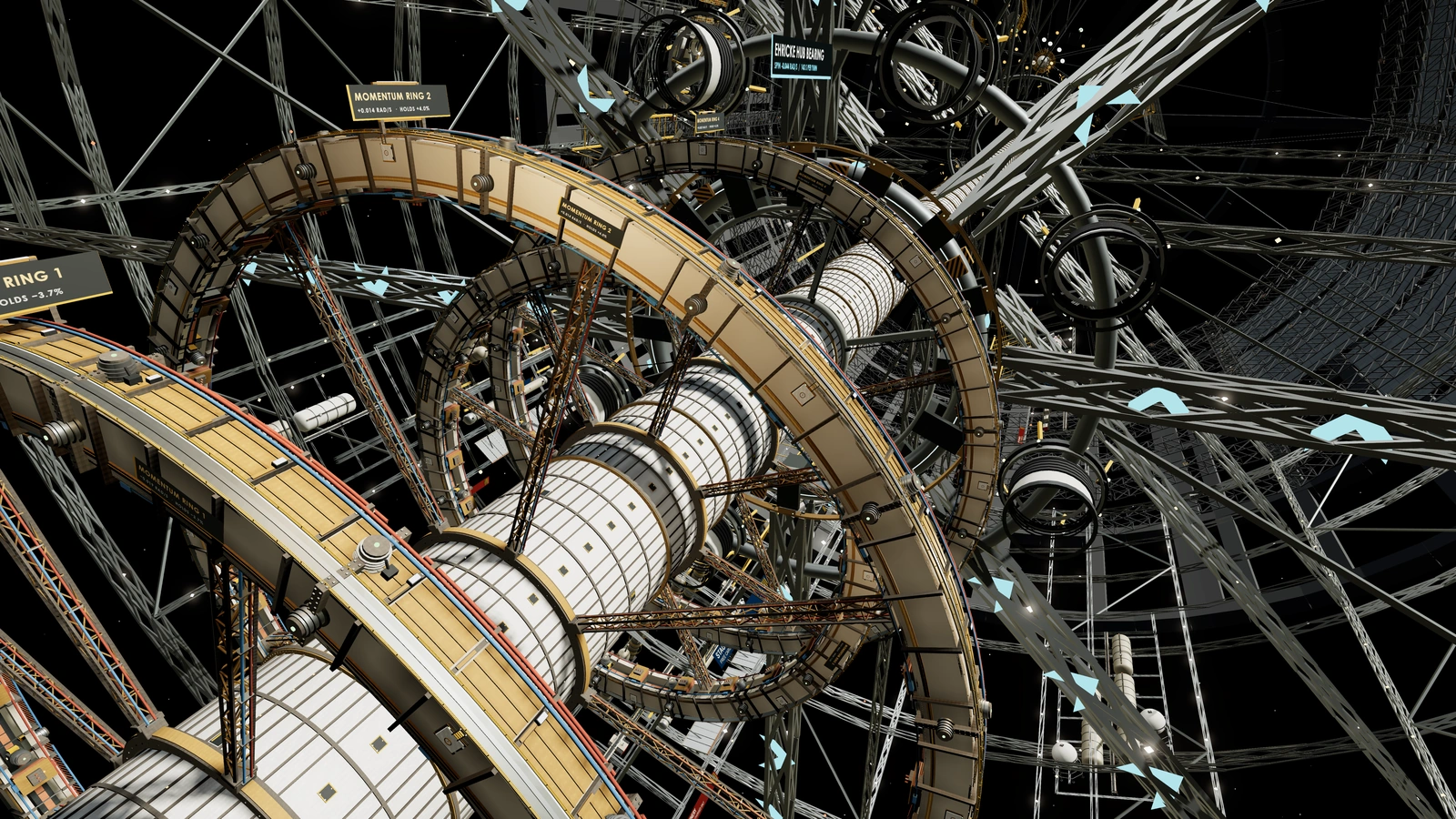
Predict
Suppose all four city rotors spun the same way. How hard would each end of the station have to push to turn it 1 degree a day?
- About 4 thousand newtons
- About 400 thousand newtons
- About 4 million newtons
Show the answer
About 4 million newtons at each end, continuously: 4.1 MN with the industrial rotor, Ehricke, and the rings already working against it. The station as built needs at most 4.5 kN. The difference is a factor of about a thousand.
Observe
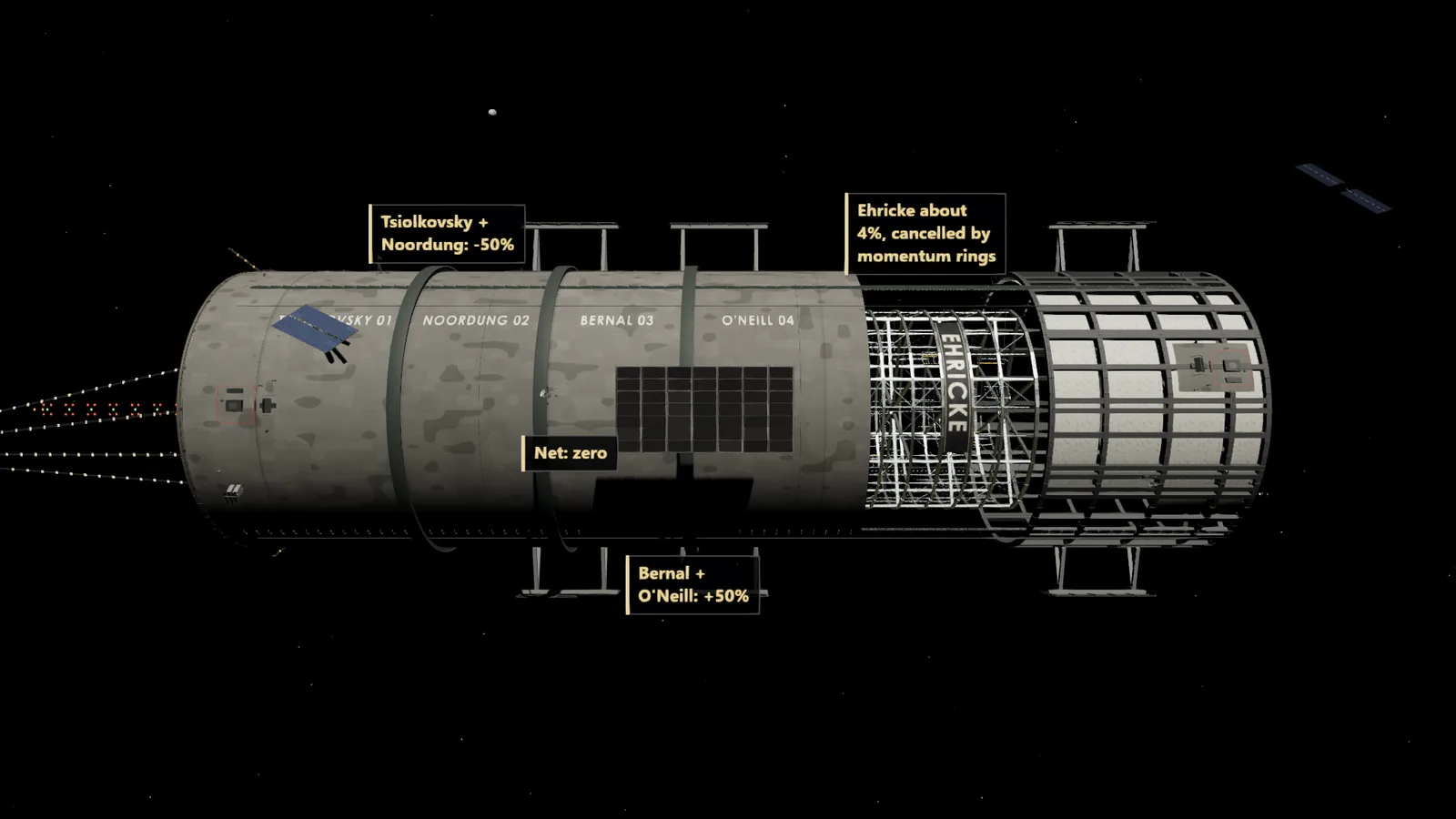
Open the momentum overlay on the whole station. Tsiolkovsky and Noordung carry one sign, Bernal and O'Neill the other, and the net is zero.
Open in the simulation: Exterior Hero: Complete Habitat
Explain
A spinning rotor is a gyroscope. Push on it to turn it and it pushes back at a right angle. Each rotor holds 1.17 × 10¹⁷ N·m·s of angular momentum, so four spinning the same way would hold 4.7 × 10¹⁷ and resist every turn. Established physics
Concordia avoids that by pairing. Tsiolkovsky and Noordung turn one way and Bernal and O'Neill the other, so the habitation rotors sum to zero. The industrial rotor turns against rotor four and holds about 4 percent of the total. Momentum rings trim whatever is left, to within 0.1 percent. Design value The pairs spin against each other at the spine, so the spine, hull and ports sit still between them.
That is the answer to the title. The rotors do spin, once every 100 seconds. The station frame does not, and it can turn on a few kilonewtons of electric thrust. Momentum is traded between rotors and rings, not thrown away, so turning costs electricity and not propellant.
Go deeper: The thrust arithmetic
Turning a body with angular momentum L at rate W takes a torque L × W. A couple across the 21 km hull supplies it.
W = 1° / day = 2.02 × 10⁻⁷ rad/s
all four one way (net 4.28 × 10¹⁷ N·m·s):
torque = 4.28 × 10¹⁷ × 2.02 × 10⁻⁷ = 8.6 × 10¹⁰ N·m
force at each end = 8.6 × 10¹⁰ / 21,000 m = 4.1 MN
as built (inside the 0.1 percent band): 4.5 kN
Counter-rotation has the full ledger, including the rings.
Change a parameter
Press All four spin one way in the ledger and read the thrust. Then press Concordia as built and watch it fall to a few kilonewtons.