Predict
You raise a radiator's temperature from 450 K to 500 K and the heat to reject stays the same. Does the panel area you need get smaller or larger?
- Larger
- Smaller
- The same
Show the answer
Smaller, by about a third. Heat radiated rises with the fourth power of temperature, so 500 K sheds 1.52 times as much per square metre as 450 K, and the area needed falls to 0.66 of what it was.
Observe
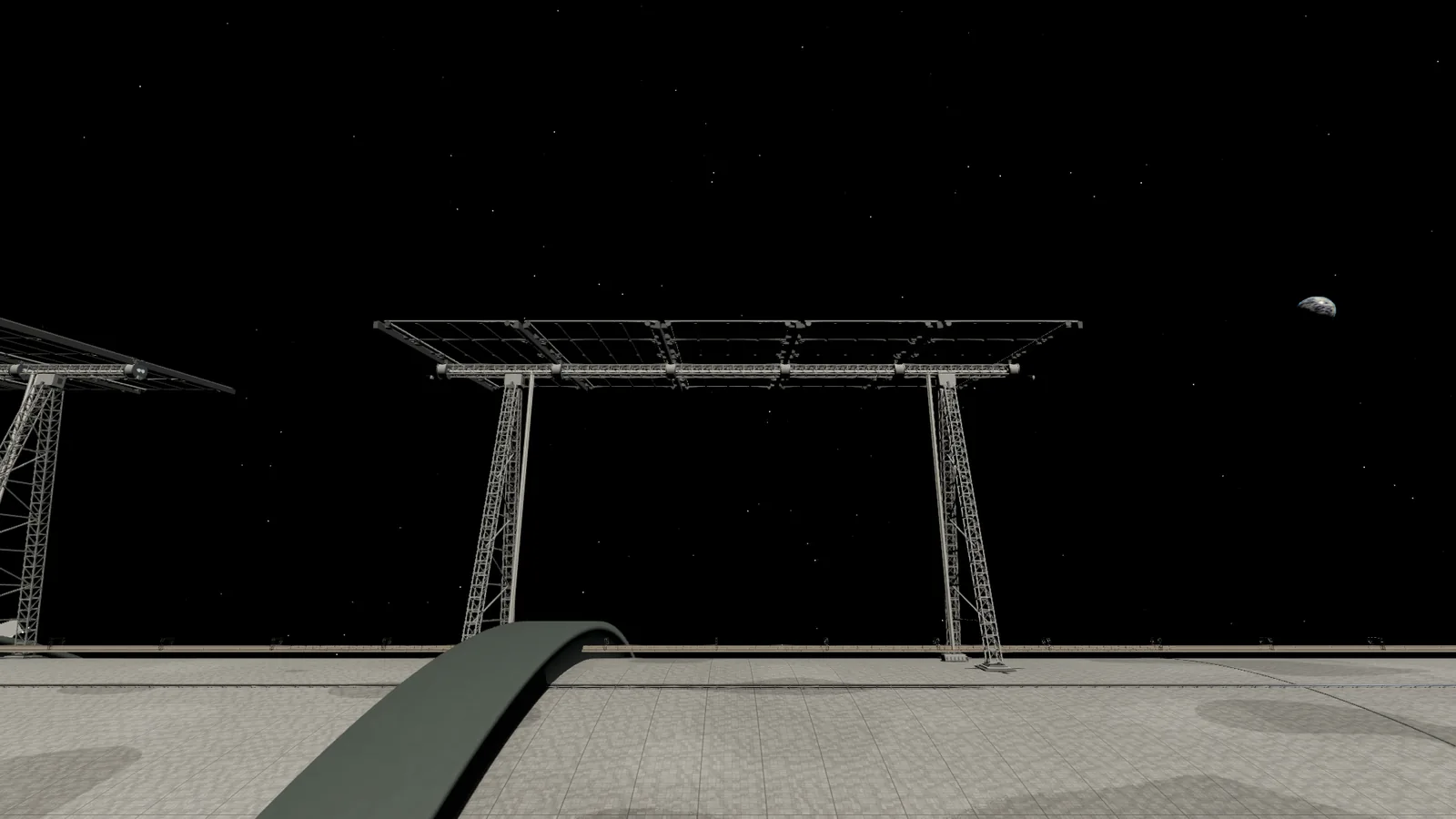
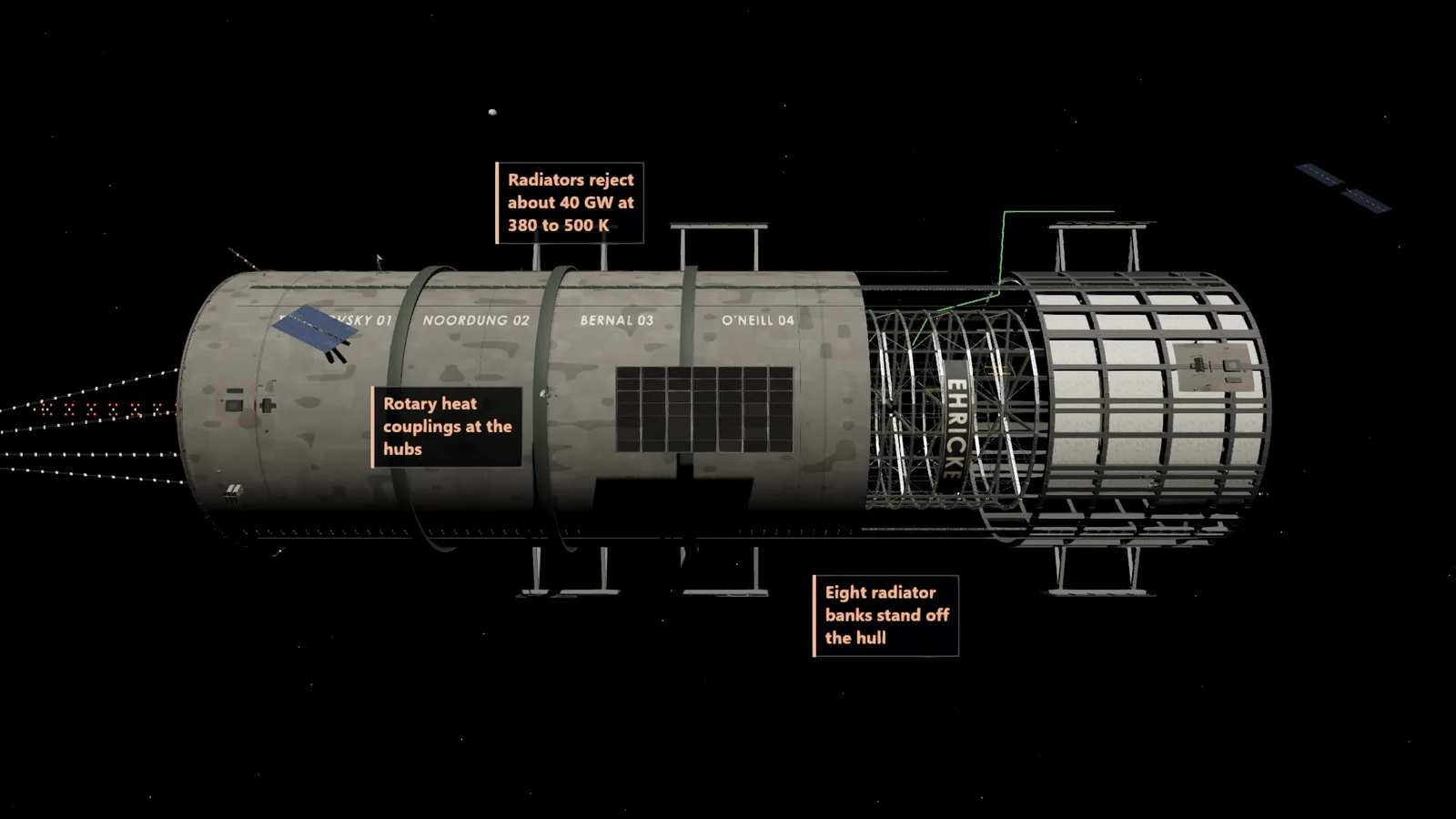
Open the thermal overlay on the whole station. The radiator banks stand off the hull on long masts, so their light has somewhere to go.
Open in the simulation: Exterior Hero: Complete Habitat
Explain
In vacuum there is no air to carry heat away and no ground to conduct it into. A hot surface loses energy one way only: by radiating it. Each square metre of a panel at temperature T sheds ε × σ × T⁴ per side, where ε is how well the surface radiates and σ is Stefan's constant. Established physics At 450 K and ε of 0.9, that is 2.1 kW per square metre.
The temperature is a choice. Hotter panels shed more per square metre and need fewer square metres, but the heat has to be carried to them at that temperature. Concordia lifts heat from the 300 K city to the radiators with heat pumps and runs the panels at 380 to 500 K. Design value For 40 GW at 450 K that comes to 19 km² of panel on one side. The scene carries 248 modules of 400 by 200 m, 19.8 km² in all, in eight banks standing off the hull.
The calculator leaves out sunlight on the panels, the work the heat pumps do, and the rotary joints that pass heat out of the spinning rotors. Each of those needs development work before anyone builds it at this scale. Engineering challenge
Go deeper: The radiator equation
Radiated power per square metre is set by temperature alone.
flux = ε × σ × T⁴, σ = 5.67 × 10⁻⁸ W/m²/K⁴
450 K, ε 0.9: flux = 2.1 kW/m² per side
area = power / flux = 40 GW / 2.1 kW/m² = 19 km²
area ratio, 500 K against 450 K = (450 / 500)⁴ = 0.66
Power and heat covers where the 40 GW goes and how the heat gets out of a rotor.
Change a parameter
Set the temperature to 500 K and watch the area shrink by a third. Then drop it to 380 K and watch it more than double.