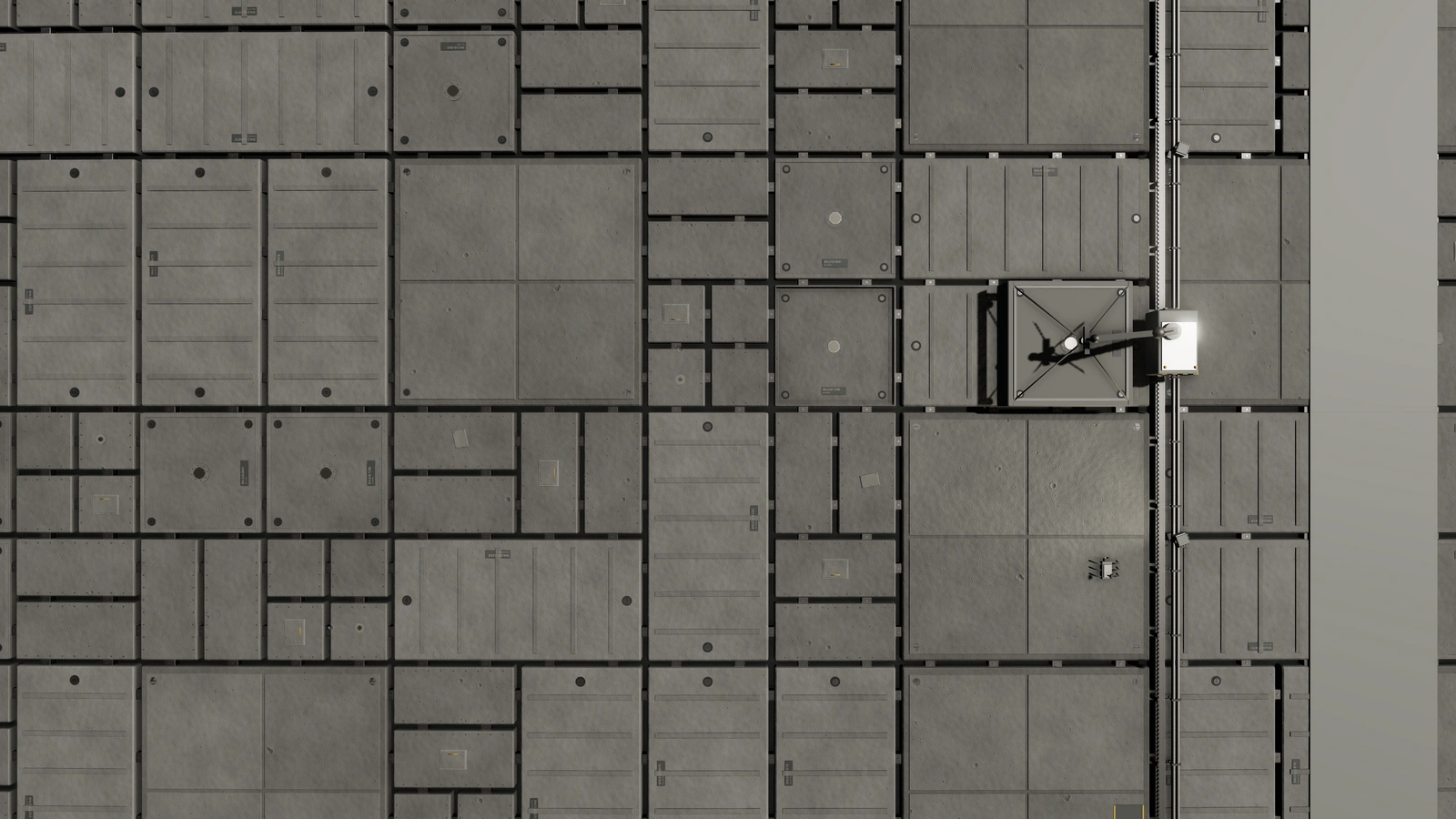
Predict
A meteoroid punches a 1 m² hole through a rotor wall. How long until the rotor has lost 1 percent of its air?
- A few minutes
- About three weeks
- About six years
Show the answer
About three weeks. At a clean opening, 22 days to lose 1 percent of the air and 230 days to lose 10 percent. The six years is the time constant, the time for the pressure to fall by a factor of e.
Observe
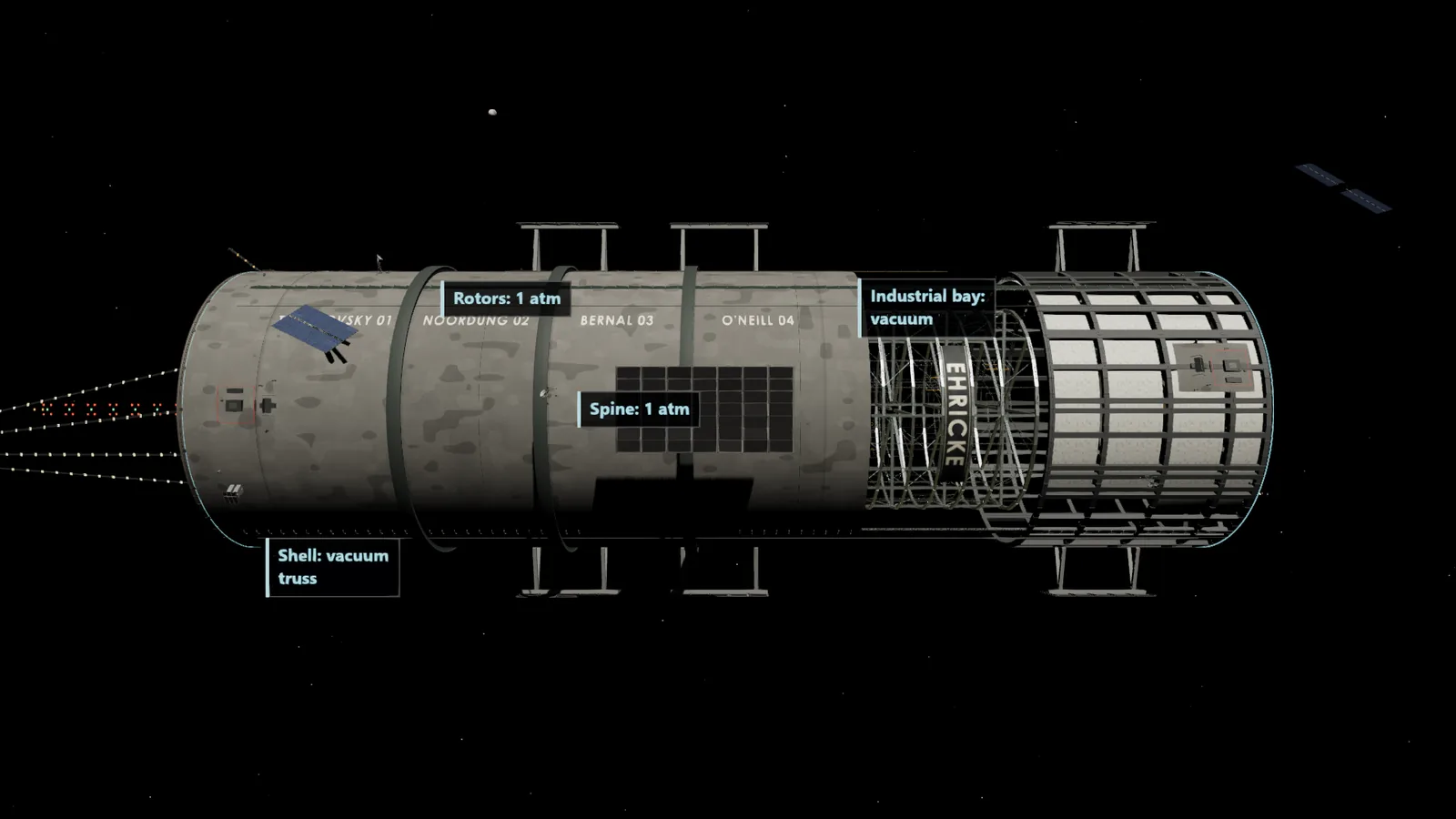
Open the pressure overlay. The rotors and the spine hold one atmosphere. The shell outside them and the industrial bay are vacuum, so every airtight boundary is a wall between the two.
Open in the simulation: Exterior Hero: Complete Habitat
Explain
Air that escapes into vacuum leaves at the speed of sound, and the speed does not change as the pressure falls. Engineers call this choked flow. At one atmosphere it is 239 kg of air per second through every square metre of hole. Established physics A rotor holds 45 Mt of air. Design value A 1 m² hole removes a small fraction of it each second, so the pressure falls on a time constant of about six years: 1 percent gone in 22 days, 10 percent in 230. A hole that cost 1 percent in a day would have to be 22 m².
Real losses are smaller still. Each rotor is split into pressure districts, with barriers that close when the pressure falls, so a breach empties one district and not the rotor. The calculator treats the whole rotor as one room. The 1975 NASA study, whose torus for 10,000 people held far less air, put a 1 m hole at once in 10 million years and reckoned at least a day to lose 60 percent of its atmosphere through it. Safety covers how Concordia contains a failure.
The calculator leaves out local wind and cold at the hole, a hole that grows, and which compartment it opens into. Those decide how a breach feels, and only a test on real hardware settles them. Engineering challenge
Go deeper: The flow law
Choked mass flow per square metre, for air at pressure P and temperature T into vacuum, then an exponential decay of the air mass.
flux = Cd × P × √(γ / (R T)) × (2 / (γ + 1))^((γ + 1) / (2 (γ − 1)))
P = 101,325 Pa, T = 293 K, γ = 1.4, R = 287 J/kg/K: 239 kg/s/m² at Cd 1
τ = air mass / (flux × area) = 4.5 × 10¹⁰ kg / 239 kg/s = 5.96 years for 1 m²
time to lose 1 percent = 0.01005 × τ = 22 days
Change a parameter
The calculator starts at a discharge coefficient of 0.8, a ragged opening, so 1 m² takes 27 days to lose 1 percent. Drag the hole to 100 m² and the same 1 percent goes in about 6.6 hours.