Predict
You walk 8 km along a ring street. Are you upside down compared with where you started?
- No, the street is flat
- Yes, and you never feel it
- Only your head feels it
Show the answer
Yes. The ring is 15.7 km around, so 8 km carries you just past halfway: your feet point the way your head did at the start. The floor pushed on your feet the whole way, so nothing felt different.
Observe
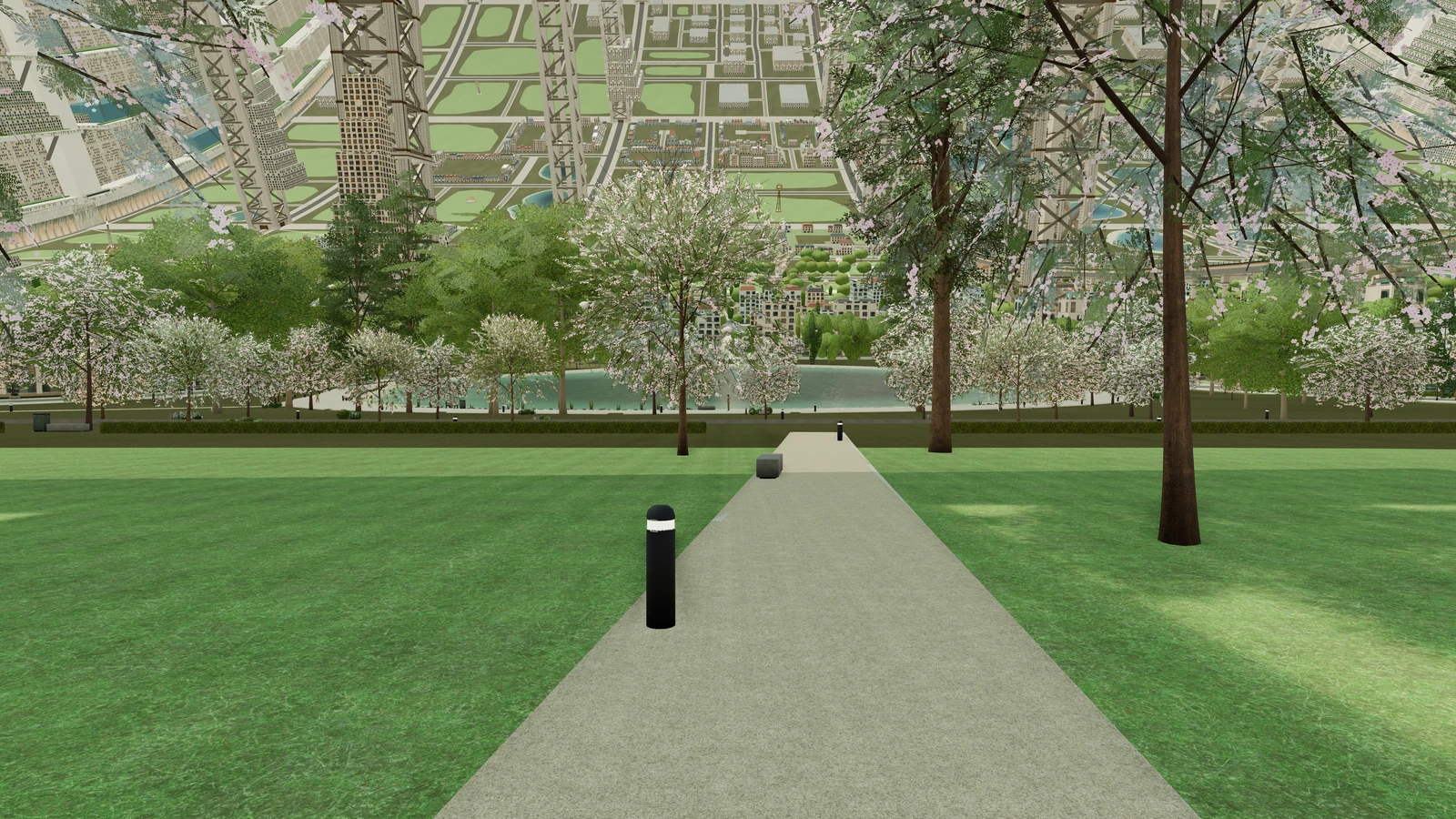
Open the park view and face down the long lawn. The far end of the ground does not drop away to a horizon. It climbs.
Open in the simulation: Groundside Park
Explain
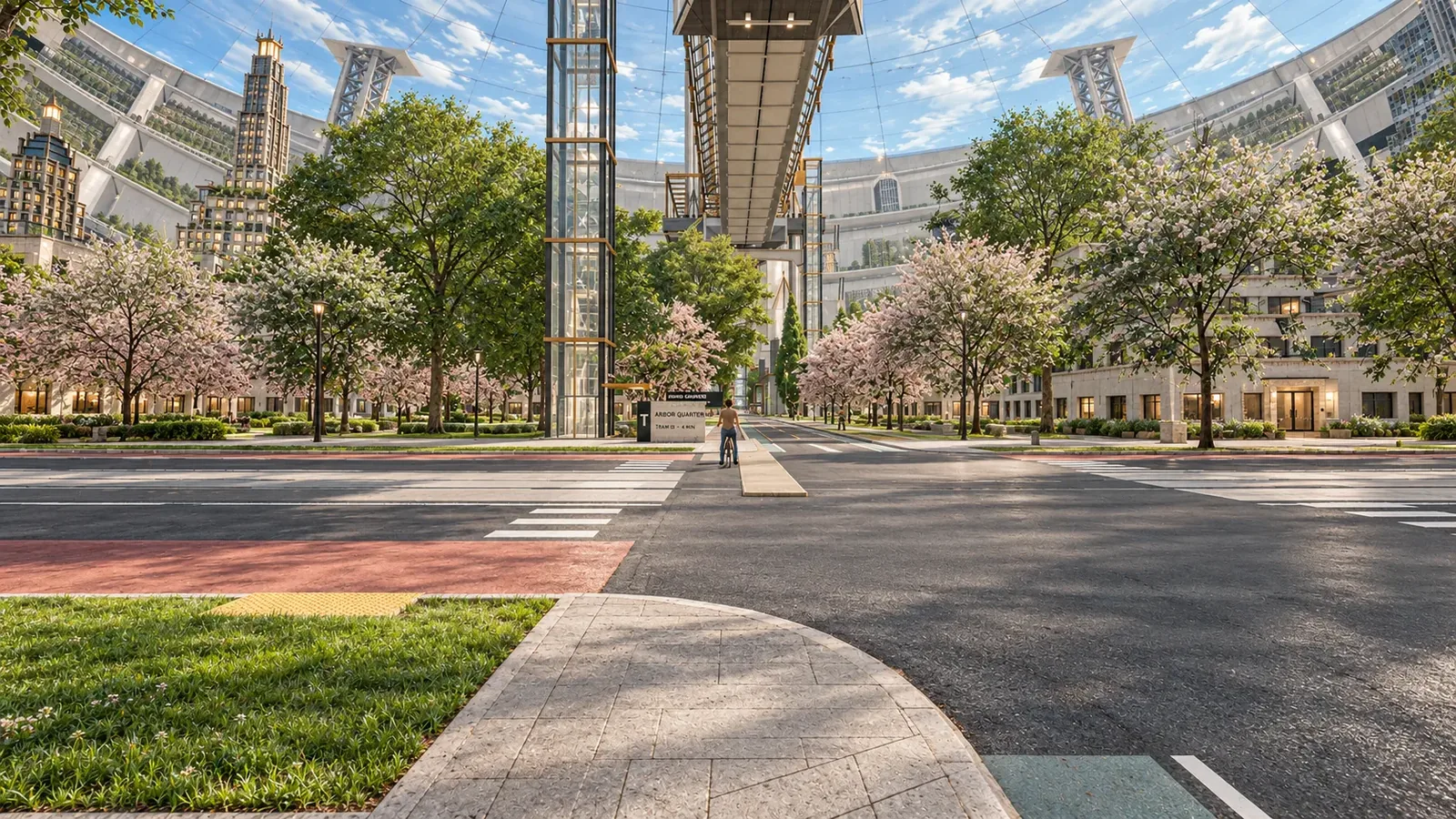
On Earth the ground falls away at the horizon because you stand on the outside of a ball. In Concordia you stand on the inside of a cylinder, so the ground curves up instead. The street never feels like a hill, because down always points away from the spin axis, 2,500 m from your feet. Your head points at the axis, and the floor pushes on you with the same force at every point of the ring. Established physics
Keep walking and the circle closes. The ring is 15.7 km around at the ground, so 8 km is 183 degrees of arc: half a turn and a little more. There the floor under you faces the floor you started on, across 5 km of air. Nobody can feel that, because the push of the floor is the only up there is.
The same shape gives the view. Along the ring the street climbs away until the bright sky closes it off. Along the axis the street runs level to the end wall. Design value
Go deeper: The circle in numbers
The ground is a circle of radius r. Distance along it turns into an angle.
circumference = 2π × r = 2π × 2,500 m = 15.7 km
angle = distance / r = 8,000 m / 2,500 m = 3.2 rad = 183°
At a walking pace of 1.4 m/s the 8 km takes 95 minutes. Artificial gravity has the full derivation, and moving around covers the ring metro that does the same trip in minutes.
Change a parameter
Slide the height to 2,000 m. The circle you stand on shrinks to 500 m in radius, 3.1 km around, and your weight falls to 0.20 g. The nearer you are to the axis, the faster the ground curves.