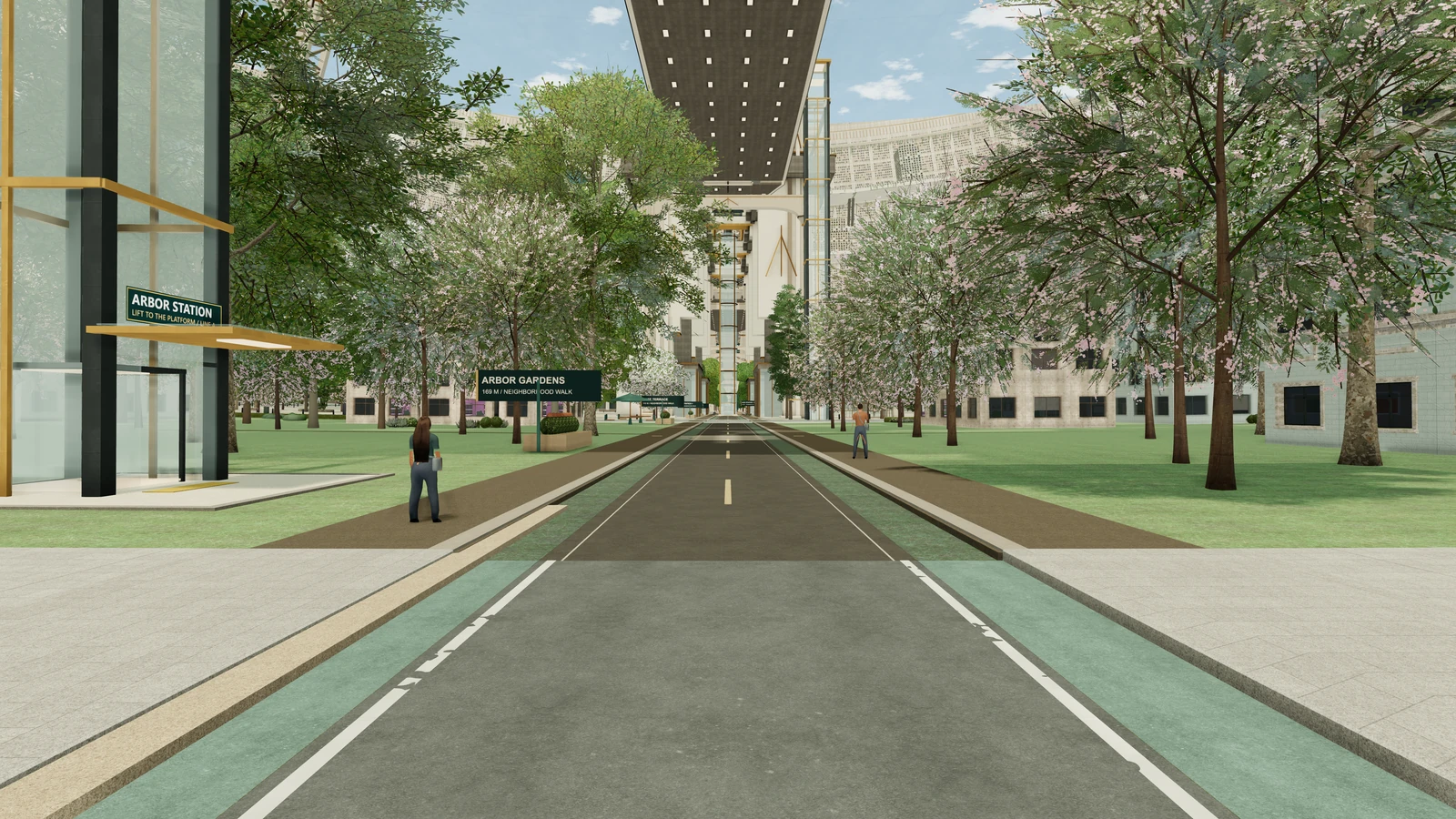
What you see
Ground level in a rotor is ordinary city. Mid-rise blocks of about five floors line streets with plane trees, columnar limes and cherry trees. Arterials are 36 m wide, with a metro or tram surface line, two cycle tracks and two rows of trees. Side streets are 12 m, quiet and walkable.
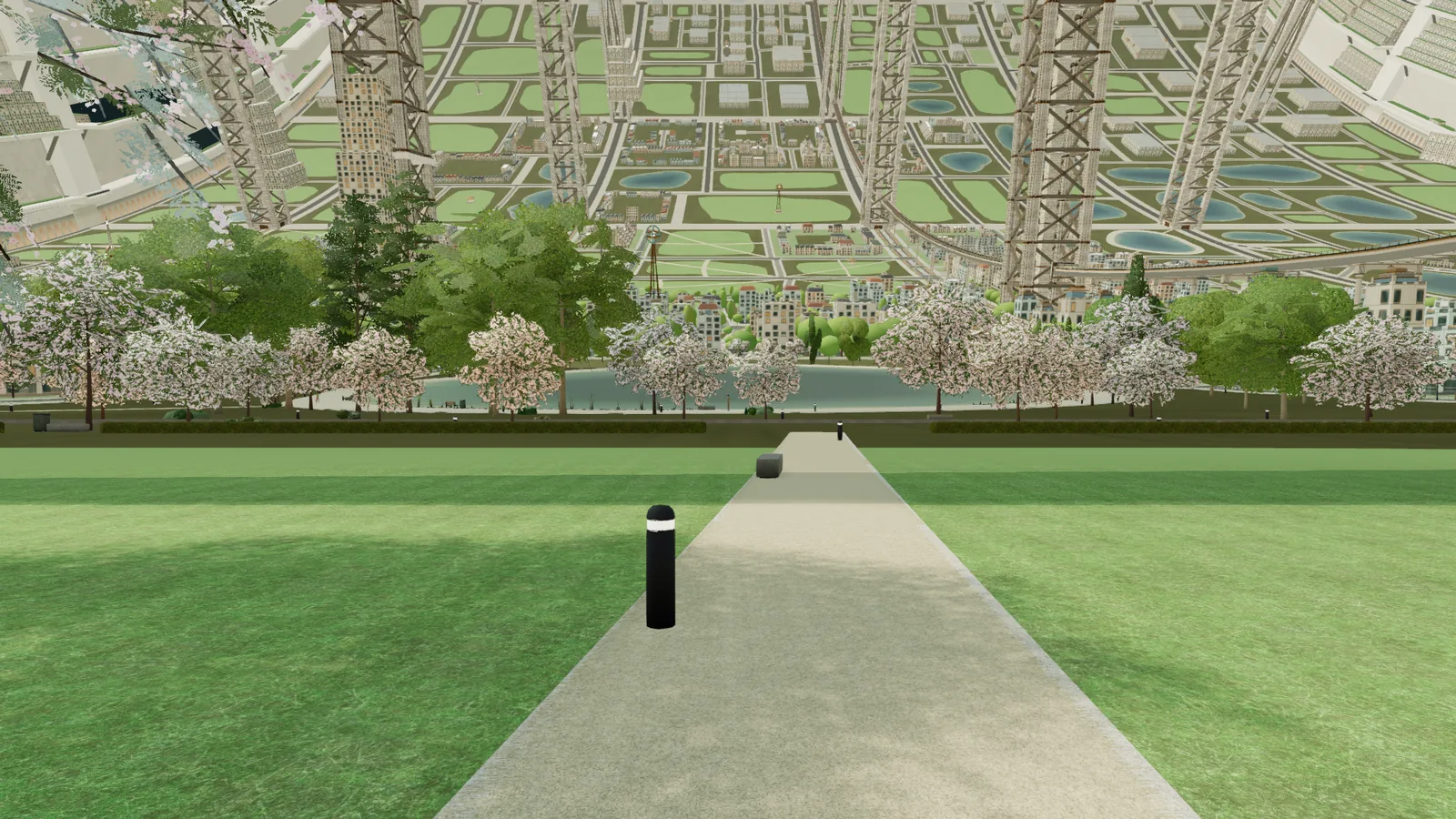
Parks and lakes take about a third of the ground. A rotor holds 72 to 114 lakes, and rotor 1 has 2,242 blocks. Each of the roughly 40 districts has a landmark: an armillary sphere, a twin-blade obelisk, a lantern tower or a ring-and-needle, lit at night. Civic halls add clock towers and porticoes.
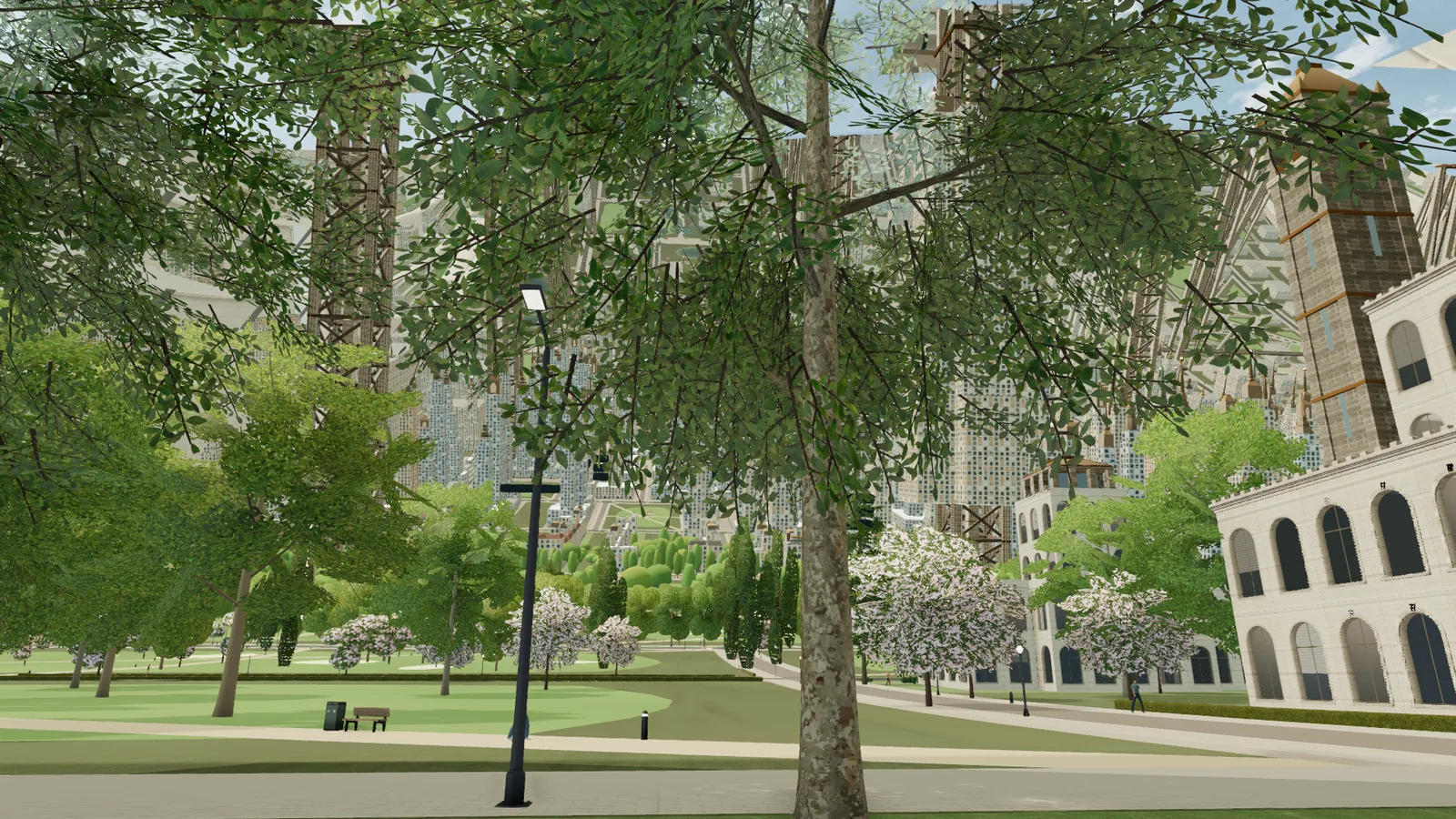
Trees are part of the plan, not an afterthought. Rotor 1 has about 88,000 of them, planted along streets and in the parks, and at least 30 percent of the groundside area is public open space. The sky schedules the weather and it never rains (light and sky). Air movement is engineered too, so the breeze in the park is a design choice.
Look along the ring and the street keeps rising. The floor is a circle 2.5 km in radius, so the horizon is a road climbing away rather than a flat line. Between the rooftops the artificial sky shows only above about 35 degrees of elevation along the ring.
Four plazas around the ring, 90 degrees apart, mark the foot of the ascender towers. Each is a public square with a monument at its centre, such as an obelisk, an arch, a column or a sundial, and the boarding lifts for the climb to the axis. The climb to the axis takes about ten minutes.
How it works in brief
Weight comes from spin: the ground presses on your feet because the whole rotor turns once every 100 seconds. Read Artificial gravity for the idea and the numbers. The light comes from a luminous ceiling, explained in Light and the sky.
The metro is the best place to feel the spin. It runs on viaducts 45 m above the street, not underground, and stations reach the street by lifts and escalators inside the pier. A train running against the spin at 100 km/h makes you weigh 0.66 g. With the spin, at 90 km/h, you weigh 1.33 g. The circumferential line is a loop of about 15 km, a lap of 13 to 14 minutes. Moving around covers the Coriolis effect behind it.
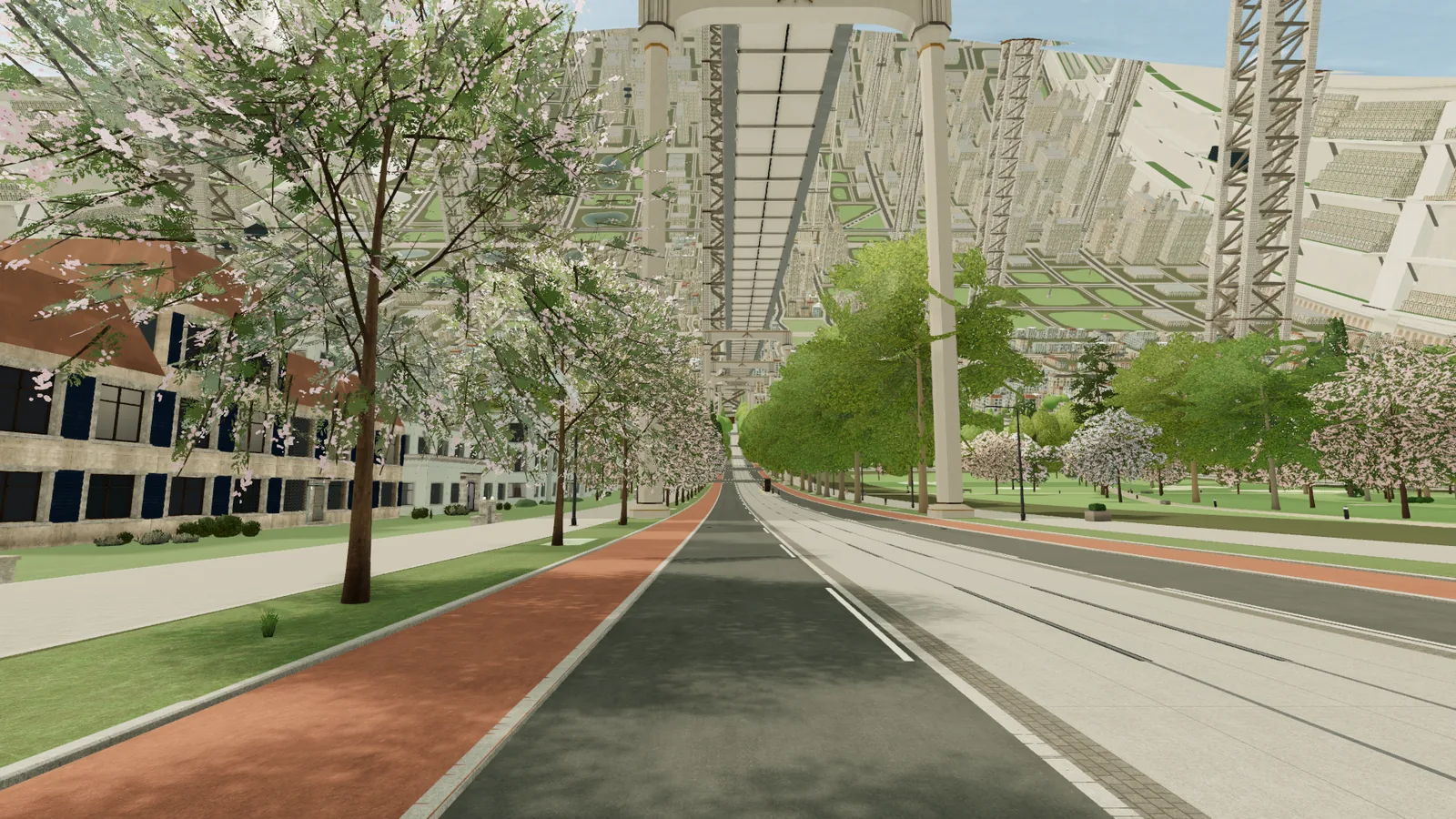
Open in the simulation: Metro Platform: Arbor Open in the simulation: Metro Lift Tower: Arbor
Key numbers
Go deeper: Streets, gravity bands and buildings
Streets come in four classes. Arterials have a 36 m right of way, collectors 20 m, local streets 12 m and greenways 8 to 20 m. Rotor 1 has 137 km of arterial, 128 km of collector and 258 km of local street.
Gravity band A runs from the ground to 200 m, where weight falls from 1.00 g to 0.92 g. Groundside housing stays in the first 150 m, at 0.94 to 1.0 g. A typical building has five floors and a roof at 17 to 21 m. The tallest ground buildings stay about 30 m below the sky and are capped at 320 m.
The metro has three line types per rotor. The gold circumferential loop runs 5-car sets of 97 m, the teal axial lines run 4-car sets of 78 m, and a silver beam line runs 3-car sets of 58 m inside the 625 m ring beam.
Visit
Open in the simulation: Residential Street Open in the simulation: Groundside Park Open in the simulation: District Skyline Open in the simulation: Civic Landmark Open in the simulation: Metro Viaduct Over an Arterial Open in the simulation: Axis Station Plaza
Nearby
Above the sky, a second city stands on the frame, and the lifts at the plaza climb to it and beyond.
The megaframe city
Above the streets, a lattice of piers and ring beams holds a second city on plates, bridges and terraces. The lattice is the megaframe.
Ascenders and the sky
The ascender is a lift 2.4 km tall. It carries 150 people from the street through the artificial sky to the axis in about ten minutes, and on the way your weight drops to almost...