Weight depends on your ground speed
Standing still on the floor you weigh 1 g. Drive spinward at speed v and your speed around the axis becomes ωρ + v, so the weight your tyres feel is (ωρ + v)² / ρ. Drive the other way and it falls. Established physics
| Speed | Spinward | Antispinward |
|---|---|---|
| 30 km/h | 1.11 g | 0.90 g |
| 100 km/h | 1.39 g | 0.68 g |
| 200 km/h | 1.83 g | 0.42 g |
| 300 km/h | 2.35 g | 0.22 g |
| 370 km/h | 2.74 g | 0.12 g |
At 563 km/h antispinward the car matches the floor's speed and floats. Spinward it would weigh 4 g there.
What it does to the car
Tyre grip scales with the load. The same car launches to 100 km/h in 2.47 s spinward, 2.79 s along the axis and 3.27 s antispinward, and stops from 100 km/h in 30 m, 36 m and 45 m. Design value Challenge this: Design value claim Driving against the spin is the dangerous direction: a 200 km/h car leaves the road at any crest tighter than 757 m radius, while spinward the figure is 172 m.
The Roadster has four defences. Suspension and an adaptive ride height follow the felt weight. Assisted mode caps speed so the felt weight stays between 0.5 g and 2.0 g, which is 234 km/h spinward and 165 km/h antispinward. Eight cold-gas thrusters push the car down onto the road: full down thrust adds 0.52 g of tyre load, and it lasts 2.1 s from the 40 kg store. And the stability system steers the wheels on its own when the car yaws.
At 370 km/h antispinward the tyres carry 0.15 g without thrust and 0.67 g with it. Design value Challenge this: Design value claim
The sideways kick
A moving object in a rotating frame is pushed sideways by the Coriolis force. A 0.6 m hop at speed lands about 3.5 cm spinward of where it left. Over a crest, a driver feels the car drift.
Where to drive
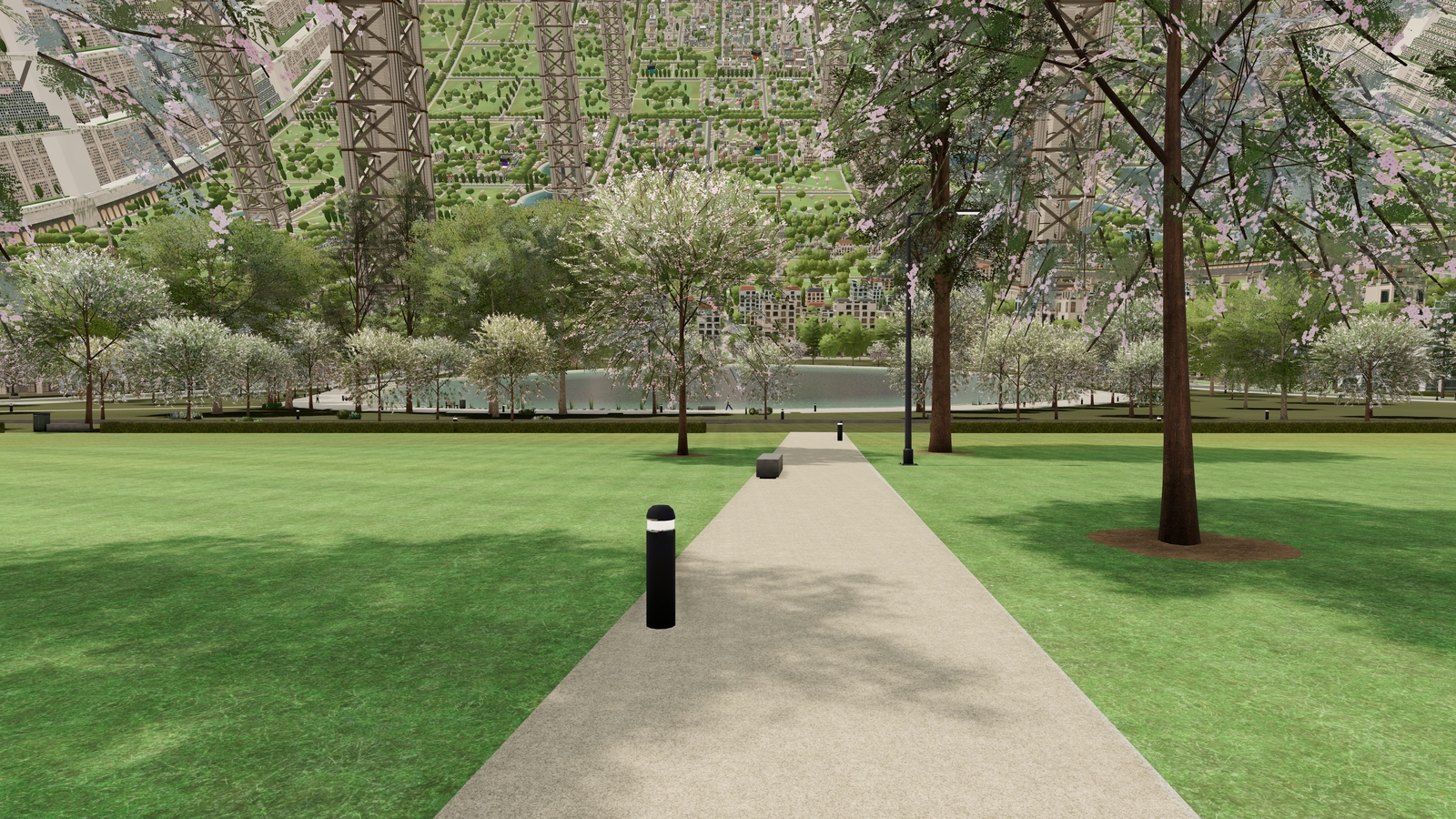
The five ring arterials, 36 m wide, run the full 15.7 km ring through a 30 m pier gateway every 654 m. They are the top-speed route. The Brook Park lawns and gravel paths are drivable too, at a fraction of the grip, and the brook has a shallow ford. Lakes, deep water and planting beds block the car. Design value Challenge this: Design value claim
Four bays, two cars each, wait on the hero street, at Brook Park and on two points of the ring arterials. Walk up to a car and press G, or press B anywhere and then 5 for the nearest one.
Sources and further reading
Real-world sources
- The rotating-frame effective weight, g = (ωρ + v)² / ρ, is textbook mechanics: Wikipedia, "Coriolis force" and "Rotating reference frame".
Concordia design documents
- The felt-weight table, launch and braking figures, thruster endurance and crest radii are printed by
scripts/analysis/roadster_table.pyin the Concordia repository (docs/specs/roadster-output.txt); design notedocs/specs/roadster-spec.md.